Category Archives: Books

Book Review – The Mayors of Batley: 1869 to 1974

Following several years of painstaking research, Kevin McQuinn and Val Mitchell, assisted by others, have produced the ultimate reference guide to the Mayors of Batley.

It is the only book to cover all 72 men and women who served as Mayor on the Borough of Batley Town Council from its incorporation in 1869 through to the 1974, when Batley’s governance was taken over by the newly created Kirklees Metropolitan Borough Council.

The book truly has been a labour of love, and the passion of the authors for their subject really does shine through. Running to 152 pages, the A4 wire-bound booklet has a chapter devoted to each Mayor. Besides providing their biographical details, it covers the key civic challenges they faced, and developments for Batley, during their tenure as Mayor.

It means the booklet goes far beyond the lives of these individual men and women. When combined with other chapters describing the history of Batley before incorporation, and key developments introduced in the first 50 years after Batley became a Borough, it gives a unique perspective of the history of the town as seen through the prism of the decisions of the Borough Council.

It demonstrates the civic pride which drove the Borough Council to strive for better infrastructure, housing and public buildings for the town’s residents to improve their lives. It illustrates the rivalry between Batley and Dewsbury, competitiveness which again led to tangible improvements to the town and the lives of its people. It shows how at times of war the townsfolk united in a common purpose, contributing to the war effort. Above all, it shows how much power the Mayors and Borough Council wielded to focus on the things that really mattered to residents at a local level. It really is a window on the lives and times of our Batley ancestors.

Fully illustrated, it is a book to dip in and out of, and will be one to which I will refer for years to come.

Priced at £12.00, plus post and packing, any profit made will be given to Kirkwood Hospice (so, if you can afford to pay more for your copy that would be most welcome). Ordered copies will also be available for collection at Batley Library.

If you are looking for gift ideas for someone interested in Batley’s local history, you can’t go wrong with this. You can even arrange for a personally dedicated copy to make it extra special. Neither will it break the bank, and you’ll be helping Kirkwood hospice too.

To order a copy, please contact either Kevin McQuinn or Val Mitchell on the designated book ordering email at: bhg.mayors@gmail.com

Full disclosure: I normally receive a free copy of a book in return for a honest review. In this case I have had no hesitation in buying my own copy, as I believe this is an invaluable booklet for a Batley local historian, more so given some of the Mayors were Catholics and therefore link to my Batley St. Mary of the Angels One-Place Study. In addition the money being raised from sales is going to a hospice which has provided care for my family, and which relies on the generosity of the community to continue providing its vital services.

Book Review – Genealogy in Reverse: Finding the Living (A Practical Guide for All Genealogists)

Written by professional genealogist Cheri Hudson Passey, and drawing on her experience in carrying out work for the U.S. Army Past Conflict Repatriations Branch (for UK researchers this equates to the MOD’s War Detectives from the Joint Casualty and Compassionate Centre Commemorations team), the stated aim of this book is to help genealogists of all levels to trace and connect with descendants of ancestors. These connections might lead to more information, documents, family memorabilia, photographs and photo identification, to enrich research and add colour to your family history.

The slimness of the book, running to 56 pages, is indicative that it is a basic overview. After the preface and methodology, the chapters are as follows:

  1. Building a Solid Foundation.
  2. Looking for Clues in Records.
  3. Researching Online.
  4. Researching on Location.
  5. People Finders and Social Media.
  6. Reaching Out to Family.
  7. A Word About DNA.
  8. Working Through a Soldier Repatriation Case: Steps for Finding Living Family.

There is also a concluding section and, to round off, a couple of pages listing tools and resources – although there are some website address errors here.

Together they provide a step-by-step guide to finding relatives down both ancestral and collateral lines, using modern tools to track them down.

Some of the steps are obvious, like ensuring your family tree is accurate and complete. The value of research plans to keep on track is discussed, as well as the need to follow the Genealogical Proof Standard (GPS), concepts which may be new to non-professionals.

Building mini trees is suggested as a research tool, and the book includes several screenshots on how to export GEDCOM files with which to work from. These, along with other images, are greyscale rather than colour.

Various sources are highlighted as useful for providing clues, building a body of evidence and resolving conflicting information. Search tips are given for finding living family members, including through using online trees. Tools such as reverse image searches are covered. I was pleased to see recognition that everything is not online. And I particularly enjoyed the chapter which pulled everything together in working through a soldier repatriation case.

From my UK and Ireland research perspective, the fact that it is written by a U.S. researcher means it is naturally geared towards research in that country. This is particularly obvious in the sections dealing with locating newspapers, and people finding sources. It is explicitly acknowledged in the section about national public records. That being said, there are general tips to be gleaned from those researching beyond the U.S., especially for the less experienced researcher.

Arguably the most crucial chapter is the one about reaching out to family. It was good to see advice given about handling these tricky initial contacts. This includes being aware of the fear factor behind unsolicited contacts in this world of scammers, along with the need to respect privacy and reach out with respect and sensitivity to living connections, upholding the ethics of handling information about living, and obtaining informed consent around any information shared.

However, one important topic I would have liked to have seen covered in a little more detail was the potential ethical dilemmas posed by this aspect of family history research, very much like DNA tests, the risks of which are dealt with in the book.

Contacting distant living relatives can potentially lead to unforeseen and unintended consequences, especially if that family history is challenging and sensitive, and it might have been useful to have consideration of this aspect. This is a particular issue when the person being contacted has no obvious family history interest, and is not on a family history platform, so is unaware to the possibility of such contacts.

As I have mentioned, the book is only a brief introduction to the subject of identifying and tracking down living relatives, and ethical dilemmas are a meaty subject. But a cautionary, if not a deeper exploration of this angle, would have been helpful.

That aside, when these contacts work out the mutual benefits can be huge, and this book is a useful addition to my genealogy library as a handy and concise aide-mémoire to this type of research.

The book was published in 2025, ISBN 9780806321516. For ease I’ve attached the purchase links for both Amazon and Genealogical.com

Full disclosure: I received a free copy of the book from Genealogical.com. I was not asked for a review in return, but I thought it would be useful to post one to introduce this book to others who may not be aware of it. In doing so I have expressed my honest opinion.

Scottish Baronial Families, 1250-1750

What family historian isn’t a bibliophile? I’m no exception to the rule, living by the principal “A house isn’t a home without at least one bookcase for every room”.

I love exploring a multitude of family and local history topics, so it was a pleasure to be introduced to a new subject – the baronial system in Scotland, as covered by David Dobson in his book Scottish Baronial Families, 1250-1750. Published by the Genealogical Publishing Company, this paperback runs to 199 pages.

It opens with a brief summary of the feudal governance system introduced and used by Scottish monarchs, at the heart of which was the administrative unit of a barony. Headed by a baron, who in effect was a crown vassal, it was a system which operated until 1747 when the British government curtailed their powers with the Heritable Jurisdiction Act, their response to Jacobite rising of 1745-46. With Baronial responsibilities extending to the tax collection, supplying of men for military purposes, as well as jurisdiction over civil and criminal matters, and the baron’s principal seat of authority being the caput, in terms of English equivalent a baron was something akin to a Lord of the Manor.

The introductory section also explains the difference between barons and the noble rank of baronet, the latter created in 1611 by King James VI1 as a way of fundraising, along with promoting the Plantation (organised colonisation) of Ulster, and settlement in Nova Scotia. These are also featured in the book.

Next there is a simple one-page bibliography, which acts as a very basic proxy for specific source citations.

Before getting into the meat of the publication, there are seven images. Whilst they are captioned, I would have found it helpful to also have an accompanying page number to link them to the specific section in the book.

We then come to the main body of the book. Drawing mainly on the Register of the Great Seal of Scotland, this is an alphabetical listing of the Scottish Baronial families – covering in total around 1,000 Scottish baronies and baronetcies. And whilst the listings are dominated by men, there are also a smattering of female holders. The listings detail the families, plus when, where, and by who, they were granted their baronies/baronetcies. Some have additional information. The pieces range from a couple of sentences, to – in some cases – upwards of a page for those families with multiple grants, or where there is extra details.

The book concludes with a select listing of Scots-Irish baronetcies established in Ireland and in the New World.

It is a book to dip into for reference, rather than one to read from cover to cover, and it acts as a concise introduction to the subject. Personally, as part of this reference material, I would also have found a place name index useful, in order to link locations to baronies. But there’s no doubt this is an impressive starting point and companion book for researchers and local historians investigating these families.

The book was published in 2024, ISBN 9780806359748. For ease I’ve attached the purchase links for both Amazon and Genealogical.com

Full disclosure: I received a free copy of the book from Genealogical.com in return for a honest review. I have expressed my truthful opinion in the above review.


Footnotes:
1. King James I of England, although it was not until 1707 that new baronets were established under the United Kingdom.

The Complete Guide to FamilyTreeDNA

This is the book I wish I’d had nine years ago when dad and I tested with FamilyTreeDNA. It is now proving invaluable in helping me finally navigate our tests in an informed way. I’ve also been reminded about biobanking which means, even though dad died a few years ago, I can upgrade and expand his tests – and crucially know how to understand and make best use of the results.

Written by DNA expert Roberta Estes, who you may know as the author of the DNAeXplained blog, it is 247 pages packed with information to help you choose which FamilyTreeDNA test is right for you, and to ensure you get the most out of your test results. Those pages run to 11 chapters, walking you through the types of tests, who they are relevant for, along with their various associated tools.

Whenever I see a book review, I always want a run-through of the contents to see if what’s covered is of interest to me. After all, I need to make sure I’m spending my money wisely. So I’ve listed the chapters, and included the page numbers, to give an idea about what is covered, and the depth devoted to each broad topic.

  • Chapter 1: Types of Testing – Y-DNA, Mitochondrial DNA, Autosomal DNA, and X-DNA. Pages 6-10.
  • Chapter 2: Setting Yourself Up For Success. Set-up preparations to help get the most from your test. Pages 11-23.
  • Chapter 3: Y-DNA – Your Father’s Story. A detailed explanation of test options and goals, which shows how to use your results. Pages 24-96.
  • Chapter 4: Mitochondrial DNA – Your Mother’s Story. It explains the goals of this test, covers matches, what they mean and how to take those further. Pages 97-131.
  • Chapter 5: Autosomal DNA – The Family Finder Test. Probably the best-known test type, with matches to all family lines. Pages 132-172.
  • Chapter 6: X Chromosome – Described as your secret tool that’s included with Family Finder, it shows how this can be used. Pages 173-186.
  • Chapter 7: Ethnicity – My Origins. How this is calculated, the caveats around it, plus ethnicity chromosome painting. Pages 187-206.
  • Chapter 8: Advanced Matching. A useful, and often-overlooked, filtering tool. Pages 207-208.
  • Chapter 9: Finding, Joining and Utilizing Projects. An overview of various DNA projects, what to expect when joining one, and the benefits of getting involved. Pages 209-217.
  • Chapter 10: Third Party Tools. Covers Genetic Affairs and DNA Painter. Plus creating a powerful DNA Pedigree Chart to weave the various tools together. Pages 218-224.
  • Chapter 11: Creating Your Step-By-Step Roadmap. A useful bullet-point roadmap summary of all the various FamilyTreeDNA tests and third-party tools. Pages 225-230.
  • Glossary. This explains in straightforward terms the sometimes daunting vocabulary associated with DNA testing. Pages 231-247.

As you might have spotted from the above, there’s no index. This is a potential drawback, because it is less easy to home in on a specific issue. The chapters though are divided into bite-sized chunks, which are outlined in the chapter sub-headings and these sub-headings might, in some instances, act as a proxy index.

Throughout the book, there are plenty of graphics to help illustrate and explain, and there are also handy associated tip boxes.

Understanding DNA testing can be bewildering, and there is no doubt that this is a book which requires concentration. But it does help explain a complex subject, and makes it more accessible to those of us with less grounding in science.

The Complete Guide to FamilyTreeDNA is published by Genealogical Publishing Company, and is available in eBook, non-colour paperback and colour paperback formats – so there are a choice of reading options and price points.

Be aware, there are pros and cons with each.

I have the full colour paperback version of the book – something I welcome, given the number of charts and diagrams, the meaning of which might get lost in the black/white/grayscale paperback. But the colour paperback version does cost more, and price is an important consideration. Checking the Genealogical.com website, there is a free colour supplement download available for selected pages, so this could provide a workaround for the non-colour paperback. And the eBook is in full colour.

I personally prefer a physical book, as best suited to my reading and learning style. The drawback of the paperback format is the absence of footnote hyperlinks to take you directly to the DNAeXplained website references. I imagine you’d get that with the eBook version.

My edition was published in August 2024, ISBN 9780806321400. I’ve attached the Amazon link, and also the Genealogical.com link for all versions.

My conclusion. If you have invested in testing with FamilyTreeDNA, I’d say it is worth the extra outlay on this book, to make sure you’re getting the most from your results.

Full disclosure: I received a free copy of the colour printed paperback book from Genealogical.com in return for a honest review. I have expressed my truthful opinion in the above review.

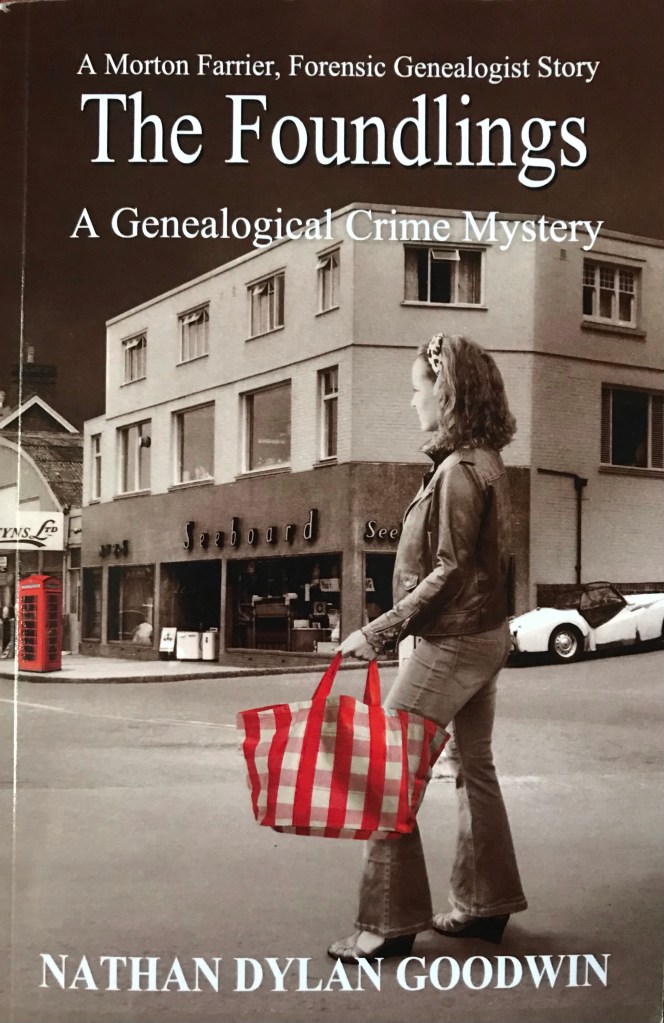
Book Review: The Foundlings by Nathan Dylan Goodwin

The Foundlings is the ninth novel in the Morton Farrier Forensic Genealogist series of books by Nathan Dylan Goodwin. And I promise no spoilers in this review. Suffice it to say if you read the book you’re in for a treat!

Once more genealogist Morton Farrier’s latest investigation is a fast-paced enjoyable read with plenty of plot twists and turns along the way, keeping you guessing right to the end. Farrier’s own family history is woven into the case, which proves all the more emotionally challenging for him because it is close to home.

It’s a case in which Farrier combines traditional family history research with DNA and genetic genealogy in order to find out the parentage of three women abandoned as babies. There’s real creative skill in how the author draws together all the various strands in this multi-layered story, with shades of darkness, to build to a credible ending. And for me it’s a sign of a good book when I’m compelled to flick back through the pages once I’ve finished, to re-read those “Aha” moments whose significance I’d not realised in my first run through.

As a family historian I really appreciate this series of books because I love following Farrier’s research processes. I can relate to the various records used, both online and in archives. And I do try to guess what steps he will take. This tale introduced an ethical dimension too. That being said, you certainly do not need to be a genealogist to become immersed in the story. If you like a satisfying mystery or crime novel, especially with some history thrown in too, The Foundlings – and the previous Forensic Genealogist books – will be right up your street.

I must confess I’m already an avid fan of the Morton Farrier Forensic Genealogist series of books, so his character was not new to me. I had just finished reading The Spyglass File. It meant The Foundlings was a few jumps ahead from where I’d got to in the series. And yes, I can confirm it can be read as a stand-alone novel, though I did quickly skip the few references to his previous case so as not to give away any clues to that story. I can also confirm it is up there with the previous books in the series, which goes from strength to strength.

In summary, if you’re in to family history, crime mysteries or historical thrillers I can highly recommend this book, along with all the others I’ve read in the series.

If you’ve not read any of the previous books in the Forensic Genealogist series and want to start at the beginning to sequentially see how the character’s back story evolves, here’s the full list:

  • The Asylum – A Morton Farrier short story;
  • Hiding the Past;
  • The Lost Ancestor;
  • The Orange Lilies – A Morton Farrier novella;
  • The America Ground;
  • The Spyglass File;
  • The Missing Man – A Morton Farrier novella;
  • The Suffragette’s Secret – A Morton Farrier short story;
  • The Wicked Trade;
  • The Sterling Affair;
  • The Foundlings.

Finally, here’s the all-important purchase information for The Foundlings. I read the paperback version, ISBN-13: ‎979-8481041421, price £8.99. There is also a kindle edition. Full purchase details for this, and all the previous books in the series, can be found on Nathan Dylan Goodwin’s website.

Footnote: I was given a copy of this book by the author to preview. But if I hadn’t received a copy I would have certainly bought it – as I have all the earlier ones

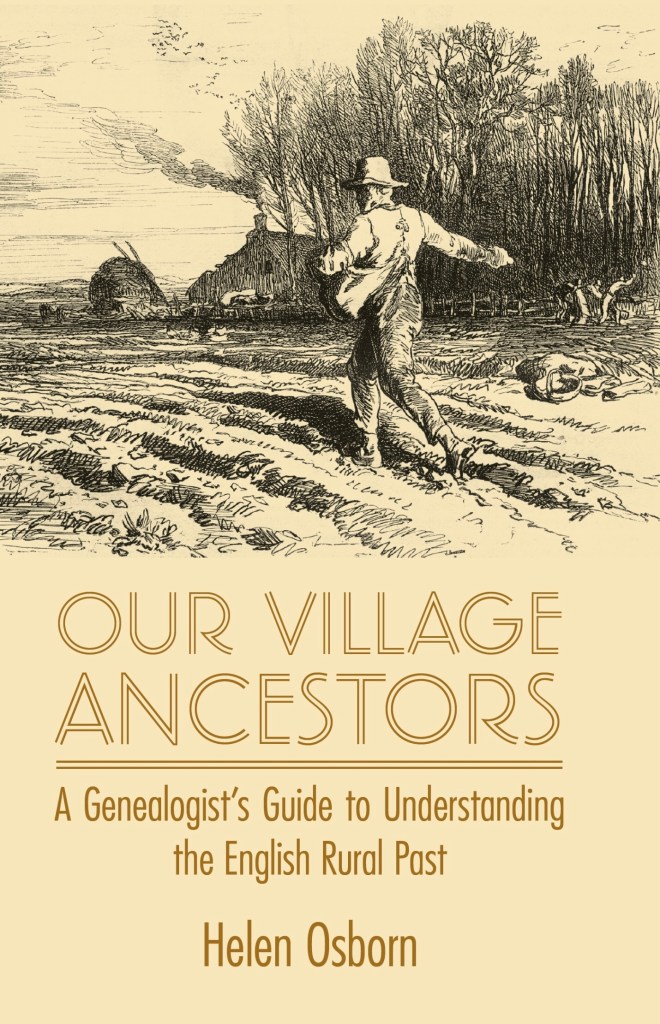
Book Review: Our Village Ancestors, A Genealogist’s Guide to Understanding England’s Rural Past – Helen Osborn

Helen Osborn’s Genealogy: Essential Research Methods is a key book for many family historians. Her latest book, Our Village Ancestors: A Genealogist’s Guide to Understanding England’s Rural Past, is certain to form another important element in the family history researcher’s toolkit.

Focussing on village life from the mid-sixteenth to the turn of the twentieth century, the book is aimed at those who want to fill in the details of the lives of their ancestors, and want to open up – and make best use of – the wealth of records out there to achieve this. Even those at an early stage of their family history journey will benefit from the information it contains.

Placing these records in their geographic and historic context is a theme which runs throughout the book, because as the book explains:

…in order to gather truly the evidence that we need to reconstruct families into genealogical trees, we should understand both the historical and local context as well as have a good understanding of the documents used.

Farming communities and countryside life is integral to the research of most family historians, with up until the nineteenth century the majority of people living a rural existence. As the book says:

Almost everybody with English roots will have an ancestor who lived in a village…

The book covers records applicable to a full range of village ancestors from the humble agricultural labourer to farmer ancestors, those in supporting village industries and crafts, right through to the more affluent landowners.

It contains eight chapters covering a multiplicity of these genealogical records, all of which combine to help build a picture of our village ancestors’ lives. The chapters are:

  • The Rural Past;
  • Parish and Family;
  • The Land and the Farmer;
  • The Church and the Tithe;
  • Supporting the Poor;
  • Work and School in the Countryside;
  • The Whole Community: Lists of Villagers and the Victorian Census; and
  • Leaving the Village.

There is also an appendix containing a handy list of dates of interest.

Each chapter introduces a series of key records, explaining the background to their creation, the information they contain, any particular issues or pitfalls associated with them, and how to interpret and locate them. This information is interspersed with examples of these records from across the country. Accompanying this information are fascinating facts, and tips, which aid family historians and provide food for thought in applying to research. There are also pointers as to how indirect evidence can be extracted from records, even when ancestors are not specifically mentioned. The individual chapters conclude with a Starting Points for the Researcher section which neatly summarises the records discussed in the preceding pages.

Through combining information from these sources, pictures of the lives of even quite ordinary ancestors can be built up. The book includes examples of such record-combining to reconstruct a person’s life, including a 19th century agricultural labourer and the harrowing story of the Eaves family.

The book is packed with information, and there are far too many records and information sources for me to mention. But they include parish registers and how to unpick information from them; manorial records; enclosure details; probate inventories; tithe maps and apportionments; glebe terriers; churchwardens’ accounts; vestry minutes; Quarter Sessions; various records relating to the old and new Poor Law; hearth tax; rate books; newspapers; and early censuses. Note, if you are looking for information about records created by Victorian national administrations, such as civil registration from 1837, these are not covered.

In addition to the records, I found the individual topics covered fascinating. From the social status of the farmer, the farm and its work, alongside wages and conditions, to tips on matching tithe maps with older records and using the early census to discover whole communities. And how many of us have ancestors who appear and disappear? The Leaving the Village chapter is full of strategies and tips for filling these gaps.

It is an immensely readable book (I completed it over a weekend). It is also one which will act as a reference, and refresher, to a series of genealogically valuable records for anyone researching their family history, running a one-place or one-name study, or with an interest in local history generally. And, although the focus is on village life, there is a cross-over in terms of many records to our more urban ancestors.

In conclusion, this is a worthy addition to any family historian’s bookshelf.

Our Village Ancestors: A Genealogist’s Guide to Understanding England’s Rural Past – Helen Osborn
Publication date: 28 June 2021
Publisher: Robert Hale
ISBN 9780719814167
Hardback £15.99

Book Review: Titanic Survivor – The Memoirs of Violet Jessop – Stewardess

Titanic Survivor – The Memoirs of Violet Jessop are the recollections of the life of a stewardess who survived the sinking of both the Titanic and Britannic (‘sister ship’ of the Titanic). This written narrative is interspersed with commentary and explanations by editor John Maxtone-Graham.

Whilst not a literary masterpiece, Violet’s memoirs have a charming appeal, and capture an era of ocean travel from the perspective of a working-class woman on board a ship – a voice that is not often heard. For anyone with ancestors employed in a ship’s victualling department in the first part of the 20th century, particularly as a first class cabin steward, these memoirs give an authentic insight into their life and work.

Violet, born in Buenos Aires on 2 October 1887, was the daughter of Irish immigrants William Katherine Jessop (née Kelly). Suffering serious bouts of ill-health in childhood, in 1903 following the death of her father, she came to England with her mother, brothers and sister.

In October 1908 she made her first sailing as a stewardess with the Royal Mail on the West Indies route, the start of her 42-year career at sea. Her final sailing, in 1950, was in the employ of the same company she started with.

In between, she had employment with White Star (a company she only joined with reluctance), P&O (very briefly) and Red Star. As well as working as a stewardess for first class passengers on transatlantic crossings with the White Star Line, she undertook World Cruises, hedonistic “booze cruises” during the US prohibition era, and had a stint as a VAD nurse in World War One on board the Britannic, which was converted to a hospital ship. All this was punctuated by periods on shore undertaking a variety of clerical work. The Titanic and Britannic therefore only formed a short period in what was a career spanning decades.

So do not expect a book purely focused on Titanic.

In fact the Titanic forms only three of the 34 chapters. And many of the names of crew and passengers are disguised, perhaps with the discretion of an employee still working on ships (the memoir dates from the mid-1930s whilst Violet was still working). Of those identified and identifiable, she does mention ship designer Thomas Andrews, and clearly had great affection for him. And violinist Jock Hulme is also referred to by name, one of the bandmen who also perished in the early hours of 15 April 1912.

Her Great War VAD experience on board the Britannic, which struck a mine on 21 November 1916 and sank off the coast of the Greek island of Kea, fills another three chapters. These also cover her repatriation as a Distressed British Seaman. From her Titanic shipwreck experience she made sure she abandoned the Britannic with her toothbrush!

And there are intriguing gaps too. Although her White Star Line career included time on the Olympic starting from its maiden voyage in June 1911, it also covered the ship’s fifth voyage when she collided with British warship HMS Hawke. This event is not mentioned. Again it illustrates that there is so much which Violet’s memoirs have skimmed over or omitted – events which would have interested readers.

That being said, Violet’s memoirs are well worth reading for the additional first hand perspective she gives of historic events.

More that this, her memoirs give a broader insight into the work of life with a ships’s victualling department generally, and the lot of cabin stewards in particular, in that golden era of sea travel of the early 20th century. They give a flavour of difficulties of a young girl getting such work in the first place (it was normally a job for more mature women), the job insecurity, the hard work, long hours, short breaks, and the difficult conditions under which they lived on board. There are anecdotes about the foibles and demands of passengers, the job offers, and the marriage proposals. Violet frequently analyses the character and behaviours of those serving alongside her in a ship’s victualling department – from their tippling, to the drive to earn tips to supplement their meagre wages.

And, on a human level, there are the tantalising snippets leaving you wondering who she was referring to – for example on the Titanic; what became of Ned – the love of her life; who was the man she had a brief and unsuccessful marriage with – never referred to in her memoirs; and what was in, and became of, the missing chapter.

To conclude, I really enjoyed this easy to read, conversational-style book. A perfect weekend indulgence.

My 2020 Family History Review. And is it Really Worth Setting Any Goals for 2021?

Well 2020 did not go as planned. Massive understatement.

When the New Year dawned, little did I think the goals I set would be scuppered to such an extent. And if there was to be a hitch, a global pandemic would not have been top of my list of reasons. In fact, it would not have featured at all. But there you go.

2020 did begin well. Research for my new book got off to a great start. I gave a talk at Leeds library about World War One research based on the book I co-authored with my rugby league journalist husband. Other talks were lined up. I booked a couple of conference tickets, and the associated accommodation and transport.

And then March came, and with it lockdown. Everything went pear- shaped.

Archives visits and travel generally halted, along with it the prospect of any associated book research. Events and conferences were cancelled, one by one. As were the prospects of any further talks in these pre-Zoom days.

And unimaginably I lost any enthusiasm to review my family tree – apart from anything else getting through the trauma of daily life, where everything was so much more challenging and time-consuming, was an achievement. And these home-life challenges included a major water leak at the start of the year which necessitated a new kitchen and new bathroom – all work due to start in March. Lockdown came in as our bathroom was ripped out. Family history was the last thing on my mind.

The only thing that continued from my 2020 goals was blogging. In fact, this year saw an increase of around 50% in terms of those viewing my blog posts. Thank you. That was the one bright spot in my goals.

But things did pick up. In the place of conferences, I attended far more talks than I ever have before thanks to the wonders of Zoom. I also did a one-place studies course, and ended up starting one for Batley St Mary’s during World War One. Something entirely unexpected and unplanned at the start of 2020. But something I’m thoroughly enjoying.

As was becoming a grandma for the first time as 2020 drew to a close – I know, I’m way too young! It meant much of my free time this year was taken up with stitching a birth sampler ready for the big event.

Birth Sampler

In the light of all this I did think seriously about whether to set any goals for 2021, given the uncertainty we are still living under. But I do need something to aim for.

However, for 2021 my goals will be far more work-related, given how this has taken off.

And with work in mind, this was the major reason behind my decision to step down as editor of the Huddersfield and District Family History Society Journal. I loved doing it, and it is something I’m immensely proud of. But as work built up I increasingly found it squeezed the time I could devote to the Journal, particularly in the lead up to print deadline. My last Journal as editor goes out in January 2021.

And linked to this, my family history column in Down Your Way magazine also came to an end in 2020. The much-loved Yorkshire memories magazine was a casualty of the COVID-19 economic downturn. I must admit I really do miss writing a regular magazine feature, because it gave me another family history focus. But it has freed up even more research time.

As for my goals for 2021, they will be as follows:

  1. Pick up my book research, as and when I am able;
  2. Continue my blogging;
  3. Build up my St Mary’s Batley WW1 One-Place Study, details of which are at the top of my WordPress site;
  4. Focus on my research work for others. It’s a huge privilege to be entrusted with someone’s precious family or local history research, and I undertake it with the same dedication and thoroughness as I would my own; and
  5. Keep up to date with advancements in the field of genealogy as part of my continuing professional development programme. This will include undertaking a minimum of two formal courses, as well as a broad range of reading and practical work.

Finally a huge thank you for continuing to read my blog in these very trying times. As I said earlier this has truly been one of my year’s bright spots.

And as for the New Year, I hope that 2021 will be far kinder to us all than 2020 was.

My Family History Goals for 2020

2020 promises to be another busy and exciting family history year, both professionally and personally. Away from my professional research, I’m continuing with my monthly family history column in ‘Down Your Way’ magazine. I’m also starting my second year as editor of the Huddersfield & District Family History Society Journal.

But, as ever, I want to set myself some personal family history and general research targets. I’m aiming for a variety of tasks which will be mentally stimulating and stretching, as well as emotionally rewarding. Setting them down in writing will, I hope, focus my mind on these specific pieces of work. If I formally write them down, I can’t ignore them.

Keep on Blogging: If you’d have said back in 2016 how many would read my blog in 2019 I’d be gobsmacked. Due to other time-pressures, blogging is becoming increasingly difficult. The local history pieces are particularly labour-intensive. However, because the mix of local history, family history tales, genealogy tips and one-name studies posts is proving of interest I want to continue with the variety.  I am formally committing to continuing writing a minimum of two posts per month. 

Conference Commitment: In 2020 I aim to attend one national event, as well as a mixture of courses, talks and local family history fairs. I do feel formalising this is a signal that family history is not only looking backwards. It is pushing forwards, equipped with new skills and strategies.

Tree Review: My family tree has been developing for over 15 years. In 2020 I want to revisit this early research. This is important because my skills today are so much more advanced than my 2004 research abilities. Looking at everything with fresh eyes, using the knowledge I’ve gained over these years, may help me spot gaps and provide a wrecking-ball to earlier brick walls. I also want to re-visit my earlier research to include full source citations. When I started out I was more concerned with the thrill of the hunt, rather than establishing fully documented proof. Now I realise the importance of the latter, not only for me and the need to record the sources for hypothesis and their results, but also for the future generations to whom I will pass on the family history baton. They need to see exactly how I built my proof case.

A New Book Beckons: After completing ‘The Greatest Sacrifice: Fallen Heroes of the Northern Union‘ I said never again to researching and writing another book. The whole experience of authorship was akin to having a baby. The anxiety, doubts and pain of researching, writing, re-writing and proofing took over my life for months. My daily existence revolved around producing a perfect book which would do full justice to those in it. In the final weeks my entire being seemed to be totally devoted to creating this entity. It was my first thought in the morning, my last at night … it even haunted my sleep. And even then, once I’d given birth to it, the nurturing continued. I wanted to ensure others loved it the way I did. Seeing the fruits of all my labour was an overwhelming experience. And now, over a year on from publication, it is out there with a life of its own. I’m there guiding it and watching over it.

But it’s gained its independence. And I’m now ready to create once more. So 2020 will be the start of my new book’s research and development phase. Publication won’t be until 2021 at the earliest. I won’t say too much for now. But it will be based around giving voices to those not normally heard. And it will use my family history research skills. Watch this space for further updates.

It’s Good to Talk: I have already delivered several talks locally. However, I’m expanding on this in 2020. I am rolling out three talks aimed at family and local history audiences. They are about my Rugby League WW1 book, and more generally researching Great War Army ancestors; a Batley and Spen Valley local history talk; and, based on my experience as a genealogy blogger, I have one talk dedicated to blogging for family and local history.

For more details about these talks, including fees, please contact me at: pasttopresentgenealogy@btinternet.com

All that remains is for me to thank you for reading my blog in 2019, and to wish you a very Happy New Year. May it be all that you hope.

How to Pick a Baby’s Name – Enid Blyton Inspiration

This post is prompted by my daughter’s birthday and a Twitter thread about name inspirations.

Way before the resurgence in popularity of Amelia as a name in England, we chose it for our daughter. She was named after my all-time favourite childhood book character – Enid Blyton’s Naughty Amelia Jane.

As a child I spent lengthy periods in hospital. One of my earliest memories is one of the nurses in the now long-since closed Batley Hospital reading me a chapter from an Amelia Jane book before bedtime. Incidentally it is in the grounds of this hospital that my grandad died whilst building an air raid shelter.

batley hospital

It also brings to mind my two cousins and I (separated by only three months in birth and five minute’s walking distance as children) swapping Enid Blyton books in school holidays.

In the early 1990’s my love for Amelia as a name was reinforced by my reading of William Makepeace Thackeray’s Vanity Fair. Whilst pregnant my initial favourite name for a girl was Alice. But in the final weeks I returned to a name which evoked happy childhood memories, combined with more recent literary reading.

As to family links, to put in perspective it’s family associations a decade or so ago I was inordinately happy to learn my 4x great aunt was an Amelia. That’s really the closest ties family history-wise.

I did baulk at a middle name of Jane. My daughter was unique and I’ve never been keen enough on my name, which has no real family history, to saddle my daughter with it. In fact I’ve no idea as to why I ended up with it as a name. Funnily enough some do think it is her middle name!

Amelia’s name origins continued to have relevance as she grew up, with me reading to her bedtime stories and tales of the naughtiest toy in the toy cupboard. I loved reading them to her, reliving my childhood in the process – though I do think she preferred The Faraway Tree (Silky was NOT a naming option.)

img_2469

And so I think about my ancestors and naming patterns. So many names are recycled across the generations. But that recycling is disappearing. Family sizes have diminished so there is less opportunity for generational-straddling family names. And in the last century or so name choices have widened. We have literary, musical and cinematography associated names. Travel horizons and migration have broadened, also correspondingly increasing choice. And have middle names also increased in usage? Also we are no longer bound by the same religious constraints with saints names.

In fact our naming choices are far less prescribed than in other countries. Responding to a FOI request in 2008, the General Register Office (GRO) stated:

Registrations of births in England and Wales are made under the Births and Deaths Registration Act 1953 and the Registration of Births and Deaths Regulations 1987. The legislation does not set out any guidance on what parents may name their child.

Our advice to registrars is that a name should consist of a sequence of letters and that it should not be offensive. The reason for limiting the registration of names to a sequence of letters is that a name which includes a string of numbers or symbols etc. has no intrinsic sense of being a name, however the suffix ‘II’ or ‘III’ would be allowed.

The only restriction on the length of a name is that it must be able to fit in the space provided on the registration page. There are no leaflets or booklets available giving guidance on this matter.

Where the registrar has any concerns over a name they will discuss this with the parents and point out the problems the child may face as they grow up and try to get them to reconsider their choice.

For those name and stats geeks (like me) the most popular first names for baby boys and girls in 2017 using birth registration data can be found here. You’ll have to wait until September 2019 for the 2018 stats. The historical data for the top 100 names for baby boys and girls for 1904 to 1994 at 10-yearly intervals is here. Another ‘names through time’ using civil registration information which is great fun is here.

My family history also displays the vagaries of names. And this is something to consider when searching for ancestors in the GRO Indexes.

Dad was never known by his registered first name. My grandma registered it unbeknownst to my grandad who detested it. Hence my dad was always known by his middle name – the source of much official confusion. And payback for my grandma was her next son was born on the saint’s day my dad was registered under.

Another example is of a collateral ancestor known by a totally different name than the one registered. Anecdotally the parent registering apparently used the similar-sounding name of an old girlfriend.

And my 2x grandmother and great grandfather were both initially registered under different names, their parents changing their minds and exercising their option to amend, something I wrote about a while ago.

So for family history purpose do ask why your parents chose your name. Note to self: I need to ask mum why she and dad chose my name. I recall dad saying his choice was Michel(l)e. I reckon they were just popular names at the time.

And if my daughter ever asks, she owes her name primarily to Enid Blyton, and William Makepeace Thackeray was the deciding factor. Charles Lutwidge Dodgson (aka Lewis Carroll) didn’t quite match up.

Sources: