Category Archives: Archives

Borough Court Records: Crime, Punishment & Bastardy in Batley – Part 1

In my murderous assaults post I mentioned I would be undertaking a series of archives visits focusing on the Batley Borough Court registers to try to establish a fuller picture of court cases involving my ancestors.

The records are held at the Wakefield branch of West Yorkshire Archives. The office closed on 13 May 2016 in preparation for the move to a new building in early 2017. More details are here. So it was something of a race against time to complete this work. But I am pleased to report I did get there in the end. 

The registers are not available online – no, contrary to what some would hope, not everything is! So it is a case of visiting the archives and going through each register page by page. For me it’s a joyful experience, especially with a set of information-rich records for my family history like these proved to be.
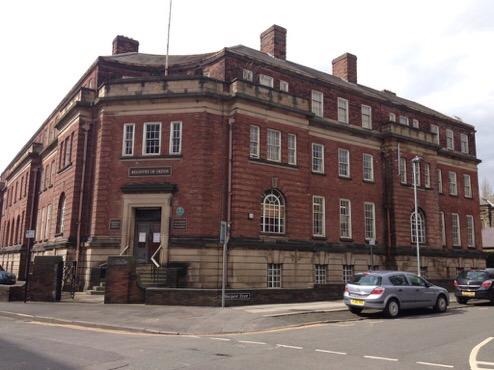
West Yorkshire Archives, Wakefield Office – Photo by Jane Roberts

The Batley Borough Court records run from 1872-1974, 116 volumes in total. However with the 100 year legal restriction access limit, I only (!) had to go through 58 of them.

And it has been wonderfully, and unexpectedly, enlightening.

The registers contain columns giving information such as:

  • the date of the case;
  • name of informant/complainant;
  • name of the defendant and age if under 16;
  • nature of offence;
  • adjudication; and
  • the names of the Justices.

There are also other pertinent notes, for example if the fine was paid and, if not, when the custodial sentence was imposed.

Whilst the registers give only the bare bones, they do lead on to other sources, from bmd and employment records to prison registers and newspapers. And because you have a date for the case it is a short-cut for newspaper searching, especially for those “not online” papers, or where online newspaper optical character recognition (OCR) is problematical.

It also pays to check the other cases heard that day as they may be linked to the “partners in crime” of ancestors. 

The cases brought before the court cover the run-of-the-mill drunk and riotous or obscene language cases; incidents of stealing; animal cruelty; failure to send children to school; wilful damage; employees taking employers to court on non-payment of wages (from these I’ve learned the name of the stone mason who employed my 2x great grandfather William Gavan); to attempted suicide and more serious assault, indecent assault, rape and murder cases, some of which are referred onto a higher court. There are a fair few children brought before the Justices and punishments ranged from birch-strikes to reformatory and industrial school sentences. Smallpox vaccination exemptions, applications for children to perform in theatrical productions and beer selling licence transfers and applications also feature.

There are also more domestic-centred cases including married couple disputes, separation orders, orders relating to married women’s property, child neglect accusations, and unmarried mothers claiming maintenance payments for their illegitimate children – crucially providing the name of the father. These maintenance orders were lodged with the petty sessions, or other jurisdiction, local to the mother up to one year after the child’s birth. In these cases the burden of proof was very much weighted in favour of the mother, for obvious money-saving reasons.

Three women connected with my family history appear in this latter set of cases. All three cases have contrasting elements and outcomes, and will feature in three separate posts. This is the first.

Sarah Gavan was born in Kidderminster in June 1857, the third daughter of my 2x great grandparents William and Bridget Gavan (Knavesay). She was baptised in the town’s Catholic chapel on 5 July 1857. Within three years the family relocated to Batley.

On 19 September 1875 Sarah gave birth to her first child, a son named John Thomas. He was baptised at St Mary of the Angels RC church on 3 October 1875. The baptismal register entry starts to records a father’s name, “Thoma“, but this is scored out and there is no surname for him. Sarah was unmarried. But clearly the child’s father was common knowledge.

I am curious to see a birth certificate for John Thomas, to see if his father officially acknowledged him here. From 1875 the reputed father had to be present at the registration to formally consent to his name being included on the certificate. As the Act stated “The name, surname and occupation of an illegitimate child must not be entered except at the joint request of the father and mother; in which case both the father and mother must sign the entry as informants“.

Looking at the GRO indexes, I can’t see a relevant birth registration for a John Thomas Gavan (or variant). Interestingly the Dewsbury Registration District does have a birth registered for a John Thomas Connell in Q4 1875 Vol 9b Page 625. This is a possible, given subsequent research including bmds and the 1881 census onwards. I would love to look at this to see if it did relate to Sarah’s son, and if so why he is not registered under Gavan: Was “Thomas” from the baptismal register present to jointly register is son’s birth as it appears. Oh for the long awaited certificate price-reduction!

As indicated, my search of the Batley Borough Court records adds an additional layer of paternal proof and a new dimension to events. On 10 November 1875 Thomas Connell appeared before the court on a bastardy charge and was ordered to pay Sarah Gavan 3s a week from their child’s birth until the age of 14.

Payments were occasionally difficult for Irish-born pit-worker Thomas, and his parental responsibility not always diligently complied with. Perhaps his court appearances and fines played a part.

It appears that he, and a number of other coal miners, were taken to court in 1876 by their Batley colliery employer James Critchley for absenting themselves from service without appropriate notice. In Thomas’ case this was from 17-24 January, and his employer sought compensation of 17s 6d. The case was heard at Batley Borough Court on 26 January 1876 and Thomas, who failed to appear, was found guilty and ordered to pay. The incident was reported fully in the local papers.

Weeks later, on 28 February 1876, there is another court register entry with Sarah in the role of complainant against Thomas. The entry merely says bastardy, so presumably this is for arrears. The obvious conclusion is the colliery episode and subsequent fine played a part in his financial difficulties and failure to pay.

The next entry for a case between Sarah and Thomas was on 24 June 1878. This was adjourned for four weeks, until 22 July 1878. The July entry also contains an adjournment note.

After that nothing – because within the month the two were wed. Less than three years after John Thomas’ birth the couple married on 17 August 1878 at St Mary’s. They went on to have at least eight more children before Sarah’s death in 1907.

St Mary of the Angels RC Church, Batley – photo by Jane Roberts

The Borough Court register was a crucial part of evidence in ascertaining the paternity of Sarah’s baby . None of these bastardy cases against Thomas made it to the local papers, as far as I discovered.  Contrast this with the next family court case. To be continued

Sources:

  • Batley Borough Court Registers (P/11) – West Yorkshire Archives
  • Batley Cemetery Register (unconsecrated)
  • Batley Reporter” and “Dewsbury Reporter” newspapers of 29 January 1876
  • Census – 1861-1911
  • GRO indexes
  • Parish Registers – St Ambrose, Kidderminster & St Mary of the Angels, Batley
  • My ancestor was a bastard” by Ruth Paley


Visit Tips for Archives

My family history research is currently on hold whilst I recuperate following surgery. Whilst I rue my enforced house confinement and the temporary halt to my archives visits, I’ve set out some tips for future visits.

1200px-Coventry_History_Centre

Coventry History Centre – Wikimedia Commons Photo by Herry Lawford (see Sources)

  1. Check opening times. Archives are not 9-5 open every day of the week places. If possible pre-book your visit to ensure there is space and the facilities you require are available – there may be limited reading room places, map tables and microfilm/fiche readers. And do let the archives know if you can’t make your slot so your space can be freed up;
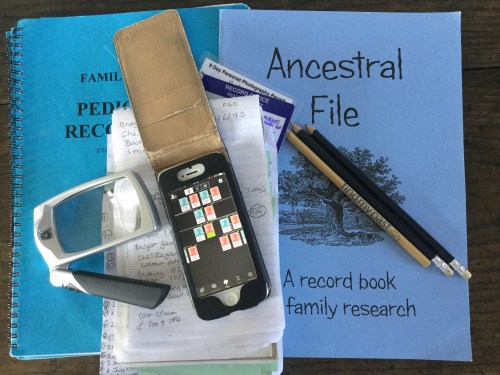
  2. Come prepared – plenty of sharpened pencils (pens not allowed), paper and a magnifier. Also your reader ticket, or appropriate signature/address identification to obtain one. Check if laptops etc are allowed; my preparation also includes checking online catalogues, which may not be the full range of holdings, and any visitor guides for particular archives advice;
  3. Don’t forget to bring your family tree/research notes. I have separate “Ancestral File” books for my maternal and paternal lines. I also have a (private) online tree available via the Ancestry app on my phone;
  4. Have a research plan. My plan includes preparing a list of documents I want to work through. I tend to focus on sources only available at the archives. An increasing number of collections are online, so for me looking at something readily available on Ancestry as a first step, for instance, may not necessarily be the best use of my time. I wouldn’t rule it out though as an online search may have produced ambiguous results;
  5. If possible order documents in advance because: a) they are not all necessarily held onsite; and b) if you have some documents ready for your arrival it saves valuable research time;
  6. Monitor the documents you have lined up throughout your visit to ensure you have a steady flow. Archives may not, for instance, bring down documents over the lunch period; or within a certain time before closing. There’s nothing worse than sitting twiddling your thumbs waiting with the only thing occupying your mind is counting wasted time! Although you could use the downtime to have a refreshment break (which may not necessarily be onsite), review your notes or revisit your research plan;
  7. If you want to take photographs consider which type of permit best suites your needs (eg day, year etc). But be aware not all documents are suitable for photographic reproduction – they may need to specialist equipment so need ordering. There may even be copyright restrictions;
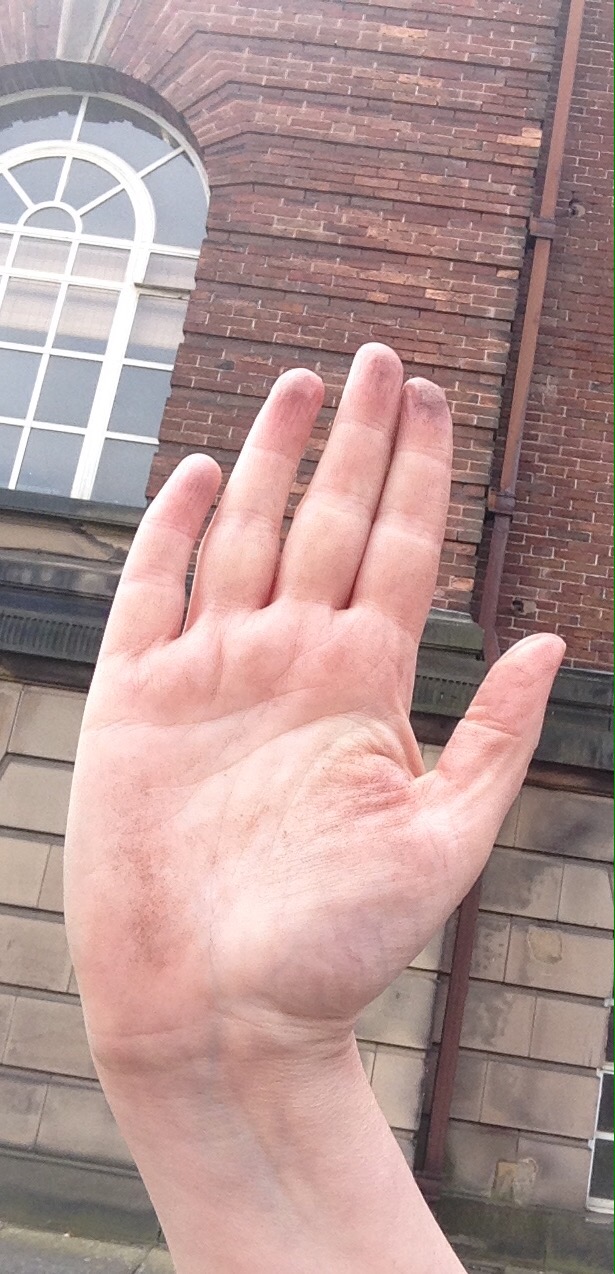
  8. Wear comfortable clothes, ones that you don’t mind getting dirty – be warned, old documents are dusty. 

    The “Archives Hands” Phenomenon

    Include a jumper/cardigan as some archives can be cold; 
  9. Check your notes and write them up as soon after your visit as possible. It’s easier to decipher “hieroglyphic” handwriting (well that’s what mine occasionally resembles) whilst it is fresh in your mind. If you’re not taking photographs read them through during your visit to make sure you’ve included key information; and
  10. Don’t be afraid to ask. Not everything is included in online catalogues. The staff have a wealth of knowledge, experience, know their collections, the geographical area and are used to dealing with all levels of expertise. Don’t go away from what might be a one-off visit thinking if only…..
Archive kit

My Archives Visit Kit – Photograph by Jane Roberts

Sources:


Removal Orders and Child Stealing Chimney Sweeps: Seeking a One-Handed Gypsy – Part 3

I’m preparing for another Tyne and Wear Archives visit so I’m reviewing my Burnett and Jackson ancestor research. Some of this research is in Part 1 and Part 2 of “Removal Orders and Child Stealing Chimney Sweeps

In these posts I wrote about how a newspaper article detailing the outcome of a Quarter Sessions case demolished some brick walls in my family history. In April 1830 Drighlington township unsuccessfully attempted to remove John Burnett’s widow, Jane, and her children to Newcastle All Saints parish. John was the brother of my 3x great grandmother.

The newspaper report provided family details which enabled me to progress back to child-stealing-accused chimney sweep Stephen Burnett and Charlotte, the woman he for some time lived in concubinage with – my 5x great grandparents.

Since writing these posts I’ve accumulated three more snippets of information, all from different sources. One of these has particular relevance for my proposed visit to Newcastle.

New Information
The first record is the administration granted to John Burnett’s widow, Jane, after he died intestate. This provides some additional pieces of background information. It states John died on 16 June 1829. Previously I only had his Drighlington burial date of 19 June 1829. The administration gives the names, abode and occupations of the two bondsmen: As yet no obvious family link, but you never know when this might be useful. I also have additional confirmation that he lived in Drighlington and that he was a collier (coalman on the administration).  Finally there is a written statement outlining the whole of his goods and chattels amounted to under £5.

The second piece of documentation is via the West Yorkshire Archive Service record set on Ancestry. The “Removal and Settlement” records show the Drighlington Churchwardens and Overseers of the Poor made a failed attempt in late 1829 to remove Jane Burnett and her children Nancy, Stephen, Maria and Jackson, to Halifax.  This is useful because it is further supporting evidence for the 27 June 1798 St John the Baptist, Halifax, baptism I traced for John. So all part of the migration pattern of the family – from Newcastle and the North East, to Cumbria and then down to Drighlington in Yorkshire via Halifax.

The third piece of information is a newspaper notice in early 1830. Thwarted by Halifax, the Drighlington poor law officials had All Saints parish in Newcastle firmly in their sights as a place to offload the potentially financially burdensome young family. On 9 December 1829 a Removal Order was issued, but Newcastle challenged it. This Order was respited pending an appeal. The January 1830 West Riding Quarter Sessions, held in Wakefield, show this appeal by the All Saints churchwardens and overseers would be heard at Easter 1830 Quarter Sessions at Pontefract. It was the report of this appeal which features in Part 1.

675px-All_Saints_Church,_Newcastle_2014 (2)

All Saints Church Newcastle – by Hewarthjb (see Sources for full details)

The overseers at All Saints now set about gathering evidence. And part of this was an appeal for the whereabouts of Charlotte Burnett. This advert appeared in the “The General Hue and Cry” column of the “Newcastle Courant” on 13 February 1830. It read:

One Pound Reward
If Charlotte Burnett be living, she will hear Something to her Advantage, by applying to Mr Salmon ___ Overseer for All Saints’ Parish, in this Town. She is upwards of 70 Years of Age[1] was born with one Hand only, and was last seen in this Neighbourhood in 1827, at which Time she was travelling with her Daughter and Children as Gipsies. It is presumed that she is known by the Name of Burnett. Any Person giving such Information as will enable Mr Salmon to find out her Place of Residence, shall receive the above Reward.
Newcastle, Feb 4 1830.”

The reward indicates the importance to the parish in locating what would be a prime witness for them.[2] From the notice I have an idea of the mobile lifestyle of Charlotte. There is confirmation of another branch of the family. There is also an indication of the hardship she faced, living with a disability for all of her life in such unforgiving times. So some more pieces in the family history jigsaw puzzle.

jigsaw-305576_1280 (2)

Jigsaw Image from Pixabay

The overseer succeeded in his search because Charlotte was traced and did appear at the appeal. The assumption that she used the name “Burnett” was correct, as was proved at the Easter Quarter Sessions. But I still do not know for sure whether she married Stephen Burnett. Neither do I know any maiden name.

The newspaper piece gives me some information to work with when I next visit to Tyne and Wear Archives – more parish record searches, including overseers accounts and vestry minutes for 1829-1831.

Sources:

  • All Saints Church, Newcastle picture from Wikimedia Commons under Creative Commons Attribution Share Alike License by Heworthjb – Own work, CC BY-SA 3.0, https://commons.wikimedia.org/w/index.php?curid=33465964Ancestry – West Yorkshire Archive Service; Calderdale, West Yorkshire, England; West Yorkshire, England, Removal and Settlement, 1627-1912 Ref OR 98
  • Ancestry – West Riding Quarter Sessions, Wakefield – January 1830
  • FindMyPast newspapers. “Newcastle Courant” – 13 February 1830
  • Measuring Worth: https://www.measuringworth.com/
  • Pixabay – Jigsaw Image
  • Prerogative Court of York – Administration for John Burnett – Jun 1829 – vol. 179, f – Borthwick Institute

[1] She was actually in her early 80s
[2] The Measuring Worth Calculator shows the 1830/2014 real price is of £1 is £79.97; labour value is £766.60 and income value is £1,429.00