
Name: Thomas Egan
Rank: Gunner
Unit/Regiment: Royal Artillery, 80 Heavy Anti-Aircraft (HAA) Regiment
Service Number: 11420390
Date of Death: 8 November 1943
Cemetery: Salerno War Cemetery, Italy

Thomas Egan (Jnr) was the youngest child of Thomas Egan (Snr) and wife Ann(e) (formerly Meehan). Thomas (Snr) was from Carracastle, County Mayo, and came to the Batley area in around the late 1870s.1 He started out working in the local textile mills, being employed as a rag grinder when he married Morley girl Anne Meehan at St Mary’s in 1892.
Thomas (Snr) was well-respected throughout the parish. The regard in which he was held was demonstrated in 1900. Pope Leo XIII announced that, to open the 20th century, the year would be a designated Holy Year. To mark the Holy Year’s end, pilgrims across the world converged to the Vatican City, with clergy appealing to their congregations to nominate parish representatives to attend. Thomas Egan (Snr) was chosen to represent St Mary’s, and the congregation paid for his visit in October that year. He was one of 15,000 in attendance at St Peter’s on Saturday 13 October to personally receive a Papal Blessing, which he did on behalf of St Mary’s and its congregation.2
By this point Thomas (Snr) was a father of four. Daughter Mary Ellen was born in 1894, followed by sons – Francis in 1897, Austin in 1898, and Henry in 1899. Finally, when the family lived at North Bank Road, fifth child Thomas arrived on Christmas Day 1902. He was born into a family whose fortunes took a surprisingly upwards turn.
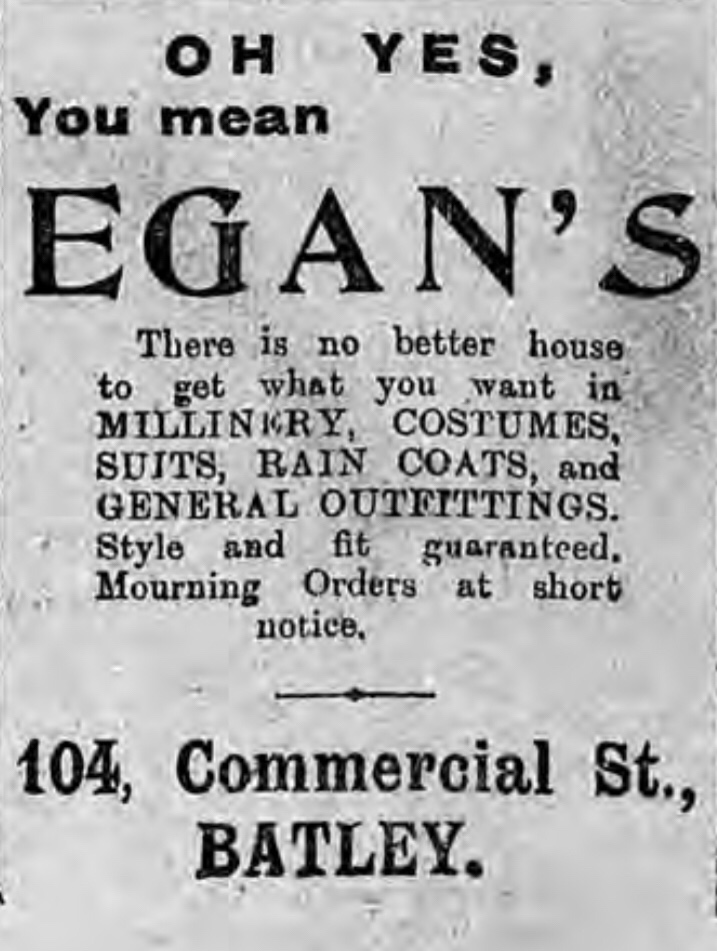
A short time after his marriage, Thomas (Snr) was forced to leave his arduous textile industry job – a life-changing work accident resulted in the loss of his arm.3 By 1901 he was employed as a life insurance agent. 10 years later he was self-employed, working as a house furnisher and jeweller. And by the time of the Great War, Thomas (Snr) had his own clothing shop on Commercial Street selling, amongst other things, millinery, suits, and rain coats. The 1921 census records him as a clothier and draper, assisted by his wife.
But this does not tell the full story.
Thomas (Snr) also had local political ambitions, elected as a Liberal Councillor for Batley’s West Ward in a by-election in October 1904, when still working as an insurance agent. He regarded himself as representing the Irish community in town, but would do his best for all classes.4 Doing this was not always plain sailing though. He managed to displease Batley Catholics in 1905, when he participated in Nonconformist temperance meetings which included Nonconformist religious services – it was contrary to Catholic teachings to attend services of another denomination.5 The displeasure, however, was not sufficient to result in the end of his political life.
In addition to his council role, he was elected to the role of President of the Batley Chamber of Trade, taking office in January 1925.6 In 1929 the prominent Roman Catholic became a Borough of Batley magistrate.7 His wife Ann did not live to see this achievement. She died at the close of 1928.
This then was the family background of Thomas (Jnr). It was not the typical background of many other St Mary’s children.
As for Thomas (Jnr), a pupil at St Mary’s school for his early years, he went onto secondary education at Batley Grammar School.8
Having completed his education, he went on to work for the Prudential Assurance Company, based in their Batley branch. The 1921 census shows the family living at 104, Commercial Street (which was also the address of the family shop), with 18-year-old Thomas employed as an insurance clerk for Prudential Assurance, in their Bradford Road office.
However, he did have a later career change. Shortly after the outbreak of war, and prior to his enlistment, he is described as a costumier.9 This job title, with its French undertones, was usually applied to a working proprietor of a small dressmaking or costume establishment. This role was undertaken in the Egan family millinery business on Upper Commercial Street. The implication from the 1939 Register was Thomas (Jnr) now ran the shop, with his father described as retired. In contrast, other sources indicate he assisted his father with the business.10
The 1939 Register also shows Thomas (Jnr) living with his father and sister Mary Ellen (also working in the family business) at 50B Healey Lane. Next door, at 50A, was Thomas’ married brother Henry Egan, a tripe dealer.11 Incidentally, Henry’s house was damaged in the Luftwaffe bombing of Batley on the night of 12/13 December 1940. More details of this can be found here (and in the other linked posts).
Outside of work Thomas appears to have taken an interest in singing, described as “an enthusiastic member of St. Mary’s Church choir.”12
Thomas (Jnr)’s military career was worlds apart from his work in Batley. He served as a Gunner with the Royal Artillery’s (RA) 80th Heavy Anti-Aircraft (HAA) Regiment, being posted overseas to join them in January 1943.13
HAAs were initially known as Anti-Aircraft (AA) Regiments. They added ‘Heavy’ to their title when the Light Anti-Aircraft units were formed early in the 2nd World War.
The 80th (Berkshire) Anti-Aircraft Brigade RA (TA) was formed in November 1938. It became the 80th (Berkshire) Heavy Anti-Aircraft Regiment RA (TA) in June 1940.14 Based initially in the UK, it moved to overseas service in November 1942, and consisted of three batteries.
As a Gunner in the 80th HAA Thomas (Jnr) saw action in Tunis, and the invasion of Sicily, from where he wrote his final letter home.15
Then, on 3 September 1943, the Allies invaded the Italian mainland across the Strait of Messina, codename Operation Baytown. 194 and 250 HAA Batteries of the 80th HAA Regiment provided AA cover for this operation from Messina, Sicily.16
The invasion continued on 9 September with landings at Salerno, codename Operation Avalanche. For ‘Avalanche’, 80th HAA’s 252 HAA Battery was in No 4 Beach Group under the authority of 12th Anti Aircraft (AA) Brigade. Following the capture of Naples, 12th AA Brigade’s units were brought in by road and landing craft, and defended the port from 1 October until relieved three weeks later. It then moved up to rejoin X Corps against the German defensive position known as the Volturno Line. The other components of 80th HAA Regiment, however, remained on Sicily for the rest of the year.17
Thomas (Jnr) was killed on 8 November 1943, one of six men from the 80th HAA to die that day. All are buried at Salerno War Cemetery, on the Italian mainland. This cemetery contains 1,851 Commonweath Second World War burials, many resulting from the initial landings and the fighting which followed. However, graves were also brought in later from a wide area of south-western Italy.
On the evening of Monday 22 November 1943 Thomas’s father received a telegram at Mayville, the name of the Healey Lane family home, notifying him of the death of his youngest son.18
Thomas (Snr) was administrator for his son’s estate, with effects which amounted to £2,832 19s. 11d.19
In addition to Batley War Memorial, Thomas (Jnr) is commemorated at Batley Grammar School. He is also remembered on the family grave in Batley Cemetery, which notes he was killed in action at Reggio, Sicily.

Footnotes:
1. Batley News and Batley Reporter and Guardian, 21 October 1904.
2. Batley Reporter and Guardian, 19 October 1900.
3. Batley News, 24 January 1925.
4. Batley News, 21 October 1904.
5. Batley News, 24 March 1905.
6. Batley News, 24 January 1925.
7. Leeds Mercury and Yorkshire Post and Leeds Intelligencer, 2 May 1929.
8. Batley News, 27 November 1943.
9. 1939 Register, The National Archives (TNA), Ref RG101/3605C/016/14 KMEC
10. Batley News, 27 November 1943.
11. 1939 Register, Ibid.
12. Batley News, 27 November 1943.
13. Ibid.
1.4 The Royal Artillery 1939-1945, https://ra39-45.co.uk/units/heavy-anti-aircraft-regiments/80-berkshire-heavy-anti-aircraft-regiment-rata
15. Batley News, 27 November 1943.
16. Berkshire Royal Horse Artillery, Wikipedia, https://en.m.wikipedia.org/wiki/Berkshire_Royal_Horse_Artillery
17. Ibid.
18. Batley News, 27 November 1943.
19. National Probate Calendar.
Other Sources:
• Batley Cemetery Burial Registers.
• Censuses, 1881 to 1921.
• Commonwealth War Graves Commission.
• Egan Headstone, Batley Cemetery
• GRO Certificates.
• GRO Indexes.
• Newspapers, Various.
• Parish Registers.


 Past To Present Genealogy