Name: Bernard Stenchion
Rank: Private
Unit/Regiment: Army Air Corps
Service Number: 14895082
Date of Death: 15 June 1945
Cemetery: Batley Cemetery
In September 1939, when Britain declared war following Germany’s invasion of Poland, Bernard Stenchion was a Batley St. Mary of the Angels schoolboy, facing an unexpectedly extended summer holiday because air-raid shelters needed to be built at school. Within six years he would be a casualty of that war.

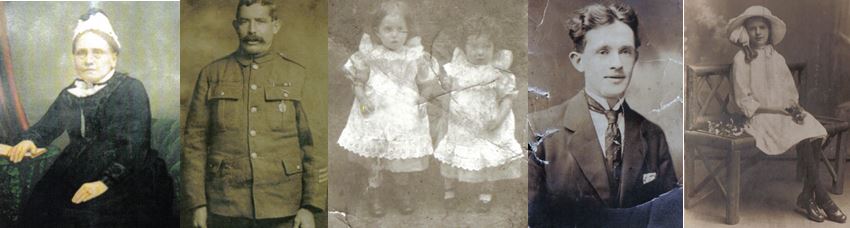
Born in Batley in November 1926, he was the youngest child of Thomas and Catherine Stenchion (late Gavaghan, formerly Donlan). The couple married in February 1918 at St. Mary’s, both for the second time. Coal miner Thomas’ first wife, Bridget, died in August 1914. Catherine’s husband James Gavaghan was killed in 1916, during the First World War – a conflict in which she also lost her brother, Thomas Donlan.
At the time of their marriage, Thomas Stenchion had six surviving children from his first marriage – John (b.1900), James (b.1901 and d.1931), Annie (b.1904), Thomas (b.1906), Nellie (b.1909), and Teresa (b.1912).1 Catherine had two surviving children from her marriage to James Gavaghan – Peter (b.1911, and Mary (b.1913).2
In addition Bernard, Thomas and Catherine Stenchion’s other children were Patrick (b.1918), Catherine (b.1920), Edward (b.1922), and Joseph (b.1925).
The family lived on Ambler Street, in the Skelsey Row area of Batley, with their 1921 census address being No 18 – Thomas’ home from his first marriage. It was a two-roomed house, and with nine people living in it conditions were crowded. So much so, that Thomas’ three older daughters – Annie, Nellie and Teresa, were living further along Ambler Street with their widowed paternal aunt, Catherine Cogan. Her husband John Thomas Cogan, who was connected with St. Joseph’s Batley Carr, was also killed in the First World War.
A member of the St. Mary’s school football team, Bernard completed his education aged 14 and went to work in the textile industry. Prior to joining up, he was employed by Messrs. Lipsey and Co. Ltd., in their Bulrush Mills, on Bradford Road, Carlinghow. This was a rag merchants, engaged in the importing and exporting of rags, shoddies and mungoes.
At the start of the war, the National Service (Armed Forces) Act imposed conscription on all males aged between 18 and 41 who had to register for service. When Bernard reached the age of 18 he joined up, serving with the Army Air Corps, the aviation arm of the British Army. This was first formed on 21 December 1941 as the overall corps for The Parachute Regiment and The Glider Pilot Regiment. These regiments had been formed as a direct response to the Germans’ use of paratroops and gliders early in the war. The Army Air Corps received its Royal Warrant just over two months later. The new corps also administered the Air Observation Post Squadrons of the Royal Artillery. In March 1944 the Special Air Services Regiment was added to the corps remit.
Bernard was assigned to 1 Parachute Regiment Infantry Training Regiment based in Albany Barracks on the Isle of Wight.
He was not the only member of his family to serve in the war. His half-brother Peter Gavaghan, who served with the 1st Battalion King’s Own Scottish Borderers, had been Killed in Action on 12 June 1944 in the early days of the Battle of Normandy and the liberation of France, which the D-Day landings on 6 June 1944 initiated. His brother, Patrick, was with the RAF, whilst his brother Joseph was with the Royal Navy. His married sister Catherine Foley, was with the Auxiliary Territorial Service, the women’s branch of the Army which undertook non-combatant roles, freeing men up for those.

On 15 June 1945, a matter of days after the first anniversary of the death of his half-brother Peter and within weeks of Germany’s surrender ending the war in Europe, Bernard was accidentally killed on the Isle of Wight, whilst undergoing his paratrooper training. In unknown circumstances, he sustained a bullet wound to his chest and a fractured thigh.
His body was returned home to Batley, where – on 20 June 1945 – a funeral with full military honours was conducted by St. Mary’s priest Father O’Mahoney. His coffin was borne by a contingent of troops from his regiment. Several school friends from St. Mary’s, who were home on leave, also attended – including Sergt.-Major Gavaghan, Pte. J. Gannon, Trooper Flexney, Pte. Gavaghan, Pte. J. Judge, Lance-Corpl. Prendergast, Pte. T. Holmes, Driver W. Ellis, Aircraft Man M. Brannan, Pte. J. Phillips, Pte. W. Heaton, Driver J. Gavaghan, and Able Seaman S. Gooder and McLaughlin. Whilst his brother Joseph was able to attend the funeral, his brother Patrick was in Germany with the RAF.
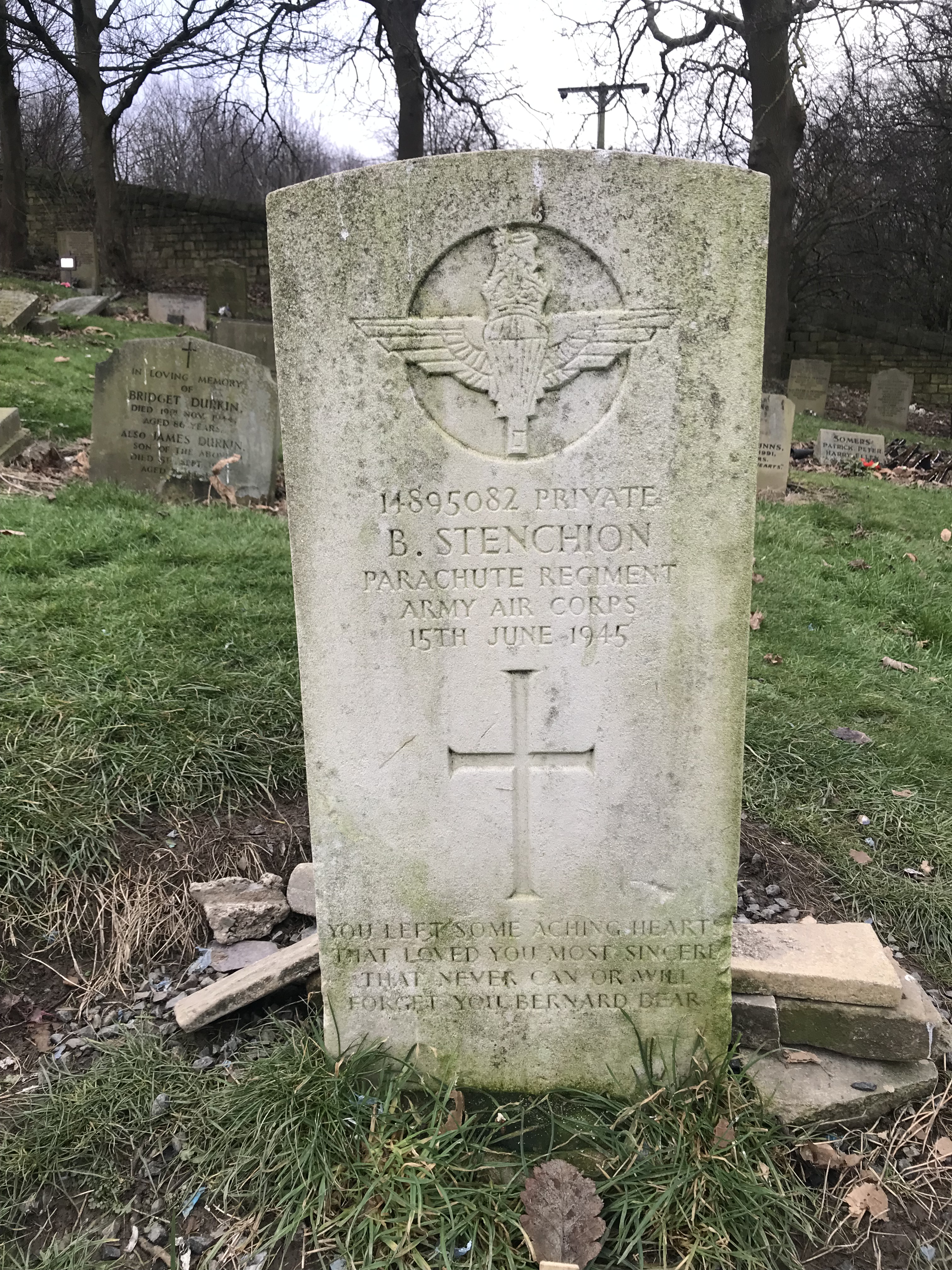
Bernard is buried in Batley cemetery, and his Commonwealth War Graves Commission headstone carries the inscription:
You left some aching hearts
That loved you most sincere
That never can or will
Forget you, Bernard dear.
In September 1945 his father, Thomas, suffered a serious accident at work. No longer working as a coal miner, he was employed in the textile industry as a minder of a scribbling machine at Messrs. Charles Robinson and Co., Ltd.’s Park Lane Mills. He lost two fingers on his right hand and, as a result of his injuries, spent two months in Batley hospital. The accident changed him. Prior to his injury he was described as a big, strong man who never had an illness. After the accident he never regained his strength, lost weight to the point of emaciation, and suffered badly with his nerves. He died on 18 May 1946, his death subsequently found to be as a result of a pulmonary abscess and chronic bronchitis. He was buried in the same plot as his son. This was also the final resting place of Bernard’s mother Catherine, who died in December 1969.
Postscript:
I may not be able to thank you personally because of your contact detail confidentiality, but I do want to say how much I appreciate the donations already received to keep this website going. They really and truly do help. Thank you.
The website has always been free to use, and I want to continue this policy in the future. However, it does cost me money to operate – from undertaking the research to website hosting costs. In the current difficult economic climate I do have to regularly consider if I can afford to continue running it as a free resource.
If you have enjoyed reading the various pieces, and would like to make a donation towards keeping the website up and running in its current open access format, it would be very much appreciated.

Please click 👉🏻here👈🏻 to be taken to the PayPal donation link. By making a donation you will be helping to keep the website online and freely available for all.
Thank you.
As a professionally qualified genealogist, if you would like me to undertake any family, local or house history research for you do please get in touch.
More information can be found on my research services page.
Footnotes:
1. Three other of Thomas’ children from his first marriage died in infancy – Edward (born and died in 1902), Mary (born 1907, died 1908), and Catherine (born and died in 1910).
2. A third child, James, died in 1911, aged18 months.
Other Sources (not directly referenced):
• 1881 to 1921 England and Wales Censuses.
• 1939 Register.
• Army Air Corps, National Army Museum, https://www.nam.ac.uk/explore/army-air-corps
• Army Air Corps, No1 Parachute Regiment Infantry Training Centre, ParaData website, https://paradata.org.uk/content/4634521-army-air-corps-no-1-parachute-regiment-infantry-training-centre
• Batley Cemetery burial registers.
• British Army Casualty Lists, 1939-1945, various.
• Commonwealth War Graves Commission.
• GRO Birth, Marriage and Death Indexes.
• Newspapers, various.
• Parish Registers, various.


 Past To Present Genealogy