
Name: Thomas William Chappell
Rank: Acting Corporal1
Unit/Regiment: 1st/4th Battalion, The King’s Own (Yorkshire Light Infantry)
Service Number: 1546
Date of Death: 5 July 1916
Memorial: Thiepval Memorial, Somme, France

Thomas William Chappell was born in Goole in 1891. His parents were Joseph and Catherine (Kate) Chappell (née McCabe), from Horbury and Wigan respectively. It appears the couple married in Batley in 1869 under the rites of the Established Church, Joseph’s religion.2
According to the 1911 census the couple had 10 children, seven still living.3 It appears they were brought up Catholic, Catherine’s faith – with the two Batley-born children baptised at St Mary’s. I have identified nine of the 10 as follows: Charles, born in Batley 1873 but who died two years later; Mary born in Wakefield in 1874; John, whose birth was registered in Goole in the March quarter of 1878; Annie, also born in Goole and registered in the March quarter of 1880; George Henry born in Ossett in 1882; Herbert, who was born and died in 1884; Sarah Elizabeth born in Batley in 1886; Emily, registered in Goole in the March quarter of 1889; and finally Thomas William.
As can be seen from their birth locations the family moved between Batley, Wakefield, Ossett and Goole. The censuses also support this. In 1871 both Joseph and Catherine were lodging in Wakefield and working as factory hands.4 By 1881 they were in Ossett, with Catherine working as a rag sorter, and Joseph an out-of-work fireman.5 This was more likely to be tending the fire of a steam engine, possibly in a mill, rather than a firefighter. By 1891 the family were in Goole with Joseph now described as a seaman.6 In fact Joseph turned his hand to a number of different jobs, including in the military serving with the 18th Hussars and Royal Marines, and civilian jobs working as a rag grinder, stoker, labourer and dock labourer.
At the time of the 19017 and 1911 censuses Catherine was in Batley working as a rag sorter/picker. Joseph tellingly was not in the family home. The couple’s marriage had always been difficult, with Catherine claiming systematic ill-treatment by Joseph throughout. This included physical assaults, throwing her out of the house, failing to provide for his family and spending his wages on drink. On one occasion he is alleged to have abandoned his family and left for America.8 Joseph’s Wakefield prison sentences included ones for neglecting his family and assaulting his wife. Three times Catherine obtained separation orders and maintenance from him, but she repeatedly returned hoping things would improve. But they never lasted long together. The last case I have found involving the couple was in July 1893 when Joseph was summoned by Batley magistrates for deserting his wife and family, but failed to appear. In his absence he was ordered to pay 7s. 6d. a week to support his wife and family.9
By 1911 Thomas William was living at Taylor Street, Batley, with his mother and sister Emily. He now had employment as a woollen piecer. In early 1912 he also joined the local Territorials, the 4th King’s Own Yorkshire Light Infantry (KOYLI).10 Whereas his two older brothers, John and George Henry, had served in the regular army in the 2nd Boer War, the Territorial Force (TF) was a form of part-time volunteer soldiering.
The TF came into being with the 1908 Army Reforms. Their purpose was to ensure home defence in the event of war causing the deployment overseas of the bulk of the regular army. They attended regular drills and annual camps, which earned them the nickname of ‘Saturday Night Soldiers.’
But that all changed with Britain’s entry into war on 4 August 1914, The declaration brought to an end Thomas William’s civilian employment in the dyehouse at Messers J., T. and J. Taylor’s Branch Road Mills. Incidentally a major fire broke out in these mills in the early hours of Sunday 11 July 1915, destroying a portion of the complex with damage estimated in the region of £20,000.11

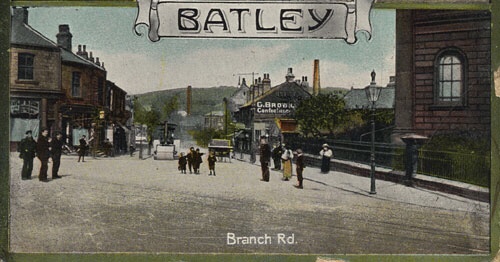
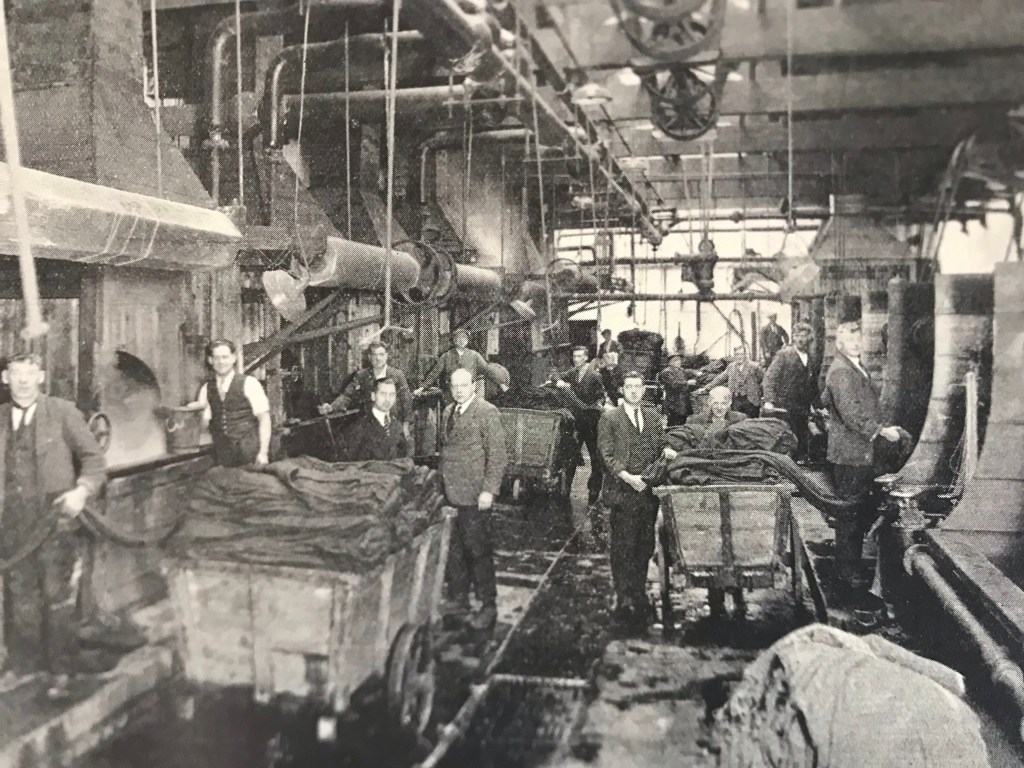

Photo 2: Dyeing at one of Taylor’s Mills, date unknown. From One Hundred Years, Theodore Cooke Taylor. See Sources.
Photo 3: Branch Road Mill fire, 1915. Source unknown.
The local Terriers were hastily called back from their annual summer training camp in Whitby, and immediately mobilised for full-time war service. Part of their TF terms of service were not being required to serve overseas, but many now waived this, signing the ‘Imperial Service Obligation.’
Initially the 1st/4th KOYLI undertook home training, including at Doncaster, Sandbeck Park (Maltby), Gainsborough and York. There is a possible reference to Thomas in a newspaper report at the time of the training exercise raft disaster in Lincolnshire in which seven KOYLI’s drowned. Lance Corporal Chorley, a Leeds solicitor in civilian life, told the Coroner at the inquest “about the pluck shown in rescue work, and specially mentioned Lance-Corporal Chappell and Private Barlow.”12 More information about the disaster can be found in the biography of one of the victims, St Mary’s War Memorial man Edmund Battye.
The 1st/4th KOYLI, including Lance Corporal Chappell, sailed from Southampton and Folkestone, disembarking at Le Havre and Boulogne on 13 April 1915, joining the Expeditionary Force initially in France as part of the 49th (West Riding) Division.
By July 1915 the Battalion had moved to Belgium, operating in the vicinity of the Ypres-Boesinghe line, an area north of Ypres along the Yser Canal. Whilst in the trenches here it was no big set-piece battles, rather a daily war of attrition, with the 1st/4th KOYLI casualties mounting as they came under repeated hostile shelling, and faced the constant threat of snipers, rifle grenade attacks and machine gun fire. Whilst out of the line they supplied working and ration carrying parties. And it was whilst in the Ypres-Boesinghe line that Thomas William and the Battalion were involved in their most significant incident to date.
Early in December 1915 intelligence reports, and information collated from captured German soldiers, suggested the enemy was about to mount a gas attack. Gas cylinders had been seen along the German front line, opposite the 49th Division’s position. At just before 5am on the morning of 19 December the anticipated attack began. The KOYLI’s Unit War Diary for the day described events:
4.50am: A hissing noise like a fast running motor car was heard in the German lines. Very shortly after the presence of cylinder gas, said to be Fosgene [sic], was detected in the air. Warning was given, tube helmets put on and rapid fire opened on the enemy’s parapet with rifles and machine guns. S.O.S Gas was sent to the Artillery who immediately opened fire. No Infantry attack was made but later a German patrol numbering about ten was seen advancing towards our trenches. Rifle fire was opened on them and they dispersed, only one man being seen to regain the German trench. The enemy heavily bombarded the whole of our front line and Support trenches during the day.13
The 1st/4th KOYLI kept the enemy at bay, but as they were being relieved that evening the enemy launched a fresh bombardment using shells filled with lethal phosgene gas.
The diary goes on to record one officer and 23 men killed through gas poisoning, with a further two officers and 149 other ranks wounded as a result of it. In addition another officer was wounded and subsequently died, and a further six other ranks were killed and 19 wounded in the ensuing attacks of the day.
News filtered home to towns across the Heavy Woollen District. The Batley News was one of many local papers to cover the incident. It included the following official praise:
How well our brave Territorials behaved in the trying ordeal on December 19th is shown by the appreciation of their Divisional Commander, who in an Order issued on December 22nd, in “Belgium,” said:—
I have just received the preliminary report of the gas attack and heavy shelling by the Germans on the Sixth Corps’ front on the 19th inst., and I should be very glad if you would convey to the troops of the 49th Division my appreciation of their steadiness and behaviour under very difficult and trying circumstances.
Owing to their steadiness the attack failed to produce any practical or material effect. It was a day which reflects great credit on the whole corps.14
At the beginning of January 1916 Thomas William came home to his family for a period of leave. His mother now lived at Wards Hill. When a Batley News reporter asked him about the gas incident, he stated the men were quite cheerful after it, and he left the Battalion in the best of spirits. In general he preferred not to talk to the journalist about his experiences at the Front, but he did mention a recent narrow escape from injury. A shell burst near him in the trenches and a fragment struck the rubber thigh boots he was wearing as a protection against water. The rubber was cut, but Thomas William escaped uninjured.15
Thomas returned to the 1st/4th KOYLI, and was serving with them when he died, during the initial days of the Battle of the Somme. The Battalion were in reserve with the 49th Division on 1 July 1916, the opening day of the offensive. But at 6pm that evening they were placed at the disposal of the 96th Infantry Brigade for their attack on Thiepval.
The following day, and into 3 July, saw the KOYLIs switching between assembly trenches in Aveluy Wood and holding trenches in Thiepval Wood, as orders kept changing. During this period, in a two-hour spell until 5 am on 3 July, they came under heavy shelling from tear gas, high explosives and shrapnel, “causing some inconvenience and slight casualties.”16
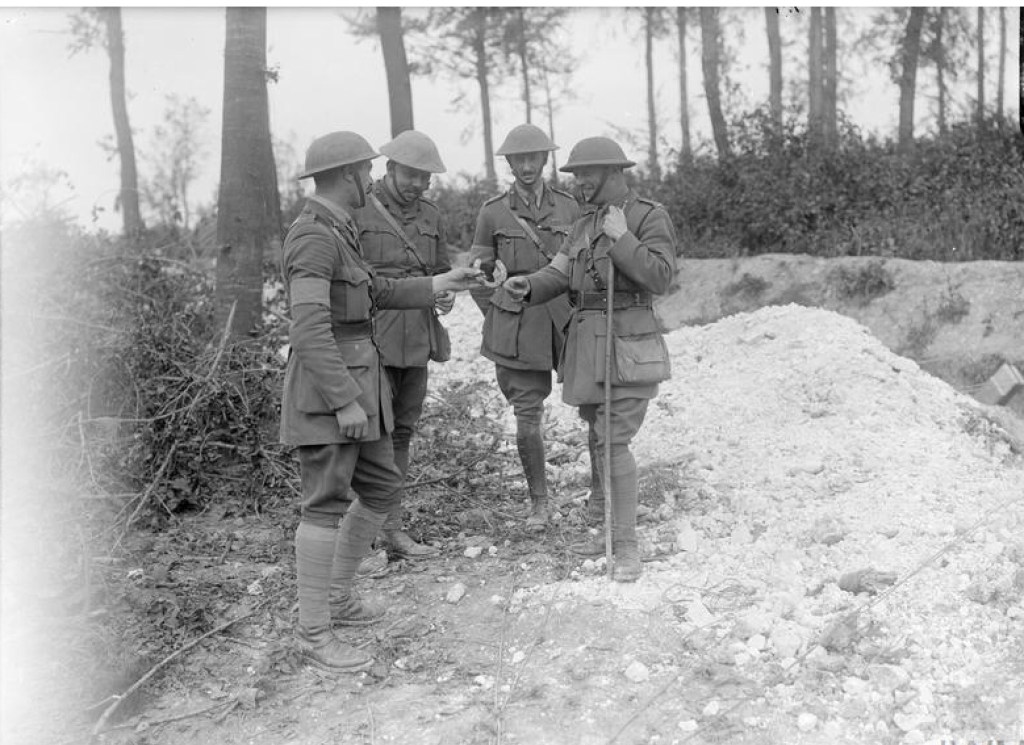

And “Elgin Avenue”, communication trench in Thiepval Wood, June 1916. © IWM HU 87947
Reproduced under the IWM Non-Commercial Licence.


The next day, 4 July, they were involved in events in the ‘A’ line of trenches in the Thiepval sector, which had been taken from the enemy on 1 July. At 2pm the enemy commenced intense bombardment on the front occupied by the battalion. Then, under cover of a heavy thunderstorm, the enemy then began attacking positions on the ‘A’ line, chiefly where the 1st/5th KOYLI were. In the ensuing action, which successfully drove the enemy off, one officer and 45 other ranks from the 1st/4th KOYLI were wounded.17
Thomas William was killed the following day, 5 July, when an unsuccessful attempt was made to seize more of this ‘A’ system of enemy trenches in the Thiepval sector. The attack commenced at 4am, mainly involving the 1st/5th KOYLI, but the 1st/4th sent two platoons of ‘Z’ company to support them. The assault was met with heavy shrapnel fire and further countered by snipers from various shell holes.18 The Germans then responded attacking positions held by the 1st/5th KOYLI, but were repulsed by two squads of the Battalion Bombing platoon and ‘W’ company.19 All in all, these events cost the 1st/4th KOYLIs twenty men and two officers wounded, one officer missing, and three men killed.20 An analysis of the CWGC records shows that Thomas William Chappell was one of three soldiers from the Battalion to die on that day.21 He was 25-years-old.
Meanwhile, back home in Batley his increasingly anxious family waited for news. After hearing nothing from her son for a fortnight, and after receiving a letter from one of his friends saying he was “sorry to hear of Thomas William’s death,” his mother made an appeal for information, which the Batley News published in their 22 July 1916 edition.
Days more anxious waiting followed before Catherine received the official War Office notification that Thomas William had indeed been killed in action on 5 July 1916. A friend, Corporal H Pulleyn, wrote telling her:
He was a very straightforward man, and he was the best chum I ever had. He died a man and a true soldier.22
In a mark of the esteem in which Thomas William was held by his former employer, Mr T. C. Taylor, MP, wrote a sympathetic letter to his mother:
We learn with sincere regret that you have received news that your son, who before the war worked at our Branch Road Mills, has been killed in action. Will you please accept our deep sympathy? Your son had the honour of being one of the first to join the Colours, and he has rendered service which entitles you to be proud of him. We are glad to think that it will be some comfort to you in your bereavement to remember his patriotic part in this great struggle.23


Thomas William was awarded the 1914-15 Star, Victory Medal and British War Medal. In addition to St Mary’s, he is also remembered on the Batley War Memorial. He has no known grave and is commemorated on the Thiepval memorial.
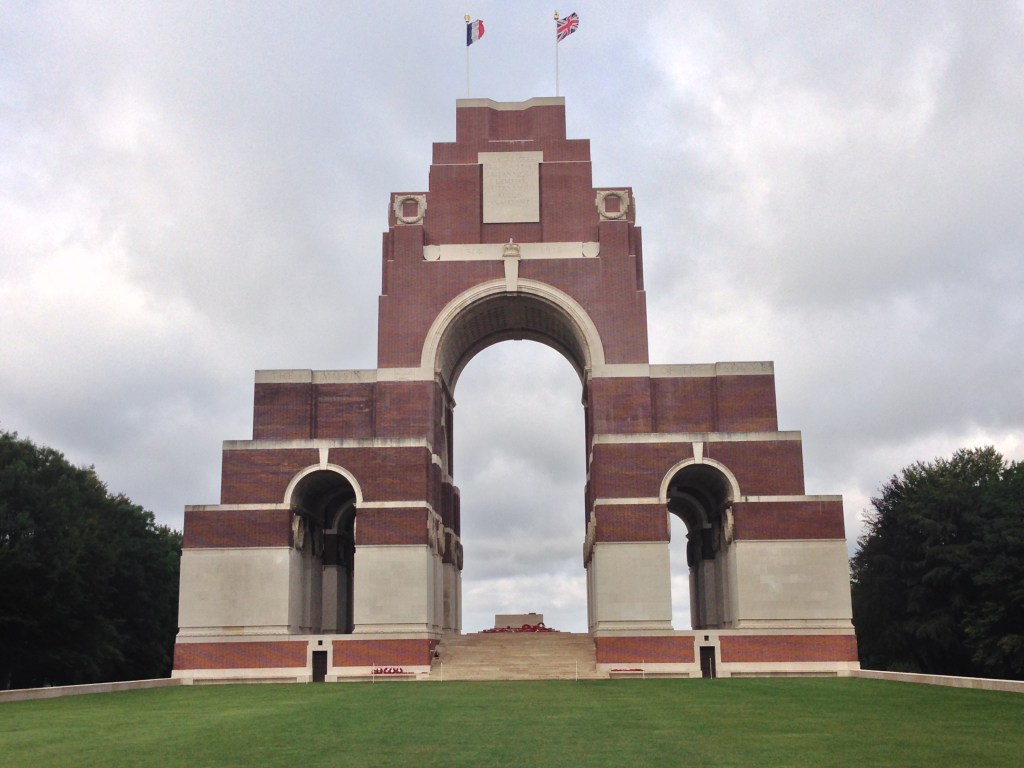
His brothers, John and George Henry, both served in the war and survived.
Footnotes:
1. Rank varies between Lance/Acting Corporal and Corporal, depending on record.
2. The most likely marriage (providing there is one!) is one at Batley Parish Church on 8 November 1869, although Catherine (who could not write) is recorded as Kaye. No other marriage matches, and the theory is her surname was misheard and incorrectly recorded. It would fit with the 1871 census, and the birth of their children. Incidentally, in various other records there is no consistency as to when they married. The 1911 census indicates 32 years (but Catherine has also shaved years off her age); One 1878 newspaper indicates they had been married ‘some years.’ One in 1885 said 16 years which fits with 1869, but a report of the same incident in another newspaper said 10 years. In 1893 she said they had been married 16 years.
3. 1911 Census – Catherine Chappell, The National Archives (TNA) Ref RG14/27239/284.
4. 1871 Census – TNA Ref RG10/4624/40/27/123.
5. 1881 Census – TNA Ref RG11/4567/32/21/251.
6. 1891 Census – TNA Ref RG12/3873/11/16/100.
7. 1901 Census – Catherine Chappell, TNA Ref RG13/4255/17/25/174.
8. Batley Reporter and Guardian, 15 July 1893.
9. Ibid.
10. Based on Service Number.
11. Batley Reporter and Guardian, 16 July 1915, Batley News, 17 July 1915 and Haigh, Malcom H. Historical Snapshots of Batley and Birstsall. Batley, West Yorkshire: Malcolm H Haigh, 1994.
12. Batley News, 27 February 1915.
13. 1st/4th KOYLI Unit War Diary, TNA Ref WO95/2806/1.
14. Batley News, 1 January 1916.
15. Batley News, 8 January 1916.
16. 1st/4th KOYLI Unit War Diary, Ibid.
17. 1st/4th KOYLI Unit War Diary, Ibid.
18. Johnson, Malcolm K. Saturday Soldiers: The Territorial Battalions of the King’s Own Yorkshire Light Infantry 1/4th 1/5th 5th 2/4th 2/5th, 1908-1919. Doncaster Museum Service, 2004.
19. 1st/4th KOYLI Unit War Diary, Ibid.
20. 1st/4th KOYLI Unit War Diary, Ibid.
21. The other two were Serjeant James Chappell, husband of Maria Chappell, of 7, Hilda St., Station Rd., Ossett, and Pte Tomas Cattle.
22. Batley Reporter and Guardian, 4 August 1916.
23. Ibid.
Other Sources (not directly referenced):
• 1921 Census.
• Batley Cemetery Register.
• Bond, Reginald C. History of the King’s Own Yorkshire Light Infantry in the Great War, 1914-1918. London: P. Lund, Humphries, 1929.
• British Army Service Records.
• Commonwealth War Graves Commission website.
• GRO Birth, Marriage and Death Indexes.
• Imperial War Museum website.
• The Long, Long Trail website.
• Maggie Blanck’s website – http://www.maggieblanck.com/Land/PhotosBatley.html
• Medal Index Card.
• Medal Award Rolls.
• National Library of Scotland maps.
• Newspapers – various editions of the Batley News, Batley Reporter and Guardian, Dewsbury Chronicle and West Riding Advertiser and Howdenshire Gazette.
• Ossett – The History of a Yorkshire Town website, https://ossett.net/
• Parish Registers.
• Pension Index Cards and Ledgers.
• Soldiers Died in the Great War.
• Soldiers’ Effects Registers.
• Taylor, Theodore Cooke. J., T. & J. Taylor Ltd … One Hundred Years. Records, Recollections and Reflections. Leeds, 1946.
• Wakefield Prison Registers.
Postscript:
My website has always been free to use, but it does cost me money to operate. In the current difficult economic climate I’m having to consider whether I can continue to keep running it as a free resource.
If you have enjoyed reading the various pieces, and would like to make a donation towards keeping the website up and running in its current open access format, it would be very much appreciated.
Please click here to be taken to the PayPal donation link. By making a donation you will be helping to keep the website online and freely available for all.
Thank you.


 Past To Present Genealogy