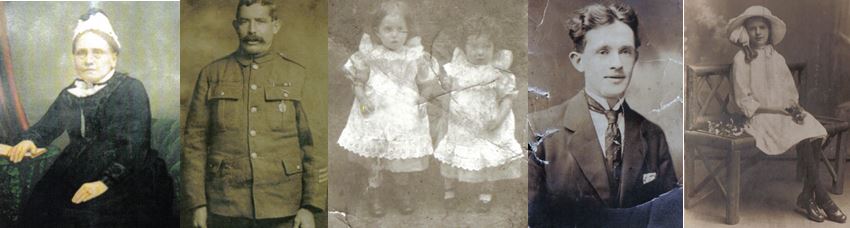
Name: Thomas Dolan
Rank: Private
Unit/Regiment: 2nd Battalion, The Leicestershire Regiment
Service Number: 19459
Date of Death: 29 January 1917
Cemetery: Amara War Cemetery, Iraq
Thomas Dolan was John William and Mary Ellen Dolan’s third child. Known as Tommy, he was born in Batley on 20 November 1894 and baptised at St Mary of the Angels the following month.
Both John William and Mary Ellen were Batley-born, and married at St Mary’s church on 14 April 1890. The couple, who spent the early years of married life at 3 Hume Street, had typical Batley jobs – he being a coal miner, she working as a rag sorter. Their first child Ellen (Nellie) was born the following March.
Initially, the couple found it tricky adjusting to married life and their new responsibilities. But, issues quickly resolved, son John was born in October 1892. He was the first of their children to die, in April 1896.
After Tommy’s birth and John’s death, Albert was born in November 1896. Their remaining six children were girls. Catherine, known as Kitty, arrived in September 1899, followed by Ann in 1902. Mary was born in July 1904, Agnes in April 1906, Margaret in September 1907, and finally Theresa in September 1910. Both Ann and Agnes died in 1906, whilst Theresa survived for only seven weeks.
The family in 1911, with the six surviving Dolan children, are pictured below. By this time they had moved to a four-roomed house on Cobden Street. This was in the same Catholic community-favoured area as Hume Street (they are also recorded living at nearby Peel Street in 1910), which lay to the side of the library and market area. Tommy now worked as a hurrier in a coal mine, after finishing his education at St Mary’s.
Whilst at school, he was one of those listed as taking part in the 1907 Batley Hospital school’s pageant, when St Mary’s pupils represented Ireland – a move which attracted criticism in some quarters. Along with his friend, James Rush, he was amongst the boys representing fishermen, part of the Queen of the Rivers tableaux, the boys dressed in dark blue smocks, red capes with tassels, and carrying a fishing net.
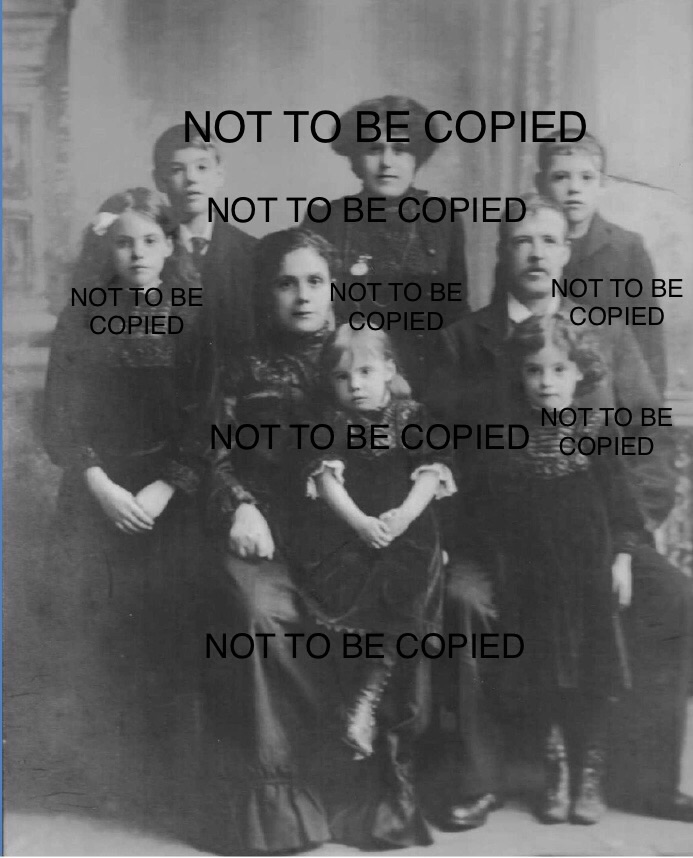
Top – Tommy, Nellie & Albert;
Middle – Kitty, Mary Ellen & John William;
Front – Margaret & Mary.
With thanks to Colin Glazebrook.
Tommy was well known in the district through his various interests and activities. Besides being associated with St Mary’s church, he was also a member of the Batley United Irish League Club. He also had social links beyond the Batley Irish Catholic community, playing football in the Westborough Junior League.
By the beginning of 1915 the Dolan family had moved to Upton Street, Cross Bank, near to St Mary’s church and school. Later that year, on around 11 August, Tommy and his friend James Rush both enlisted, initially assigned to the 3rd (Reserve) Battalion of the King’s Own Yorkshire Light Infantry (KOYLI).1 This was a training unit based in Hull, and Tommy spent his first months here as a Private, Service Number 25292.
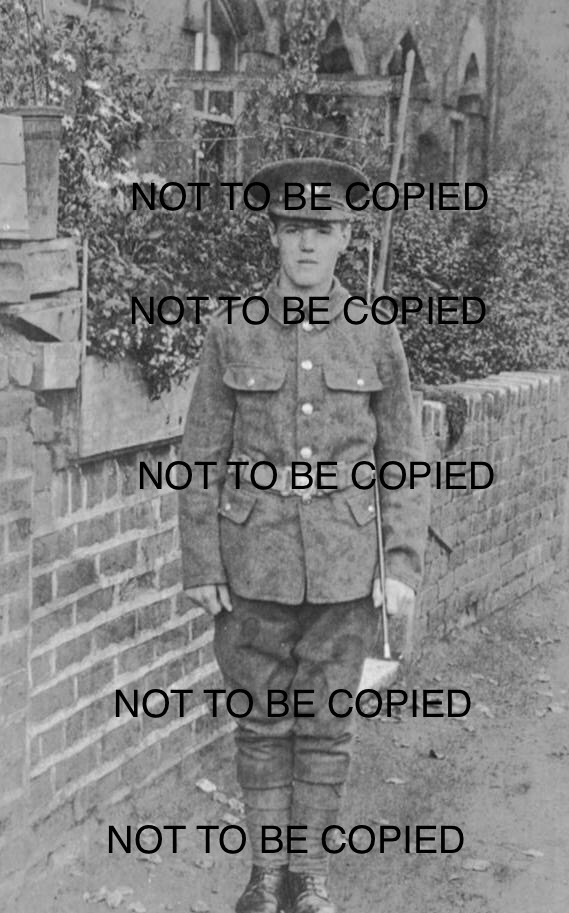
At Christmas time 1915, both Tommy and James were transferred to the 3rd (Reserve) Battalion of the Leicestershire Regiment, based at Patrington near Hull.2 This was the preliminary to deployment overseas. In mid-January 1916 they left Britain, bound for Mesopotamia to reinforce the regiment’s 2nd Battalion.3 As a result of the transfer, Tommy received a new service number, 19459.
It was also around this time, on 16 January 1916, that he penned his will in his Army Service Pay Book, indicating that in the event of his death all of his property and effects were to be left to his mother. This informal will, written whilst in actual military service, would later be recognised as constituting a valid will in accordance with War Department regulations.
Mesopotamia equates roughly to modern Iraq, but in this period it was a Turkish-controlled province, part of their vast Ottoman Empire. Turkey allied itself with Germany during the war, and this posed a specific threat to British interests in the area. For Britain had oil rights in Persia (modern day Iran), and this supply was now vulnerable to the Turks. In an effort to secure a resource vital to Britain’s war effort, with its oil-powered Royal Navy ships, in November 1914 Britain launched their offensive in the region, spearheaded by Indian troops. It would be a harsh, bitter campaign in inhospitable terrain.
The 2nd Leicestershires were part of the 28th Indian Infantry Brigade, 7th (Meerut) Division of the Indian Army. They arrived in Mesopotamia at the end of 1915. Within weeks they were already urgently needing reinforcements after incurring heavy casualties in action against Ottoman forces, during the first attempt in early January 1916 to relieve besieged British troops in the garrison town of Kut. By early March, Tommy and James had joined their new Battalion in the field, with the Kut relief attempts still ongoing.4
The campaign in Mesopotamia is notorious for its appalling conditions. The extreme heat, combined with poor medical facilities, a lack of clean water, flies, mosquitoes and vermin, resulted in shocking sickness levels and death. Those wounded in battle were particularly susceptible. A region of few roads meant reliance on water transport, which in turn led to lengthy delays in transporting injured men to hospital.
This appeared to be the case with Tommy, though ironically in his case it may have prolonged his life. In March 1916, as efforts continued to relieve the beleaguered British troops at Kut, Tommy was wounded, and then went down with a fever.5 Hospitalised, it meant he was not in action on 6 April 1916 when his friend James was killed in action as the Kut efforts – which were ultimately in vain as the garrison was forced to surrender – dragged on.
However, the reprieve for Tommy proved only temporary. December 1916 newspaper reports about his brother, Albert, being invalided home for hospital treatment for a gunshot wound, included a reference to him being wounded in Mesopotamia.6 It is unclear whether this was a fresh incident, or if the papers were noting his wounds from earlier in the year.
What is clear though, is on 29 January 1917 22-year-old Tommy Dolan died of wounds. His parents received official War Office notification of his death in early February 1917.7
Following his death, his mother was awarded a weekly War Pension of 7s.
Tommy Dolan is buried in Commonwealth War Graves Commission (CWGC) Amara War Cemetery, Iraq. The town was occupied by the Expeditionary Force on 3 June 1915 and – with its proximity to the River Tigris and therefore water transport – it immediately became a hospital centre. The accommodation for medical units on both banks of the Tigris was greatly increased during 1916, so perhaps it is in one of these facilities that Tommy Dolan died.
Amara War Cemetery is unusual because it has no headstones. They were all removed in 1933, because the salts in the soil were causing them to deteriorate. Instead, a screen wall was erected with the names of those buried in the cemetery engraved upon it. However, today the cemetery is essentially off-limits for British and Commonwealth visits because of the political situation. In lieu, there is now a Roll of Honour listing all casualties buried and commemorated in Iraq which is available for public viewing at the CWGC’s Head Office in Maidenhead.8
In addition to the St Mary’s War Memorial, Tommy is also commemorated on Batley’s War Memorial, his name being submitted by both his father and parish priest Fr. Lea. He was also awarded the Victory and British War Medals.
His brother, Albert, survived the war.
Postscript:
I may not be able to thank you personally because of your PayPal contact detail confidentiality, but I do want to say how much I appreciate the donations already received to keep this website going. They really and truly do help. Thank you.
The website has always been free to use, and I want to continue this policy in the future. However, it does cost me money to operate – from undertaking the research (various genealogy subscriptions, archive visit costs, document purchases, and ring fencing time away from paid research etc.,) to annual website hosting costs which increase as the information uploaded – and space required for it – grows.
In the current difficult economic climate I do have to regularly consider if I can afford to carry on with my research whilst continuing running the website as a free resource.
If you have enjoyed reading the various pieces, and would like to make a donation towards keeping the website up and running in its current open access format, it would be very much appreciated.
Please click 👉🏻here👈🏻 to be taken to the PayPal donation link. By making a donation you will be helping to keep the website online and freely available for all.
Thank you.
Footnotes:
1. Based on a proxy service record with similar service numbers and regiment details. These are not perfect replacements for destroyed service records, but they do give a rough idea. The Batley News of 14 August 1915 indicated his recent enlistment, so this would seem to fit a 11 August date.
2. Ibid. Though the proxy record used has a 14 January 1916 transfer date.
3. Ibid. The proxy service record used has a 21 January 1916 Devonport sailing date on the requisitioned Cunard liner Alaunia, with Basra arrival of 21 February 1916. This is in contrast to newspaper reports which give the sailing date for Tommy Donlan and James Rush as 16 January 1916, which is the same date Tommy wrote his informal will.
4. The proxy record has a 1 March 1916 date. James Rush, in a letter home dated 10 March 1916 stated he had already been in action, which is in keeping with the proxy record.
5. Batley Reporter and Guardian, 19 May 1916 and 9 February 1917.
6. Batley Reporter and Guardian, 1 December 1916 and Batley News, 2 December 1916.
7. When putting his son’s name forward for inclusion on Batley War Memorial John William Dolan said they had received official notification of his death on 9 February 1917. However his death was reported in the Batley Reporter and Guardian of that date, and it said the family had already received official notification – which indicates an earlier official notification date than that given by John William.
8. CWGC website.
Sources:
• 1871 to 1921 Censuses (England & Wales).
• 1939 Register.
• Batley Cemetery Burial Registers.
• Batley St Mary of the Angels Parish Registers – baptism, marriage and burial.
• Commonwealth War Graves Commission.
• General Register Office Indexes.
• Medal Award Rolls.
• Long, Long Trail Website.
• Mesopotamia Campaign, National Army Museum, https://www.nam.ac.uk/explore/mesopotamia-campaign.
• Newspapers – various.
• Pension Ledgers and Index Cards.
• Soldiers’ Effects Register.
• Soldiers Wills.
• Unit War Diary, 2nd Bn Leicestershire Regiment, The National Archives (TNA), Ref: WO 95/5140/3 and WO 95/5140/4.
• Wylly, Col. H. C., History of the 1st & 2nd Battalions, the Leicestershire Regiment in the Great War [British Army], Publication date 1928.


 Past To Present Genealogy