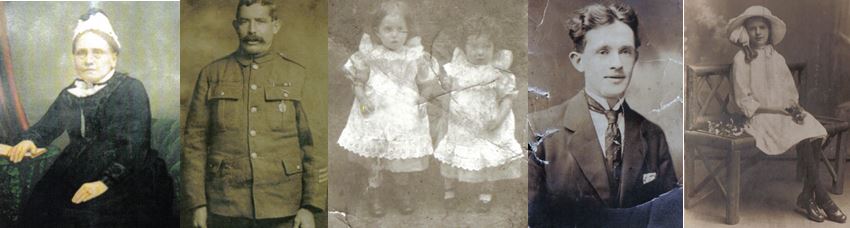
Name: Peter Gavaghan
Rank: Private
Unit/Regiment: 7/8th Battalion, King’s Own Scottish Borderers
Service Number: 21115
Date of Death: 23 July 19181
Cemetery: Buzancy Military Cemetery, Aisne, France
There are two Peter Gavaghans commemorated on the Batley St Mary of the Angels First World War Memorial. They were cousins. This biography is about the younger of the two – the Peter Gavaghan born in Batley on 26 April 1897, son of James and Catherine Gavaghan. Peter, along with his brothers James and Thomas, were all killed in the conflict, and all three are remembered on the church War Memorial.
Their parents James and Catherine (whose maiden name was Lynch), both came to Batley from Charlestown, in County Mayo.2 They married at St Mary of the Angels in June 1883, and went on to have eight children, five of whom were alive by the time of the 1911 census. In addition to Peter, James was born in 1883, Mary in 1890, Thomas in 1893, and John in 1895. Another son, also named John, was born and died in 1887.
In 1891 the family address was Churchfield Terrace, Batley, but subsequent censuses saw them living at 10, Ambler Street, in the predominantly Irish Catholic Skelsey Row area of town. This was the family address at the time of Peter’s death.
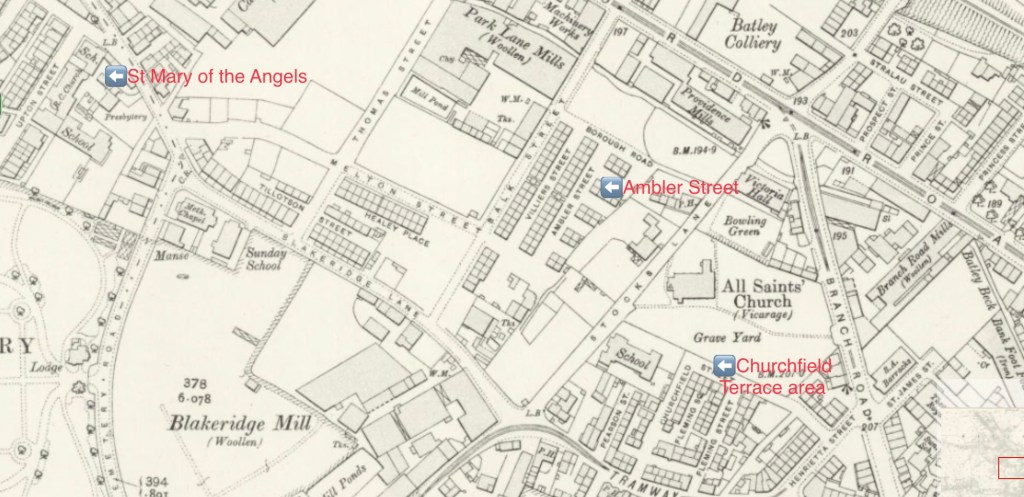
Peter’s father, James, worked as a wool willeyer according to the 1891 and 1911 censuses. A willeyer (with spelling variants including willier) was someone who prepared the wool for carding, using a willeying machine to cleanse and separate it. However, at other periods he undertook farm labouring work, and this was his occupation at the time of the 1901 census. His mother Catherine’s occupation was one shared by many local women, with the 1891 and 1901 censuses recording her as a rag sorter.
Peter too went into the textile industry after leaving school. Age 14, the 1911 census shows him, along with older brothers Thomas and John, working as piecners in the woollen manufacturing industry. Also known as a piecer, this was often a starter job in mills. The piecer assisted spinners, with their main task being to piece, or join together, by hand the threads broken in spinning. Other tasks included keeping the mule clear of waste. More information about the work, its dangers and wages, can be found here.
Peter enlisted in Batley after the outbreak of war, serving with the King’s Own Scottish Borderers. This was the same regiment as his brother John, the only one of the four Gavaghan brothers to return home.
Peter arrived in France on 19 December 1915. Later that month he joined up with the 7th King’s Own Scottish Borderers. Their Unit War Diary noted several days in the second half of December when men were taken on strength.3 During this period the 7th KOSBs were based in billets at Berbure in the Pas-de-Calais region in the north of France. This was an area used for rest and training periods for troops who had been fighting in the Loos area. The Battalion had lost about two thirds of its strength during the Battle of Loos that autumn.
Although Peter was away from the Front Line initially, within days of his arrival in France his elder brother Thomas was killed whilst serving in Belgium with the 1/4th KOYLI. Thomas’ biography is here. His brother, James, was killed the following August, and his biography is here.
It was not until Christmastime 1916 that Peter managed to get back to England to see his family, after action during the Battle of the Somme at Martinpuich. It was his first home leave since deployment overseas. By now he was a Private with the 7/8th KOSB, created in May 1916 from a merger between the Regiment’s 7th and 8th Battalions.
It was during this period of Christmas leave that his sister Mary, and her husband Richard Cunningham, popped in to see Peter and mother Catherine. The couple, who married earlier that year, lived a few doors further up Ambler Street. Mary flicked through her brother’s Army Pay Book, and noted Peter had left the details blank in the space regarding his will. When she quizzed him about who he would leave everything to, he said his mum had the most right to it, stating:
If I got killed everything I have, my Will and what they find in my pocket, my mother will get it all.4
Peter returned to his battalion, fighting amongst other places at Arras in the great push of 1917, at Pilckem during Third Ypres (better known as Passchendaele), again at Arras during the great German Spring Offensive of 1918, and finally on the Marne in the summer of 1918, with the French and Americans.
It was here, on 23 July 1918, that Peter was involved in the Battle of the Soissonnais and of the Ourcq. During this battle, after an advance begun on the 18 July 1918, the French village of Buzancy was reached (though not held) by the 1st American Division, on 21 July 1918. Then, on the evening of 22 July 1918, the 7/8th KOSBs, part of the 15th (Scottish), Division, relieved part of the 1st American Division in the line. They were due to continue the attack in conjunction with French, with Zero Hour being set at 4.55 a.m. the following morning.
However, detailed orders for the attack were not issued until 11.30 p.m. Getting these orders to the Company Commanders caused further problems, with the runners tasked with their delivery being unfamiliar with the weedy, marshy ground, which was also under cover of darkness. The barrage, which commenced at 4.10 a.m., failed to eliminate a large number of concealed enemy machine guns, which which were then able to fire on the attacking men. This resulted in heavy casualties.
At 10 a.m. on 23 July, orders were received that the French would attack Buzancy and the 7/8th KOSB’s were amongst those designated to defend their flank. Throughout the day the attack was continually postponed, and the following day the Battalion was withdrawn to Brigade reserve – Buzancy was not taken until 28 July.
It had been at a heavy cost to the KOSBs. For that one day’s action on 23 July 1918 the Unit War Diary records 3 Officers killed, 1 missing, and 10 wounded; along with 32 Other Ranks killed, 61 missing, 2 wounded and missing, and 214 wounded.4

Initially Peter was amongst those posted missing. Weeks dragged on, and whilst others families were celebrating the survival of their loved ones, the Gavaghan family were making enquiries to the Red Cross as late as 20 November 1918. It was eventually concluded that he was killed in action on 23 July 1918.
His body was recovered, and he is buried in Buzancy Military Cemetery, where – as you can see in the photo to the left – his headstone incorrectly has his date of death inscribed as 5 August 1918.
Peter was awarded the 1914-15 Star, Victory Medal and British War Medal. In addition to St Mary’s, he is also remembered on the Batley War Memorial. He is also commemorated on the Scottish National War Memorial, within the walls of Edinburgh Castle.
No written will was ever located for Peter but his oral will, spoken in the presence of his mother, sister and brother-in-law, was accepted as valid. Until her death in February 1921, his widowed mother Catherine (his father James died in January 1917) also received a small pension for the loss of her son.
Postscript:
I may not be able to thank you personally because of your contact detail confidentiality, but I do want to say how much I appreciate the donations already received to keep this website going. They really and truly do help. Thank you.
The website has always been free to use, and I want to continue this policy in the future. However, it does cost me money to operate – from undertaking the research to website hosting costs. In the current difficult economic climate I do have to regularly consider if I can afford to continue running it as a free resource.
If you have enjoyed reading the various pieces, and would like to make a donation towards keeping the website up and running in its current open access format, it would be very much appreciated.
Please click 👉🏻here👈🏻 to be taken to the PayPal donation link. By making a donation you will be helping to keep the website online and freely available for all.
Thank you.
Footnotes:
1. Peter’s date of death in multiple sources is given as 23 July 1918. These include one of his Medal Index Cards (he has two, the other has no date), his 1914/15 Star Medal Award Roll, his Soldiers Effects Register entry, his nuncupative will, his Soldiers Died in the Great War entry, and his pension records. The Red Cross records he was missing from 23 July 1918. And there is an amendment to one of his Commonwealth War Graves Commission (CWGC) forms, the Graves Registration Report, which indicates 23 July 1918. Yet his death date on the CWGC database, and headstone, is 5 August 1918. Incidentally the Unit War Diary entry for 5 August 1918 records no deaths that day, with the Battalion resting.
2. This birthplace is taken from the 1911 census, with the 1891 and 1901 indicating Ireland generally.
3. 7th KOSB Unit War Diary, The National Archives (TNA), Ref: WO95/1953/1
4. Nuncupative will.
5. 7/8th KOSB Unit War Diary, The National Archives (TNA), Ref: WO95/1953/3.
Sources:
• 1891 to 1911 Censuses (England & Wales).
• Batley Cemetery Burial Registers.
• Batley St Mary of the Angels Parish Registers.
• Commonwealth War Graves Commission.
• General Register Office Indexes.
• Medal Index Cards & Medal Award Rolls.
• National Library of Scotland Maps.
• Newspapers – various editions of the Batley News and the Batley Reporter and Guardian.
• Soldiers Died in the Great War.
• Soldiers’ Effects Registers.
• The King’s Own Scottish Borderers – https://kosb.co.uk/
• The Long, Long Trail – The British Army in the Great War 1914-1918: https://www.longlongtrail.co.uk/


 Past To Present Genealogy