
Name: Patrick Lyons
Rank: Private
Unit/Regiment: 1st/5th Battalion, The King’s Own (Yorkshire Light Infantry)
Service Number: 235098
Date of Death: 6 December 1917
Cemetery: Lijssenthoek Military Cemetery, Poperinge, West-Vlaanderen, Belgium
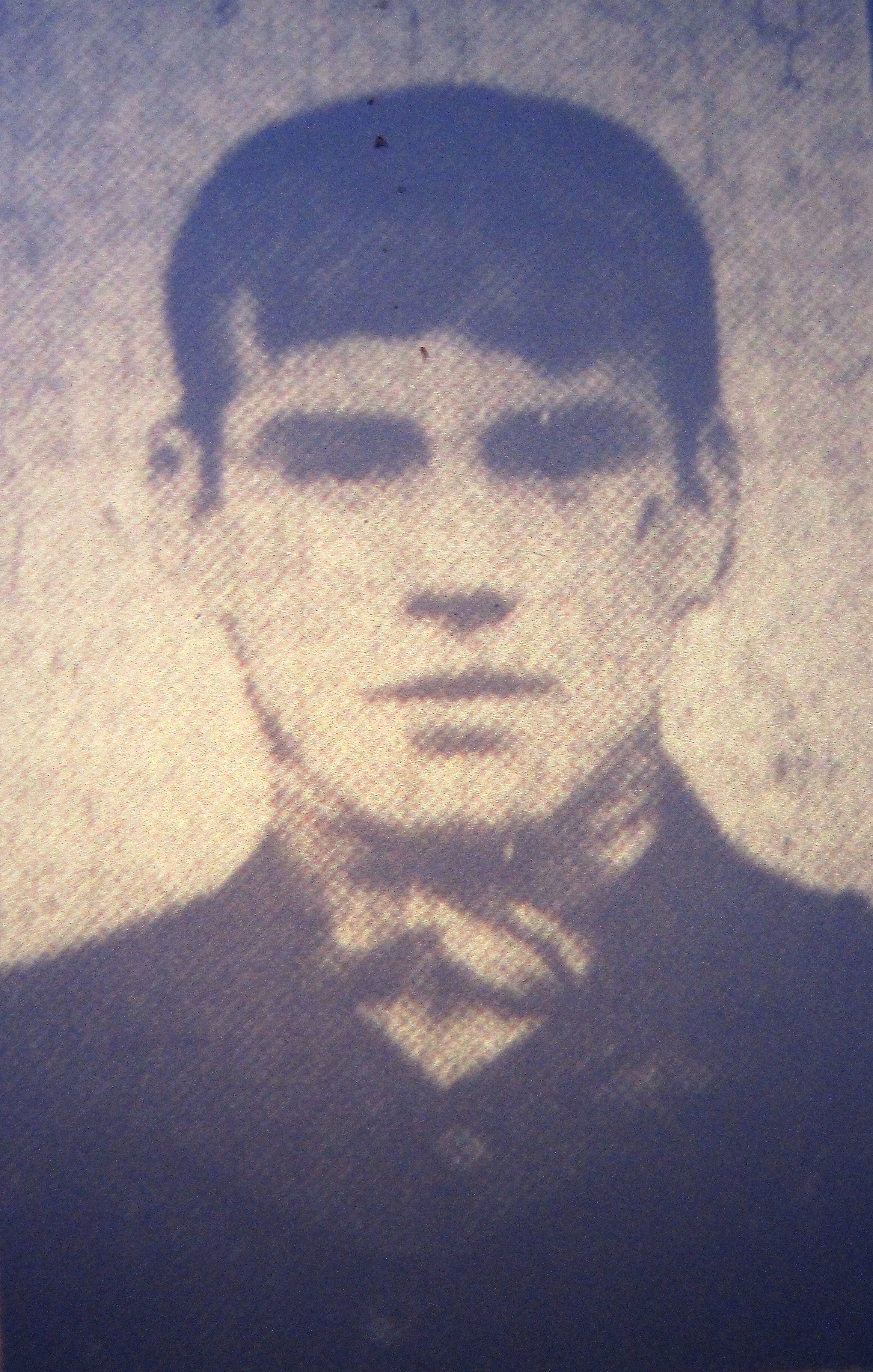
The son of John and Catherine Lyons (née McGuire), Patrick Lyons was born in Batley on 4 September 1890, shortly after the County Mayo couple’s marriage.1
The 1891 census records the young family living at 10 New Street, in the household of Catherine’s widowed mother, Mary, along with two of Catherine’s older siblings and her niece.2 John was working as a mason’s labourer, the job he undertook through his working life, and Catherine was a rag sorter, which was her regularly recorded employment.
The family subsequently moved to 16 New Street, where they appear in the next three censuses. This was the family home at the time of Patrick’s death. It was also home for most of their nine children. John was born on Christmas Day 1893. Then came James in 1895; Thomas in 1897; Mary Ellen, born and died in 1900; Michael in 1902; Catherine in 1905, but who died before her first birthday; and Annie in 1907. The ninth child has not definitively been identified, but it is possible he was a boy, born in 1892, who survived for only two weeks.
In the 1911 census Patrick was employed as a coal hurrier.3 He continued in this job right up to enlisting as a Private in the army in July 1915, working at Soothill Wood Colliery.4 This was the colliery where his younger brother John also worked.
Patrick initially went out to the Western Front in January 1916, to join the 1st/4th KOYLI, whose numbers had been depleted the previous month as a result of a German gas attack. He was allotted service number 4946. However, at an unspecified date, he was buried alive as a result of German shellfire and, as a consequence, was invalided back home to England suffering from shell shock.
In February 1917, deemed ready for service once more, he returned to Base Depot at Étaples. From there he joined the 1st/5th KOYLI, being allocated a new Service Number, 235098.
His family received no further ill news concerning him for most of that year. In fact, it was his father John who suffered an injury at the beginning of September 1917. Whilst working for his long-time employers, Carlinghow builders and contractors G. and J. Mortimer, he lost the four fingers on his left hand in an accident at New Ing Mill involving a circular saw.5
At the time the family received notification of Patrick’s death, John was preparing for a court case, his employers having failed to have paid any compensation for the injury.
Patrick, described as highly respected locally,6 died from wounds at a Casualty Clearing Station on 6 December 1917. I have found no indication as to when and where he suffered his fatal wounds, but according to the Unit War Diary at the end of November 1917 up to 1 December his battalion were in the Front Line trenches in the area of Belgium near Molenaarelsthoek. On 2-4 December they moved back into the Support Line trenches at Garter Point, from where they were deployed to provide working parties for the Royal Engineers and in the Front Line trenches. It is in this period ‘B’ Company working party were shelled on the Westhoek Ridge and incurred 7 casualties.7 The map below from the period indicates these various positions, and it is quite feasible that Patrick sustained his injuries in this period.

Patrick is buried at Lijssenthoek Military Cemetery, Belgium. During the First World War, the village of Lijssenthoek was situated on the main communication line between the Allied military bases in the rear and the Ypres battlefields. Close to the Front, but out of the extreme range of most German field artillery, it became a natural place to establish Casualty Clearing Stations. The cemetery was first used by the French 15th Hôpital d’Evacuation and in June 1915, it began to be used by Casualty Clearing Stations of the Commonwealth forces. At its height there were over 4,000 hospital beds in four Casualty Clearing Stations on the site.8 Presumably Patrick died in one of these.
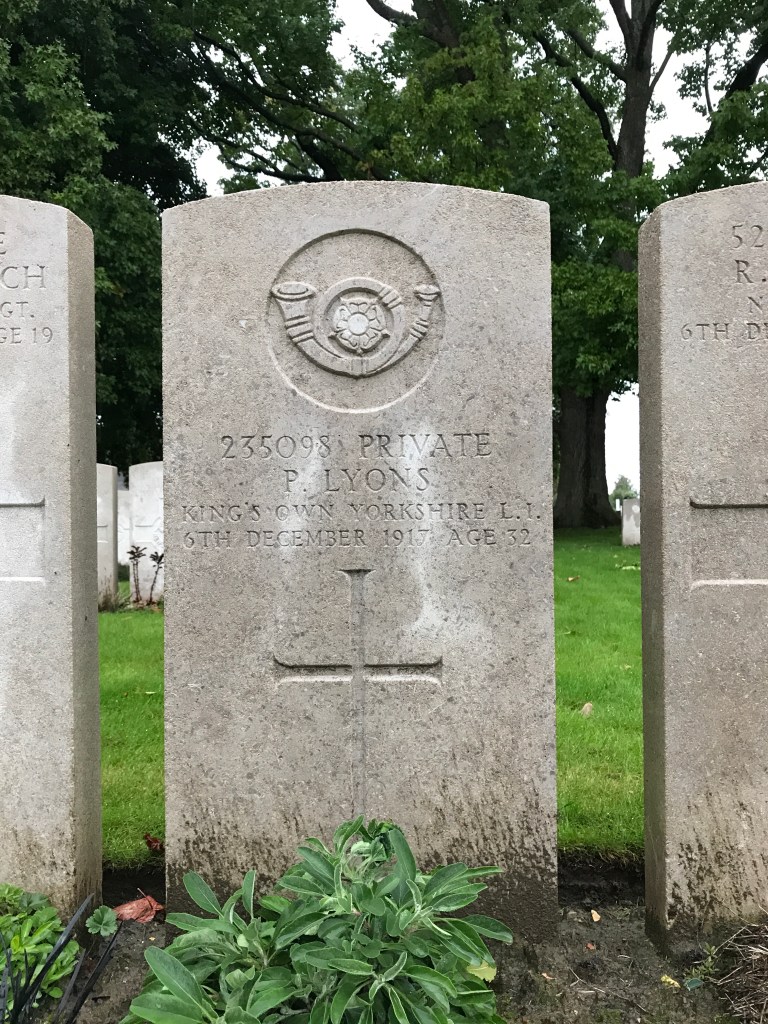
Although 27-years-old when he died, his headstone gives his age as 32. It is a thought-provoking reminder of the tragedy of war and loss. This was probably the age he would have been if still alive at the time his parents provided his headstone information to the then Imperial War Graves Commission.

For his service Patrick was posthumously awarded the British War and Victory Medals. In addition to the St Mary’s War Memorial he is also commemorated on Batley War Memorial.
Patrick’s brother John also served with the Army. Although wounded and captured by the Germans in their March 1918 Spring Offensive, he survived the war and returned home.
Postscript:
Finally a big thank you for the donations already received to keep this website going. They really do help.
The website has always been free to use, but it does cost me money to operate. In the current difficult economic climate I do have to consider if I can continue to afford to keep running it as a free resource.
If you have enjoyed reading this post (along with the hundreds of others), and would like to make a donation towards keeping the website up and running in its current open access format, it would be very much appreciated.
Please click 👉🏻here👈🏻 to be taken to the PayPal donation link. By making a donation you will be helping to keep the website online and freely available for all.
Thank you.
Footnotes:
1. Parish register – baptisms.
2. 1891 Census England & Wales, The National Archives (TNA), Ref RG12/3718/72/20/112.
3. 1911 Census England & Wales, TNA, Ref RG14/27244/107
4. Batley News, 19 January 1918.
5. Batley Reporter & Guardian, 18 January 1918.
6. Batley News, 19 January 1918.
7. Unit War Diary, 1st/5th KOYLI, TNA, Ref WO95/2806/2
8. Commonwealth War Graves Commission.
Other Sources:
• Batley Cemetery Burial Registers.
• Censuses, England & Wales – 1901 and 1921.
• GRO Birth, Marriage and Death Indexes.
• Medal Index Card.
• Medal Award Rolls.
• National Library of Scotland Scotland Maps.
• Newspapers – various editions of the Batley and Dewsbury papers.
• Parish Registers – various.
• Pension Record Cards and Ledgers, Western Front Association.
• Soldiers Died in the Great War.
• Soldiers’ Effects Register.
• The Long, Long Trail website.


 Past To Present Genealogy