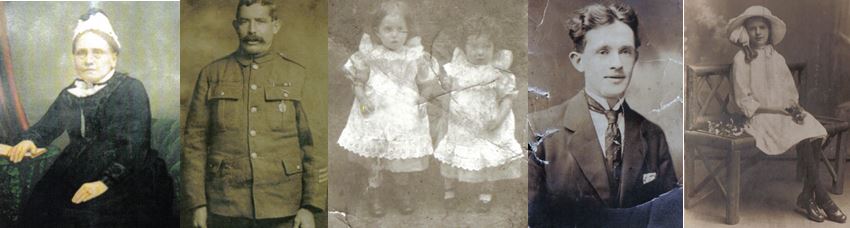
Name: Matthew Farrar
Rank: Private
Unit/Regiment: 11th (Service) Battalion (Lonsdale), The Border Regiment
Service Number: 33525
Date of Death: 3 October 1917
Cemetery: Zuydcoote Military Cemetery, Nord, France
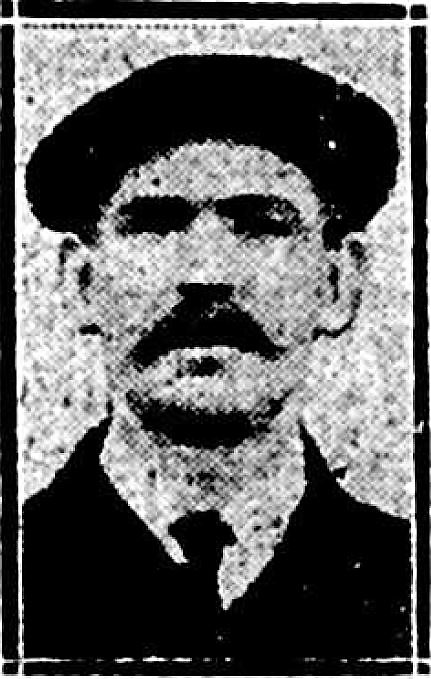
Matthew was the youngest of 10 children born to Matthew and Mary Farrar (formerly Pendergast). I will use Jnr and Snr to distinguish between son and father.
Matthew (Snr) was from an established Batley family, associated with the Parish Church. Mary was amongst those early waves of Irish migrants who came to the town in the mid-1850s, from the Charlestown area of County Mayo. Their marriage at Gomersal Register Office in April 1860 is probably reflective of these differences.1
Their eldest son, John, was born in November 1860 and baptised at St Mary of the Angels in the early years of the parish, some 10 years prior to the building we know today opening its doors.
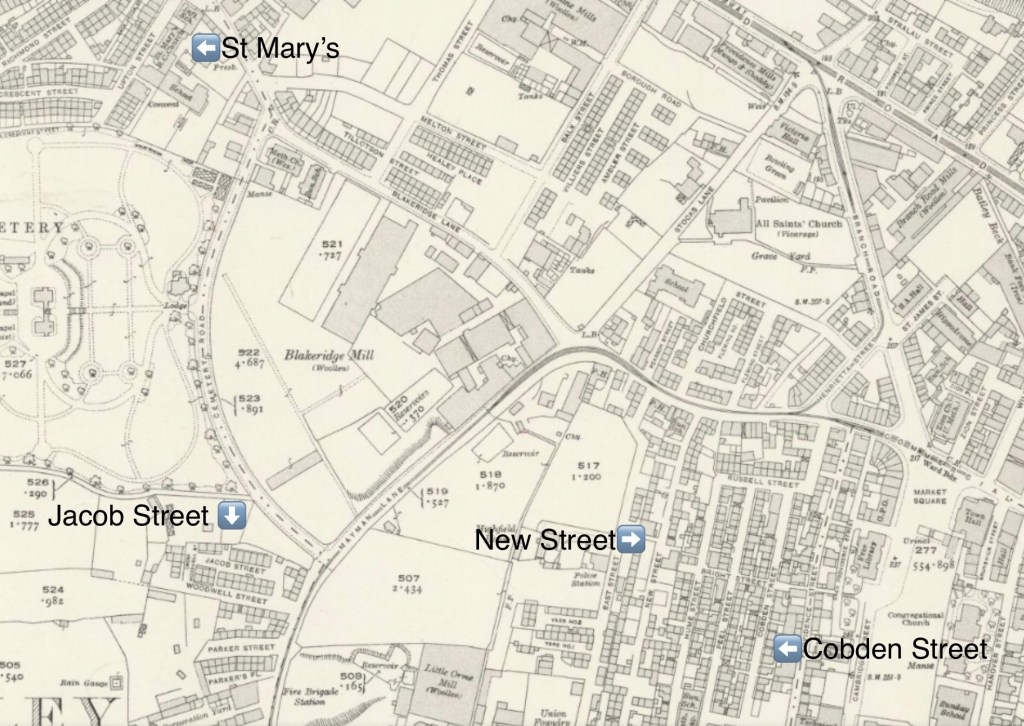
The 1861 census records the family living at New Street, along with Mary’s parents and siblings. It was a street Mary called home for seven decades. It was the street in which Matthew (Jnr) lived for most of his life.
On Christmas Day 1861 Mary gave birth to their second child, a son called Thomas. He survived for only three weeks and, in pre-Batley cemetery days, was buried in overcrowded Batley parish church burial ground.2 It was here third son William, born in July 1863, was buried at a similar age. In October 1864 daughter Susannah arrived. In 1867 the couple had another boy named Thomas. Then in 1869 Joseph was born. He died in August 1870, age 9 months, and was buried in Batley cemetery, which had opened a little under four years earlier. Mary Ellen was born in 1871, James in 1874, and George in 1876. The family was completed with the arrival of Matthew on 17 November 1879.3
Matthew (Snr), who died in 1899, worked predominantly as a willeyer in a woollen mill. The woollen industry provided employment for others in the family, including Matthew (Jnr). The 1901 census records him working as a woollen cloth finisher. This was also his occupation in the 1911 census, when he and his mother are shown as still living at New Street.
The year after this census, in July 1912, Matthew (Jnr) left the employment of Messrs. J., T. and J. Taylor’s Blakeridge Mills and emigrated to Canada.4 The move did not prove permanent. He remained for 17 months, returning home at Christmas 1913.5 Once back in Batley he took up work as a cloth finisher once more, this time with Messrs. G. H. Hirst and Co., at Alexandra Mills in Batley.6 This was his occupation when he enlisted, by which stage he and his mother had moved to Cobden Street.
Matthew (Jnr) attested on 11 December 1915, as the last day of registration under the Derby Scheme (15 December) approached.7 The Derby Scheme was introduced in October 1915 to try and bolster dwindling recruitment, after the first flush of volunteers in the early days of the war had dried up. It fell short of a compulsory conscription scheme, which would come in the following year.
Men who enlisted under the Derby Scheme received a day’s army pay on the day of attesting, and could choose to defer their service, be placed on the Army Reserve and return home to their families and jobs until called up. A grey armlet was given to them to denote they had volunteered. As part of the process the man was allocated into an assigned group according to his age and marital status, and this group would determine the basis of his eventual call up.
Matthew (Jnr) was eventually called up in August 1916.8 His papers describe him as being 5’ 9” tall and weighing 156lbs. He also had a hammer toe on both feet.9 In this condition, the second, third or fourth toes become permanently bent at the middle joint, resembling a hammer. The most common cause of it was ill-fitting shoes.
He was initially posted to the Royal Garrison Artillery (RGA), service number 113466, and went to No. 21 Company based in Leith to undertake coastal defence work.10 From there he went to the Heavy Artillery Depot at Woolwich in October.11 However, in November 1916 he was transferred nominally to the 21st Lancashire Fusiliers.12 In actuality, this home-based Reserve Battalion had recently been converted into the 72nd Training Reserve Battalion in the 17th Reserve Brigade.13 He was given a new service number, 37069.
Then, at the beginning of 1917, he was posted to France to join the 11th Border Regiment. This was also known as the Lonsdale Battalion, after the Earl of Lonsdale, the man instrumental in its formation in the early weeks of the war.
Matthew (Jnr) set sail from Folkestone and arrived in Boulogne on 4 January. From there he made the onwards journey to Etaples, before joining his Battalion in the field on 7 January.14 Private Farrar’s newly allocated service number was 33525.
It was in this frenetic period, marking the start of a New Year, that Matthew (Jnr) quickly jotted down his informal will. In it he left all his property and effects to his mother. In the event of her death, everything was to go to his sister Susannah Brook[s].15 Susannah had lost her son John, only a few months earlier, killed on the opening day of the Battle of the Somme. His story is here. Then, on Sunday 17 December 1916, Susannah’s husband Lawrence dropped dead whilst attending mass at St Mary’s. More details about that incident can be found here.
This was the background against which Matthew (Jnr) wrote his will. The death of his brother-in-law, a little over two weeks earlier, and the emotional (not to say financial) impact of this loss on his sister combined with the loss of her eldest son, clearly played on his mind as he scribbled down his wishes. Doubtless his own mortality was not far from his thoughts too.
In another touch, which will be relatable to many who have to date documents at the turn of a year, Matthew (Jnr) incorrectly dated his will as January 3 – 16, instead of the correct year of 1917.16
On 7 April 1917 the 11th Border Regiment moved to Holnon, around five kilometres from St Quentin, in northern France. On 12 April they were in the Front Line undertaking general work including making improvements to the trenches, fire positions and communication trenches. The Unit War Diary records nothing beyond this.17 But it was on this day that Matthew sustained a shrapnel injury.18 He subsequently wrote an upbeat and reassuring letter to his mother about his wounds.
I am sorry to tell you that I have been wounded in the left arm. It happened on Thursday, April 12th. I was struck by a piece of shell, but I am going on nicely so far. It is not so serious as I thought it was going to be, but I am a lucky man to have my arm left. However I don’t think it will be many months before I am all right again and on the war-path.19
He did quickly re-join his Battalion, only to sustain fatal injuries a few months later.
At the beginning of October 1917 the Battalion was in the line at the Lombardzyde Sector along the Belgian coast near Nieuwpoort, undertaking working party duties. It was on 2 October 1917 that Matthew (Jnr) was injured.20 The Unit War Diary notes that on this day one Other Rank was killed, and 14 more wounded.21
With serious shrapnel injuries to his head and leg, Matthew was transferred to the 36th Casualty Clearing Station (CCS). This was based further down the coast and over the border in France, in the village of Zuydcoote, some 10km north-east of Dunkirk.
CCS’s, manned by troops of the Royal Army Medical Corps, were part of the complex casualty evacuation chain. They were further back from the front line than the Regimental Aid Posts (the first port of call for injured soldiers) and Field Ambulance Advanced Dressing Stations, which were next in line in the evacuation process. After the Field Ambulance, most injured men were then transferred to the CCS. The role of the CCS was to retain all serious cases that were unfit for further travel, treat and return slight cases, and evacuate all others to a Base Hospital.
Matthew never made it out of the 36th CCS. He died on 3 October 1917, one of 23 deaths the CCS recorded that day.22
The Sister-in-Charge wrote to Matthew’s mother, who by now was living at Jacob Street, Woodwell, with married daughter Mary Ellen Travers. The letter said:
It is with much regret I tell you that your son died in hospital a short time after admission on Oct. 3rd. Your poor lad sustained fatal wounds in the head and leg, and was quite hopeless.23
The letter was followed by the official War Office notification.
Matthew is buried in Zuydcoote Military Cemetery.

A poignant postscript is that amongst his service records is a copy of a letter from the Army dated March 1918 to Matthew’s mother. It itemises his personal effects and asks his mother to acknowledge receipt of them, which she did in July 1918. His returned possessions were few but provide an evocative testament to the life of a soldier. They consisted of one photo, two religious books, three razors in cases, one compass and chain, one pocket manicure set, two combs, one pair of scissors, one cap badge, one rosary, one nayon bracelet,24 one metal ring, one locket, one purse and one bag.25
His family remembered him in the newspaper on the anniversary of his death. The Batley News of 5 October 1918 included verses from both his brother James and his mother. His mother’s notice read:
In ever loving memory of my dear son, Private Matthew Farrar, 33525 11th Border Regiment, who was killed in action Somewhere in France, October 3rd, 1917, aged 36.
It’s only a mother who knows the sorrow,
It’s only a mother who knows the pain,
Of losing a son she loved so well,
And knows she will never see him again.
A lonely grave in France where a brave
hero sleeps,
There’s a cottage home in England where
a mother sits and weeps.
From his broken-hearted mother, New Street, Batley.26
This was the only In Memoriam tribute in the newspaper to him from his mother. Mary Farrar died the following March. She outlived her daughter, Susannah, who died in November 1918
Matthew was awarded the Victory Medal and British War Medal.
In addition to St Mary’s (where his name is incorrectly recorded as Mathew Farrer), he is also remembered on the Batley War Memorial. Both Fr Lea from St Mary’s and his brother, James, put his name forward for inclusion on the latter.
Postscript:
Finally a big thank you for the donations already received to keep this website going. They really do help.
The website has always been free to use, but it does cost me money to operate. In the current difficult economic climate I do have to consider if I can continue to afford to keep running it as a free resource.
If you have enjoyed reading this post (along with the hundreds of others), and would like to make a donation towards keeping the website up and running in its current open access format, it would be very much appreciated.
Please click 👉🏻here👈🏻 to be taken to the PayPal donation link. By making a donation you will be helping to keep the website online and freely available for all.
Thank you.
Footnotes:
1. Leeds Times, 14 April 1860.
2. Batley Parish Church Burial Register, West Yorkshire Archive Service (WYAS), Ref: WDP37/42.
3. Batley St Mary of the Angels Baptismal Register.
4. There is a possibility this was his second foray into Canadian migration. There is a possible migration record showing a Matthew Farrer arriving at Quebec from Liverpool on the Megantic on 28 July 1912, which indicates an earlier excursion in around 1906. This is yet to be confirmed. Ref Library and Archives Canada; Ottawa, Ontario, Canada; Series: RG 76-C; Roll: T-4789.
5. Batley News, 13 October 1917.
6. Batley Reporter, 12 October 1917 and Batley News, 13 October 1917.
7. Soldiers’ Documents First World War, Burnt Records, The National Archives (TNA), WO363.
8. Ibid.
9. Ibid.
10. Ibid.
11. Ibid.
12. Medal Award Rolls, TNA, Ref: WO329/1232 and Burnt Records, Ibid.
13. Burnt Records, Ibid. Changes to the Training Reserve (TR) were introduced to cope with the large numbers of conscripts. So from 1 September 1916 men posted to the TR’s were not allocated to a specific regiment.
14. Burnt Records, Ibid.
15. Matthew Farrar’s informal Soldiers’ Will.
16. Ibid.
17. 11th Border Regiment Unit War Diary, TNA, Ref WO95-2403-1.
18. Burnt Records, Ibid.
19. Batley Reporter, 27 April 1917. The report incorrectly states him to be in the RGA.
20. Burnt Records, Ibid.
21. 11th Border Regiment Unit War Diary, Ibid.
22. 36CCS Unit War Diary, TNA, Ref WO-95-344-9_02.
23. Batley News, 13 October 1917.
24. This is the correct spelling, as noted three times in the document. However I do not know what a Nayon Bracelet is.
25. Burnt Records, Ibid.
26. Batley News, 5 October 1918. I suspect the New Street address given for Mary here relates to where son James, who also had a remembrance piece in the paper to his brother, was living.
Other Sources:
• Batley Cemetery Burial Registers.
• Censuses, 1861 – 1911.
• GRO Birth, Marriage and Death Indexes.
• Long, Long Trail, https://www.longlongtrail.co.uk/.
• Medal Index Card.
• Newspapers – various editions of the Batley papers.
• Pension Record Cards and Ledgers, Western Front Association.
• Soldiers Died in the Great War.
• Soldiers’ Effects Register.


 Past To Present Genealogy