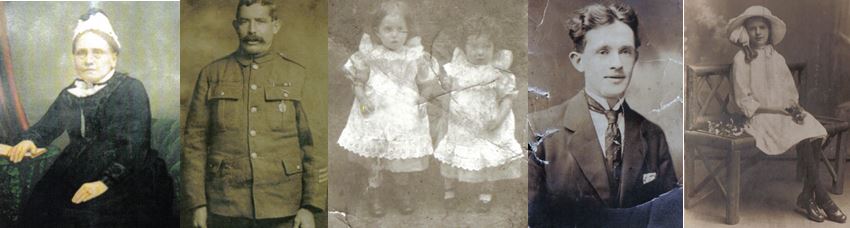
Name: James Hughes
Rank: Lance Corporal
Unit/Regiment: 4th (Extra Reserve) Battalion, The South Staffordshire Regiment
Service Number: 203612
Date of Death: 28 January 1918
Cemetery: Dernancourt Communal Cemetery Extension, Somme, France

James Hughes was born in Batley on 28 March 1887 and baptised at St Mary’s 13 days later. His parents were John Hughes, from Ballina in County Mayo, and his wife Ellen (née Kane)1 from Newport, County Mayo.
John and Ellen had ten children, including James.2 Their birthplaces track the various places the family lived before settling in Batley.
Initially the family lived in Scotland. It was here John and Ellen married in 1870, in the St George’s area of Edinburgh. The following year their eldest son, Richard, was born in the town of Queensferry, about nine miles to the west of Edinburgh. Daughter, Ellen, was born in Lasswade, nine miles south of Edinburgh, in 1874.
The couple’s next identified child, Thomas, was born in England in January 1876, in the West Ardsley area.3 This fell within the parish of Batley St Mary of the Angels, so he became the first in the family to be baptised at the church. But John’s coal-mining job meant plentiful job opportunities, and the following year daughter Mary Ann was born in another coal-mining area, Castleford, as was son John Patrick in 1880. The 1881 census confirms the family’s Castleford abode, at Nicholson Street.
By April 1883 the Hughes family were in Batley, living at Hume Street – the street the couple were to call home for the rest of their lives.4 But the spring of 1883 was a challenging time for John and Ellen, with a roller-coaster of emotions. Ellen was in the final weeks of pregnancy. On the 27 April two-year-old John Patrick, their youngest child, died. He was buried in Batley cemetery the following day. Just over two weeks later Ellen gave birth to son, Martin.
James was their next child, followed by daughter Annie in 1891 and last of all, in 1896, son Henry (known as Harry).
James attended St Mary’s school but by the time of the 1901 census he was working, described as an engine road lad in a coal mine working underground. However, 10 years later he had switched industries, to work in the one Batley was renowned for – the textile industry. He was now employed as a warp man in the woollen manufacturing industry.
It was after this switch that, on 14 September 1912, he married Elizabeth Ann Kelly at St Mary’s, the church where James was described as an active member. The daughter of Michael and Elizabeth Kelly, she too was a St Mary’s parishioner, baptised in the church in September 1886, two weeks after her birth. The couple made their home at 17, Victoria Street, Carlinghow. Outside of church he was, like several other parishioners, a member of Carlinghow Working Men’s Club, local to his marital home.
James continued in the textile trade, working his way up. Before enlisting, he was a foreman weftman at Messrs. J. Newsome and Sons, Batley Carr. This meant he was in a position of responsibility, in charge of the weft room. This was part of the weaving process, with the weft being the horizontal thread and yarn making up the main body of a fabric. He was responsible for ensuring the correct weft was given to the weavers, weighing cases of yarn from the spinners, making sure the grades and fineness of it was in the correct places, and checking the delivery of goods.
But in the early hours of 4 October 1916 fire broke out at the Bradford Road Victoria mills of J Newsome and Sons. Busy with army contracts producing khaki cloths for overcoats, up until early September the mill has been working night and day. Enlistment though had reduced the firm’s employees to around 300, and the night shift was abandoned with work finishing at 8pm.
The fire, described as one of the most disastrous to occur in the district for some time, caused around £70,0005 worth of damage. Occupying an extensive plot in the Jack Lane/Bradford Road area, it mainly affected the older four-story Victoria Mills building which had around 100 yard frontage abutting Bradford Road. This main Batley/Dewsbury thoroughfare was closed for a time due to the massive amount of masonry which came down. Even the tram wires and lines were affected.

The fire caused the destruction of most of the spinning and weaving machinery; all the warping plant, together with the yarn, was burnt out; and the finishing department was gutted. Swathes of employees were thrown out of work, though it was hoped some would quickly be back utilising the unaffected parts of the mill, and in buildings loaned by other manufacturers.6
The map below, drawn up in 1915 and published in 1922, shows the location – the Victoria Mill site is now better known as Redbrick Mill.

Revised: 1915, Published: 1922 showing Victoria Mills – Re-use: CC-BY (NLS)
A foreman was a skilled position and could explain why James had, up until now, remained in civilian life. Perhaps the fire, and a possible subsequent period out of work, changed this balance of worth tipping it towards military service. For in May 1917 James joined the army. He went out to France about four months before his death.
Serving with the 4th Battalion of the South Staffordshire Regiment, he landed with them at Le Havre on 10 October 1917. Three days before, he had written an informal will stating that in the event of his death he gave the whole of his property and effects to his wife.7

Initially a Private, by January 1918 he was a Lance-Corporal.8 From the middle of that month the Battalion were operating out of Lagnicourt Camp, providing working parties. Towards the end of the month James became so unwell he required urgent medical attention.
On 28 January 1918 Elizabeth Ann received a telegram informing her that James was lying seriously ill in a Casualty Clearing Station (CCS) in France and could not be visited. This was followed by a second telegram on 1 February which informed Elizabeth that her husband had, in fact, died on 28 January.
His place of death, that warm and sunny January day, was 56 CCS (1/1st South Midland). They were based at Dernancourt, a village three kilometres south of Albert, on the Somme. But it was also christened ‘Edgehill’, due to the rising ground on the north-west.
Elizabeth also received a letter from the sister in charge which gave her more details. James had been admitted to the CCS in an unconscious condition. He never regained consciousness, and died two days later peacefully and without any pain. The cause of death was cerebro-spinal meningitis. The sister added that:
He will be buried in the little British Cemetery besides this hospital, where lie so many brave lads who have given up their lives in this dreadful war.9
This cemetery was the one in which James lies at rest today, Dernancourt Communal Cemetery Extension.

His mother, Ellen, had been widowed in July 1916. Her husband, John, who was described as feeble and rather lame in one leg, had retired from mining. On Sunday 2 July 1916 he fell down the steps of the Batley Irish National League Club, when it was believed the ferrule of his walking stick had caught in one of the knots in the wooden stairs. He was carried home unconscious, and died the following day as a result of a huge fracture. The fracture extended from his skull base to his forehead, and caused a brain haemorrhage.10
Whether the distress of the news of her son’s death had an impact, but less than a week after receiving it, on 7 February 1918 Ellen Hughes died.
James was awarded the Victory Medal and British War Medal.
In addition to St Mary’s, he is also remembered on the memorials of St John’s Carlinghow, and Carlinghow Working Men’s Club. He is also commemorated on the Batley War Memorial, with both his widow and brother, Martin, submitting his name. His name was also on the list of parishioners submitted to the War Memorial committee by St Mary’s parish priest Fr Lea.
Elizabeth Ann was awarded a war widow’s pension. Working as a rag sorter in the years following James’ death, she died on 8 March 1947. She never moved from the 17 Victoria Street, Carlinghow home, she shared with James in their all too short married life together.
Postscript:
Finally a big thank you for the donations already received to keep this website going. They really do help.
The website has always been free to use, but it does cost me money to operate. In the current difficult economic climate I do have to consider if I can continue to afford to keep running it as a free resource.
If you have enjoyed reading this post (along with the hundreds of others), and would like to make a donation towards keeping the website up and running in its current open access format, it would be very much appreciated.
Please click 👉🏻here👈🏻 to be taken to the PayPal donation link. By making a donation you will be helping to keep the website online and freely available for all.
Thank you.
Footnotes:
1. Spelling variants included, Cain, Cane, Kain and Kaine.
2. I have identified nine of them.
3. Some sources merely state Ardsley, others vaguely say near Tingley. His baptism record says W. Ardsley.
4. This is the address given in the Batley Cemetery Burial Register for the interment of son, John Patrick.
5. Estimates ranged between £50-£80,000. But several newspapers quoted the £70,000 figure.
6. Sources of information for the fire included the Yorkshire Evening Post of 4 October 1916, the Leeds Mercury of 5 October 1916, the Batley Reporter of 6 October 1916, and the Dewsbury District News of 7 October 1916.
7. James Hughes’ will, dated 7 October 1917.
8. Some sources give his rank at death as Private. Others, like the Commonwealth War Graves Commission (CWGC) and his pension records, state Lance-Corporal.
9. Batley News, 9 February 1918.
10. Batley Reporter, 7 July 1916 and Batley News, 8 July 1916.
Other Sources:
• 1939 Register, England & Wales.
• A Dictionary of Occupational Terms: Ministry of Labour. Based on the Classification of Occupations Used in the Census of POPULATION, 1921. His Majesty’s Stationery Office, 1927.
• Batley Cemetery Burial Registers.
• Censuses, England and Wales, 1881- 1921.
• Commonwealth War Graves Commission website.
• GRO Birth, Marriage and Death Indexes.
• Medal Award Rolls.
• Medal Index Card.
• Newspapers – various.
• Parish Registers – various.
• Pension Record Cards and Ledgers, Western Front Association.
• Scotlands People.
• Soldiers Died in the Great War.
• Soldiers’ Effects Register, National Army Museum.
• The Long, Long Trail website, https://www.longlongtrail.co.uk/.
• Unit War Diary, 4th South Staffordshire Regiment, WO 95/2244/2.


 Past To Present Genealogy