
Name: James Gavaghan
Rank: Private
Unit/Regiment: 1st Battalion, The Prince of Wales’s Own (West Yorkshire Regiment)
Service Number: 3/8833
Date of Death: 10 August 1916
Cemetery: Englebelmer Communal Cemetery, Somme, France
James Gavaghan is one of three brothers killed in the First World War who are commemorated on the St Mary’s church War Memorial. Born in Batley on 29 July 1888, his parents were James and Catherine Gavaghan (née Lynch), both from Charlestown, in County Mayo.1 However it was at Batley St Mary’s that the couple married, in June 1883.
Sharing the same name as his father, James was one of their eight children. Five were alive at the time of the 1911 census. In addition to James, these were Mary (born in 1890), Thomas (born in 1893), John (born in 1895) and Peter (born in 1897). Another son named John was born and died in 1887.
In 1891 the family address was Churchfield Terrace, Batley but subsequent censuses saw them living at 10, Ambler Street, Batley.
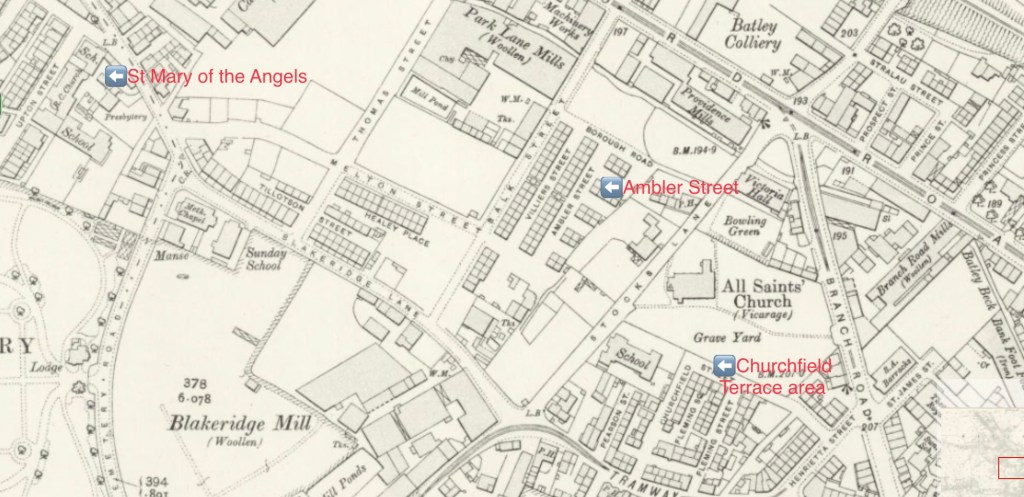
James (Snr) worked as a wool willeyer according to the 1891 and 1911 censuses. A willeyer (with spelling variants including willier) was someone who worked at a willeying machine, cleansing and separating wool in preparation for carding. However, he was not continuously employed in the textile industry as, according to the 1901 census, he worked as a farm labourer. Catherine’s occupation in the 1891 and 1901 censuses was recorded as a rag sorter.
James went to St Mary’s school, although his attendance was not unblemished. For example, in June 1899 his father was fined for failing to send James and his younger sister, Mary, to school.2
In particular some saw education as less important for girls. In other St Mary’s cases heard that day Mrs Trayner said she thought her daughter had as much education as would do her any good in this country “for it was not a lady she was wanting to make her.” Mary Gallagher’s mother said it it seemed to her that they wanted the girls to go to school until “they started courtin’” Girls were often kept out of school to help at home, or to go out to work. Boys were often kept out if work was available.
After leaving school, James went into the coal mining industry. He was employed as a miner at Bruntcliffe colliery when, on 30 January 1906, he signed for the 3rd Duke of Wellington’s (West Riding) Regiment. This was part of the Militia, a part-time voluntary force, and not a regular Army battalion.
Like many lads he was clearly a keen football player because on his Militia attestation papers in answer to a question asking if he had ever been sentenced to imprisonment by any civil power he answered no, but declared that he had received a fine of 2/6 for playing football in the streets.3
His physical description given on these papers states he was a shade over 5’6” weighing 121lbs, had a fresh complexion, black hair and eyes. He was discharged days later because he was said to be unfit.4
On 11 September 1909 he married Catherine Donlan at Batley, St Mary’s. She was the older sister of Thomas Donlan, another St Mary’s parishioner who would be killed in action during the war.
Within days of their marriage, their first son was born. The baby, named James, lived for only 18 months. He was buried in Batley cemetery on 29 March 1911. The 1911 census, taken only a couple of days later, records miner James and wife Catherine, a rag sorter, living at 17, Ambler Street, and notes the death of their only child. Catherine was pregnant at the time of this census, and son Peter was born that May. In the August of 1913 daughter Mary was born.
The following August, within a week of war being declared, James was called up as a Reservist. Leaving his coal mining employment at Soothill Wood Colliery,5 he rejoined his regiment, which was now the West Yorkshire Regiment (Prince of Wales’s Own). He had proved wrong his 1906 West Riding Regiment Militia discharge for being unfit. From dates given in newspaper reports it seems that soon after his initial Militia discharge he managed to re-enlist, and was with the Militia in 1907 when major reforms to the Army structure took place.6
Instigated by Secretary of State for war Richard Haldane, part of his eponymously-named Haldane reforms included the creation of a Special Reserve to provide a pool of trained men who could be called upon to reinforce the Regular Army in the event of war. Alongside the introduction of the Special Reserve, the Militia was terminated as a force, with many of the existing units converted to Special Reserve Units. James’ service number prefix indicates he was part of the Special Reserve.
These Special Reserve men undertook an intensive period of initial training, topped up by annual camps to refresh their skills. It meant that following his August 1914 call-up, after three weeks training on home soil, James was deemed sufficiently well-trained to be drafted to France.
He landed there on 25 September 1914, and was transferred onwards to serve with the West Yorkshire Regiment’s 1st Battalion. The Battalion received two batches of reinforcements in the days after James disembarked on French soil. These were on 27 September and 5 October, so it is logical to assume James was amongst these men.7
One newspaper reported that for about six months of his two years’ service on the continent he was temporarily attached to the Royal Engineers.8 This is not noted on any of his surviving military records. It is possible the newspaper report meant that he was simply assigned to his Battalion’s working parties for them.
In addition to James, brothers Thomas, John and Peter were also in the Army. Thomas served with local Territorials, the 1st/4th King’s Own Yorkshire Light Infantry. John and Peter both enlisted with the King’s Own Scottish Borderers.
In 1915 James was wounded in the back, but he quickly recovered from his injury and returned to the trenches without the need to return home to England. He did however manage a period of home leave at Christmas time in 1915.9
On 1 July 1916, the commencement of the Battle of the Somme, the 1st West Yorkshire’s were operating on the now much quieter Ypres Salient. At the beginning of August though they made the move south to join the Reserve Army on the Somme.
On 2 August they entrained at Doullens, reached Orville the next day, Acheux on 4 August, and arrived at Mailly-Maillet on 6 August. They did not have long to acclimatise. After being served dinner, they immediately took over trenches from the 3rd Worcestershire Regiment near Mesnil, the relief being completed by 7pm that evening. They remained in the trenches until 9 August during which time two men were killed and another ten sustained wounds.
On 9 August they were replaced in the trenches by the 1st Battalion The Buffs, the relief being completed by 4.30pm without incident. From there the 1st West Yorkshires returned to billets in the Somme village of Englebelmer where they were in Brigade Reserve. Behind British front lines throughout the war, Englebelmer, though relatively safe, was liable to occasional shelling.
On 10 August between 9pm and 10pm the village suffered one of these infrequent periods of enemy bombardment, during the course of which one man was killed and another wounded.10 James was the man to lose his life.
On Wednesday, 23 August James’ mother Catherine received official news that the second of her four soldier sons had fallen in action.11 His wife sought, and received, further details about the manner in which her husband lost his life. In answer to a letter from her, an officer replied as follows:
I regret to say that your husband was killed by a shell on the night of August 10th, near his billet. His death was instantaneous. I cannot say whether anyone saw him fall or not, as the village was being shelled at the time, and the majority of men were under cover. He is buried in a civil cemetery near the village where he was killed, and where the bodies of other men of the Regiment lie, and a cross has been erected on his grave.12
In a personal letter to James’ widow, the Colonel of the Regiment wrote:
I cannot tell you how sorry I am at your and our great loss. Your husband did his duty nobly, and you can be very proud of him. His death was pure chance. The village where we were resting was suddenly shelled at night. All ran to their cellars, as ordered, but your husband was hit by a piece of shell just as he was running down the stairs to his cellar. We are not allowed to mention names, but if you write to —–, they will tell you the name of the village and the exact position of his grave. – Yours, with much sympathy.13
The cemetery in which he was laid to rest is Englebelmar Communal Cemetery.

On 24 June 1916, only weeks before he died, James wrote an informal will in which he stated:
In the event of my death I leave all I possess to my wife Cathrine [sic] Gavaghan No9 Fleece Street, Batley, Yorkshire, England.14
Because it was written whilst James was categorised in actual military service, it was recognised as a valid will.
Additionally, Catherine was awarded a pension for her and her two children for the loss of James. Initially set at 18s 6d per week, it was increased to 22s 11d a week from 4 April 1917. However, when she married miner Thomas Stenchion at St Mary’s on 7 February 1918, Catherine forfeited her portion of the pension, though she was paid a one-off marriage gratuity sum of £35 3s 3d, and payments to the children continued till they reached the age of 16.15
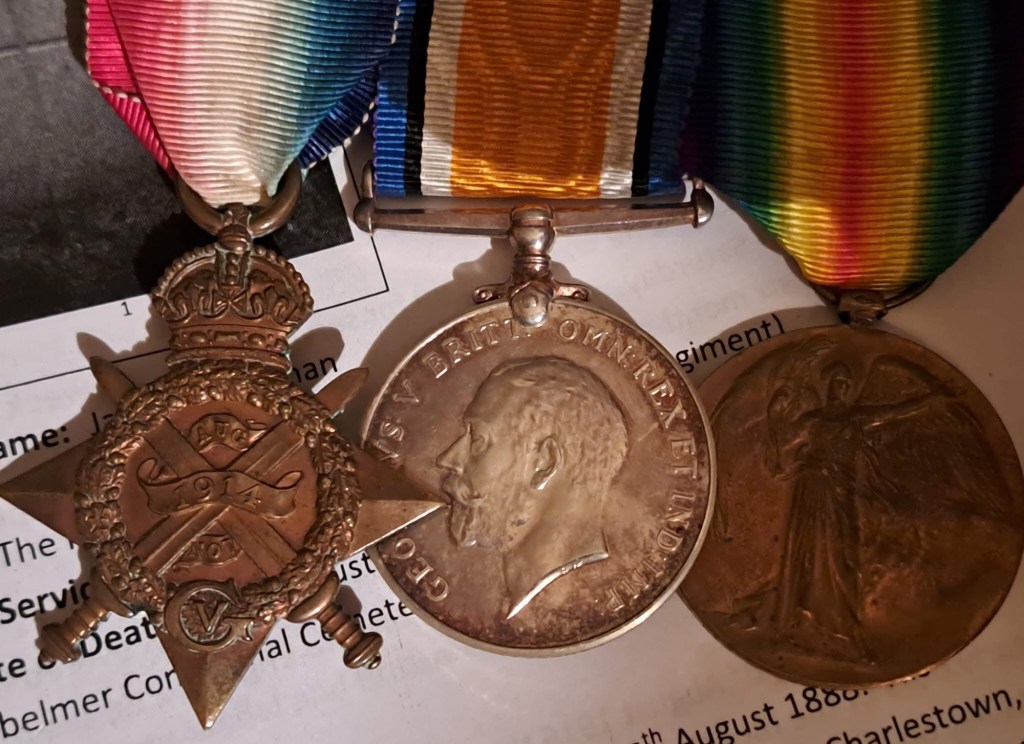
In terms of campaign medals, James was posthumously awarded the 1914 Star, Victory Medal and British War Medal. These are shown in the photographs below.

Of the four Gavaghan brothers, only John survived the war. Thomas’ biography can be found here. I will write Peter and John’s in due course. In addition, cousins Joseph and Peter Gavaghan also died, and they too are on the St Mary’s War Memorial.
The Second World War brought further family losses. James and Catherine’s son, Peter, was killed in the days after the Normandy landings of June 1944. Then in June 1945, a month after the war ended in Europe, Catherine faced yet another war tragedy when her teenage son Bernard Stenchion was killed in an accident whilst serving with the Army Air Corps.
Postscript:
I may not be able to thank you personally because of your contact detail confidentiality, but I do want to say how much I appreciate the donations already received to keep this website going. They really and truly do help. Thank you.
The website has always been free to use, and I want to continue this policy in the future. However, it does cost me money to operate – from undertaking the research to website hosting costs. In the current difficult economic climate I do have to regularly consider if I can afford to continue running it as a free resource.
If you have enjoyed reading the various pieces, and would like to make a donation towards keeping the website up and running in its current open access format, it would be very much appreciated.
Please click 👉🏻here👈🏻 to be taken to the PayPal donation link. By making a donation you will be helping to keep the website online and freely available for all.
Thank you.
Footnotes:
1. This birthplace is taken from the 1911 census, with the 1891 and 1901 indicating Ireland generally.
2. Batley Reporter and Guardian, 23 June 1899.
3. The apparent newspaper report of this misdemeanour, as covered in the Batley Reporter and Guardian of 29 August 1902, states the fine was for throwing stones in Borough Road. This was becoming a growing nuisance, and James along with James Foley were brought to court for it in attempt to deter others.
4. James Gavaghan’s Militia Attestation Papers, The National Archives (TNA), Ref: WO96/617/326
5. Batley News, 26 August 1916.
6. Ibid.
7. Wyrall, Everard. The West Yorkshire Regiment in the War, 1914-1918. A History of the 14th, the Prince of Wales’ Own (West Yorkshire Regt.) and of Its Special Reserve, Territorial and Service Battns. in the Great War of 1914-1918. Volume 1 1914-1916. Vol. 1. 2 vols. London: John Lane The Bodley Head Limited, 1924.
8. Batley Reporter and Guardian, 25 August 1916.
9. Ibid.
10. 1st Battalion West Yorkshire Regiment Unit War Diary, TNA, Ref: WO95/1618/2.
11. Batley Reporter and Guardian, 25 August 1916.
12. Batley Reporter and Guardian, 15 September 1916.
13. Ibid.
14. James Gavaghan’s will.
15. WWI Pension Record Cards and Ledgers, Western Front Association, Ref: 076/0353/Gau-Ged
Sources:
• 1891 to 1921 Censuses (England & Wales).
• 1939 Register (England and Wales).
• Batley Cemetery Burial Registers.
• Batley St Mary of the Angels Parish Registers.
• Commonwealth War Graves Commission.
• General Register Office Indexes.
• Medal Index Cards & Medal Award Rolls.
• National Library of Scotland Maps.
• Newspapers – various editions of the Batley News and the Batley Reporter and Guardian.
• Soldiers Died in the Great War.
• Soldiers’ Effects Registers.
• The Long, Long Trail – The British Army in the Great War 1914-1918: https://www.longlongtrail.co.uk/


 Past To Present Genealogy