
Name: James Edwards
Rank: Private
Unit/Regiment: 9th (Service) Battalion, The Cameronians (Scottish Rifles)
Service Number: 14186
Date of Death: 22 July 1918
Cemetery: La Kreule Military Cemetery, Hazebrouck, Nord, France

James Edwards was born in Batley on 3 October 1894, the son of widowed rag sorter Catherine Edwards (née Dolan), who was born in Mansfield. More usually known as Kate, she was the third wife of gardener and farm labourer David Edwards, who died in March 1891. Kate married David in 1884, and the couple’s two daughters, Mary Ann and Kate, were born in 1887 and 1888, half sisters to David’s eldest daughter Lydia.
Following David’s death, Kate and her children lived on Ambler Street, in the Skelsey Row area of Batley. This was the street James called home throughout his life, and even after her son’s death Kate remained here, only briefly going to New Silksworth, Sunderland to spend time with her married daughter, Mary Ann Weaver.
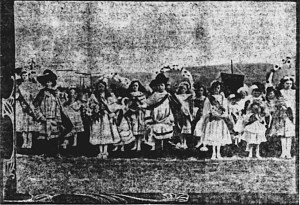
He attended St. Mary of the Angels R.C. school, and was one of the children who controversially represented them in the 1907 Batley pageant, which celebrated the successful fundraising efforts to build an extension to Batley Hospital. James was one of 14 boys dressed as fishermen, each carrying a fishing net and wearing dark blue smocks, red capes with tassels. 11 years later five of those boys – including James – were dead, killed in the War.
In 1911, having left school, 16-year-old James was employed as a coal miner (hewer). However in December 1912 James enlisted with the Regular Army, describing himself as a general labourer. He had tried to enlist previously, but was rejected because his heart had been affected by smoking. However, his application in December 1912 proved successful, and he was passed fit. He was attached to the 3rd Battalion King’s Own Yorkshire Light Infantry (KOYLI), the Regiment’s training battalion.
His papers described him as 5’5½” tall, weighing 127lbs with a fresh complexion, hazel eyes and dark brown hair. He had three small scars on his left knee cap and two scars on the left side of his neck.
Despite signing up for a period of 12 years, seven with the Colours and a further five in the Reserve, he lasted only 94 days. He was discharged Free under Article 1058 of the King’s Regulations. Essentially this meant that the Army were satisfied that his mother, or other near relatives, were in a destitute condition and in need of his support, and that he had the prospect of obtaining suitable employment. It also meant they were satisfied that he could not pay a fee to purchase his discharge. He returned home to work in the coal industry, employed at Howley Park Colliery.
James enlisted once again in the early days of the war, serving first of all as a Private with 10th Battalion, The Cameronians (Scottish Rifles). Later in his military service he would be with the 2nd Scottish Rifles,1 and latterly with the 10th Scottish Rifles.
After an initial period in Scotland, he was based at Bordon Camp, Hampshire. From here he wrote the following letter, which illustrates the problems with issuing clothes and equipment to the massive influx of new recruits in the early days of the war:
I am in good health, so far, and hope you are the same. I have not received your letter yet, but I have written for it to be sent on. I was removed the night after I wrote to you. We left Scotland about 8.30 on Saturday night for Bordon Camp, on the other side of London. [Bordon was around 53 miles south-west of London.] I am still in civilian clothes, but we have got boots, socks, and shirts to be going on with, and I don’t think we shall be long before we get our other clothes now. There are no music halls here – it is a country place. I hope you had a good Feast: I was thinking about it in the train as we rode for 15 hours.2 [Batley Feast week commenced on Saturday 12 September 1914, though many of the mills did not close this year, because of the need to fulfil urgent Army orders.]
After Bordon, James’ battalion moved to billets in Winchester in February 1915, and then in April 1915 to Park House and Chisledon Camps on Salisbury Plain.
In early July the orders finally came for them to go to France, with James disembarking at Boulogne on 11 July.
Those first days overseas were spent acclimatising and gaining experience in trench warfare, in preparation for the Battalion’s first major Battle, that of Loos. This battle was the first time the British used poisoned gas on the Western Front. It was also the first large scale British offensive action of the war. On 25 and 26 September 1915, the 10th Scottish Rifles participated in the assault on Hill 70, which at was a strategic observation point over the flat, surrounding plains of industrial northern France. In total the Battalion’s other ranks losses in the Battle of Loos were 63 men killed, 318 wounded and 239 missing.3 James’ name though was not amongst them.
He was not so lucky in 1916, and the Battle of the Somme. A representative selection of several types of medical records from various theatres of war were retained, and amongst them is an entry for James Edwards showing that on 24 August 1916 he was admitted to to 39 Casualty Clearing Station, which dealt with infectious diseases, suffering from diarrhoea.
It proved only a brief hospital sojourn. He was soon back on the front line, for he appears in a War Office official daily casualty list dated 23 September 1916 as wounded, suffering from shell shock.
There is no indication as to the date of the event which caused this, but looking at the Unit War Diary for the 10th Scottish Rifles, the 15 September assault to capture Martinpuich village is a strong possibility. This day is noteworthy as it marked the entry into war of a new weapon, tanks. Although of the four assigned to the 15th Scottish Division, under whose command 10th Scottish Rifles fell, only two materialised – of which one broke down on its way into position for the assault, and the other was said not to have been of much assistance.4
Initially the battalion sustained few casualties, and the village was successfully occupied with very little resistance. But once the Germans had recovered from the initial surprise, intense artillery and machine gun fire rained down on the battalion reducing it to just 100 men and two officers.5
James appears on another War Office casualty list on 27 November 1916, again wounded, suffering from shell shock. It is less clear when this incident took place. There is nothing of note in the 10th Scottish Rifles Unit War Diary. It also seems improbable that he had transferred to the 9th Scottish Rifles at this point, as their Unit War Diary is similarly devoid of action throughout November 1916. The most likely scenario is he was now with the Regiment’s 2nd Battalion, who were in the field under fire for periods of November 1916, and did incur casualties during this time.
James was home on leave in the early summer of 1917. He did not return to his unit on the required date and, as a result, he found himself before the Batley magistrates on 4 June charged with overstaying his leave. He was remanded to await a military escort.6
Perhaps this home visit made James consider his future. For on 16 June 1917 he wrote his informal will leaving the whole of his property to his mother in the event of his death.
He did have a further period of leave, following which he returning to France in April 1918. It was his final time in Batley.
In mid-July 1918, James was serving with the 9th Scottish Rifles. The Battalion was operating in the Meteren area of northern France, near the border with Belgium. On 19 July the 9th (Scottish) Division, of which the 9th Scottish Rifles formed part, were involved in the re-taking of Meteren from the Germans.
Their War Diary for the period around the time of James’ death shows that whereas on 19 and 20 July they did suffer casualties, both wounded and dead, the following two days were relatively quiet. On 21 July the various companies of the Battalion were repairing trenches and providing salvage parties. Reports from them said all was very quiet during the day.7
The following day, the diary says that enemy artillery was very active, and that about 100 shells fell between the hours of 10.30pm and 4am. Reports from all companies stated heavy shelling during the night. The only deaths mentioned in the diary were those of 2nd Lt. Spiers and two men who were killed by a direct hit on a trench at 1.45am.
This number of casualties, and dates, seems at odds with Commonwealth War Graves Commission (CWGC) records, with nine men in the Battalion recorded as dying on 22 July 1918, four buried in the same cemetery as James. It’s unlikely all nine died from wounds. The CWGC records also record the death of 2nd Lt. Spiers as 23 not 22 July, as per the War Diary.8 So, as is often the case, it seems the fog of war has impacted on record keeping, with the CWGC and all other official documents record James as being killed in action on 22 July 1918.

James is buried in La Kreule Military Cemetery in the hamlet of La Kreule, just north of Hazebrouck in Nord, France. His headstone also has the religious inscription ‘May He Rest In Peace Amen’. At the time the Imperial War Graves Commission, forerunner to the Commonwealth War Graves Commission, charged a fee of 3½d. (pence) per letter for British Army casualties, which deterred many poorer families from having one. This simple inscription cost Kate Edwards 5s. 10d.
In terms of financial provisions for his mother after his death, his Soldiers’ Effects entry shows the War Office paid her £6 16s. 10d., which was probably James’ wages. She was also awarded a War Gratuity of £18 19s. Alongside this, until her death in February 1932, she received a modest weekly pension for the loss of her son.
James was awarded the 1914-15 Star, Victory Medal and British War Medal. In addition to St Mary’s, he is also remembered on Batley’s War Memorial, with both his mother and Father Lea submitting his name to the Committee. He is also remembered on the Scottish National War Memorial in Edinburgh Castle.
I wanted to write this post for Remembrance Sunday, not only in honour of James but also in honour of his nephew, Joe, who served in World War II, including the Normandy Landings on D-Day +3, and who died in 2022.
Postscript:
I may not be able to thank you personally because of your contact detail confidentiality, but I do want to say how much I appreciate the donations already received to keep this website going. They really and truly do help. Thank you.

The website has always been free to use, and I want to continue this policy in the future. However, it does cost me money to operate – from undertaking the research to website hosting costs. In the current difficult economic climate I do have to regularly consider if I can afford to continue running it as a free resource.
If you have enjoyed reading the various pieces, and would like to make a donation towards keeping the website up and running in its current open access format, it would be very much appreciated.
Please click here be taken to the PayPal donation link. By making a donation you will be helping to keep the website online and freely available for all.
Thank you.
As a professionally qualified genealogist, if you would like me to undertake any family, local or house history research for you do please get in touch. More information can be found on my research services page.
Footnotes:
1. Medal Award Rolls, Victory and British War Medal, The National Archives (TNA) , Reference: WO329; Ref: 1120
2. Batley News, 03 October 1914.
3. Stewart, J., and John Buchan. The Fifteenth (Scottish) division. London and Edinburgh: William Blackwood and Son, 1926.
4. Ibid.
5. Ibid.
6. Batley News, 09 June 1917.
7. Unit War Diary, 9th Bn Cameronians (Scottish Rifles) p, TNA, Reference: WO95/1786-3.
8. The CWGC records 3 other ranks from the 9th Scottish Rifles dying on 23 July 1918.
Other Sources :
• Batley Cemetery Burial Registers.
• British Army Service Records, TNA, Reference WO97/4766/33.
• Censuses, Various (England & Wales).
• Commonwealth War Graves Commission.
• Ewing, John. The history of the ninth (Scottish) division 1914-1919. London: John Murray, 1921.
• First World War Representative Medical Records of Servicemen and Servicewomen, TNA, Reference MH 106/843.
• General Register Office Indexes.
• Medal Award Rolls.
• Medal Index Cards.
• Newspapers – various editions of the Batley News and the Batley Reporter and Guardian.
• Parish Registers, Various.
• Pension Index and Ledgers.
• Soldiers Died in the Great War.
• Soldiers’ Effects Registers.
• Soldiers Wills.
• The King’s Regulations and Orders for the Army 1908.
• The Long, Long Trail – The British Army in the Great War 1914-1918: https://www.longlongtrail.co.uk/
• Unit War Diaries, Various.
• War Office Daily Casualty Lists.


 Past To Present Genealogy