Name: Harold Gaunt
Rank: Deck Hand
Unit/Regiment: HM Motor Launch 511, Royal Naval Reserve
Service Number: 13680/DA
Date of Death: 17 October 1918
Cemetery: Batley

Born in Batley on 3 March 1890, Harold Gaunt did not have the typical Irish working-class background of the majority of St Mary’s parishioners.
His father was rag merchant William Preston Gaunt, whose shoddy and mungo warehouse was located in the Caledonia Road/Bradford Road area of Batley. William Preston Gaunt’s job involved the wholesale buying of rags, including importing them from abroad. These would then be sorted, graded and prepared at his warehouse, in readiness for onward sale to shoddy and mungo textile manufacturers. Those deemed totally unusable for the textile industry, along with sweepings from the warehouse floor, would be sold to fertiliser manufacturers. It was a recycling case study, literally turning rags to riches.
Harold’s mother was Adwalton coal miner’s daughter Mary Ann Webster. She and William Preston Gaunt married in 1874 at St Peter’s Birstall, under the rites of the Established Church.
Harold’s paternal uncles were also in the textile business as employers not workers. Ephraim Preston Gaunt, James Garforth Gaunt and Samuel Sykes Gaunt operated as rag and mungo merchants in the Healey area of town, taking over the former business of their father, James Gaunt and Sons. They went their separate ways in 1892,1 with James Garforth setting up a rag dealing business in the Clerk Green area of Batley, with the two other brothers remaining in Healey.
Neither was Harold brought up a Catholic. He was a non conformist, baptised at the Methodist New Connexion Chapel, Adwalton in 1891. He went to Park Road School, not St Mary’s. And he was a worshipper at Batley’s Zion Chapel, where he also attended Sunday School.2
It appears he was a much later convert to Catholicism, although his baptism is not recorded in the St Mary’s register.3 However, his early childhood was not without Catholic influences. His uncle James Garforth Gaunt married Irish-born Mary Ann Rush, and converted to the faith in 1894.4 Their children, Harold’s cousins, were Catholics. One, Annie Gaunt, went on to become the wife of St Mary’s War Memorial man Joseph Gavaghan.
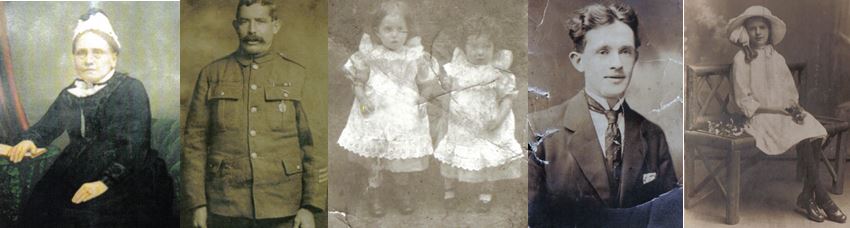
Harold was the sixth of seven children born to William Preston and Mary Ann Gaunt. His siblings were Tom Sykes (born in 1875); Sarah Sykes (born 1877); Lucy Webster (born in 1881, died in 1884); Ethel (born in 1884); James Herbert (born in 1886); Percy (born and died in 1888); and Annie (born in 1893, and who died the following year). Then, in September 1899, Harold’s mother passed away. William Preston Gaunt never remarried.
Harold grew up in the Cheapside area of Batley, with all its mills and rag warehouses, a stone’s throw from the location of his father’s warehouse. It was also handily placed for the railway station, which facilitated the town’s booming textile trade and its mill entrepreneurs.
However, by 1911 rag merchant William Preston Gaunt was living close by, and alone, just off Caledonia Road at 7, Hamburg Street (later renamed Devon Street). 21-year-old Harold’s address was 152, Grange Road, Soothill, where he lived in the household of his unmarried brother James Herbert, and sisters Sarah Sykes and Ethel.
Whereas James Herbert had employment as a rag warehouseman, Harold had a far more earthy occupation – a labouring job at a patent manure manufacturing works.
Despite increasing food imports from an expanding British Empire from the mid-19th century, and the invention of refrigeration in the 1890s enabling fresh food imports from further afield, British agricultural production was still vital for feeding the nation. Becoming more mechanised and intensive, British producers still accounted for half of Britain’s food by 1914. This should be set against the context of rapid population growth. For example, the population of England and Wales more than doubled between the 1851 and 1911 censuses. Fertilisers to improve crop yields were prized and, to keep up with the demand to produce crops for a growing population, manufacturers were creating alternative patent manure concoctions using artificial materials and synthetic processes rather than relying on purely organic material. As mentioned earlier, rag warehouse sweepings were a possible fertiliser component, so this may have explained Harold’s involvement.
But this was not a long-term career choice. Harold soon moved into far more familiar territory. A 1914 London Gazette announcement recorded:
NOTICE is hereby given, that the Partnership heretofore subsisting between us, the undersigned, Tom Gaunt Sykes and Harold Gaunt, carrying on business as Rag Merchants, at Caledonia-road, Batley, under the style of “W. P. GAUNT AND SONS,” has been dissolved by mutual consent as and from the first day of January, 1914; and the said business is now carried on solely by the said Tom Sykes Gaunt on his own behalf, under the style of “W. P. Gaunt and Sons.” —Dated this 19th day of June, 1914.
TOM SYKES GAUNT.
HAROLD GAUNT.5
But this did not mark the end of Harold’s involvement in the rag trade. As his partnership with one brother ended, a partnership with his other brother, James Herbert, began. In 1914 the pair formed a new business, Messrs. H. and J. H. Gaunt, rag merchants, based in Bar Street, Batley.6
The outbreak of war cut short the brothers’ hands-on involvement in their newly-founded business venture. Whereas James Herbert saw service with the Machine Gun Corps (M.G. C.), Harold joined the Royal Naval Volunteer Reserve (RNVR). This force of volunteers, which was open to civilians with no prior sea experience, was established to help the Royal Navy in the event of war or other national emergencies. And again his military service is untypical of that of other St Mary’s parishioners. His first allocated number was Y2698, the ‘Y’ indicating he had volunteered. Called up on 10 November 1916, he was then allocated his first service number, J61835.7
His surviving records of service give his physical description. With a fresh complexion, grey eyes and brown hair, he stood at 5’ 8”, with a 38” inch chest.8 This height and chest measurement was above average for the period, possibly reflective of the better nutrition of his socio-economic class as compared to those from a working-class background. This physical difference is illustrated by renowned WW1 researcher Chris Baker, who in a 2007 Great War Forum post, admittedly about the army, wrote:
From having carried out analysis of the army service records of hundreds of men, I can tell you that average height for an adult seems to have been about 5 feet 5 inches, weight not more than ten stone and chest measurement not more than 34 inches….
His records also confirm his rag merchant pre-service occupation, and confirm his Grange Road home address.
Perhaps Harold hoped his involvement with the Batley Ambulance Brigade might lead to Hospital Ship work. The reality turned out to be quite different. When he was formally drafted into service on 25 November 1916, it was with the Royal Naval Reserve (RNR) Trawler Section. A new service number followed for Deck Hand Gaunt, 13680/DA.9
Part of the Auxiliary Patrol of home waters, their role included mine sweeping and anti-submarine work. It was a dangerous job on small vessels in often rough seas, without the glamour associated with the Royal Navy. But it was essential, keeping the coastal waters open for trade and troopships.
Initially, civilian fishing vessels were requisitioned, and many east coast fishermen volunteered to serve. So vital proved the contribution of these craft to war effort that purpose-built Admiralty trawlers were subsequently constructed, with the Trawler Section growing to over 55,000 RNR personnel, plus other sailors from other branches of the Navy.10
On 5 April 1917, Harold finally received an onboard posting. Rather than a trawler, he was to serve as a deck hand on Motor Launch (ML) 511. These Motor Launches formed a relatively new section, and the vessels were specially-requisitioned for it.
In early 1915, because the growing German submarine threat in Great Britain’s coastal waters and the need for more vessels to counteract it, US company Elco were contracted to provide 50 specifically designed Motor Launches (ML). The Lusitania sinking in May 1915 prompted a re-evaluation of the threat, and the order was increased to 550.11 Delivery was required by 16 November 1916. The initial 50 were built at Elco’s New Jersey site, but in order to get round America’s neutrality stance, the parts for the subsequent MLs were shipped to Canada for kit form construction there, and then onward transport to Britain. Amazingly, the delivery deadline was achieved.
Once here, after commissioning, work‐up and arming, the MLs were deployed in flotillas of six craft throughout the various theatres of war – including as far afield as Alexandria and Gibraltar. ML 511 operated in waters closer to home, out of Portsmouth.

Their varied roles included as scouts, anti-submarine craft, inshore minesweepers, smokescreen layers and hydrophone vessels. Some, though not ML 511, participated in the 1918 Zeebrugge raid. In the Mediterranean, MLs even conveyed intelligence officers and spies to and from enemy shores.
ML 511 being part of the second batch of launched commissioned, had a slightly different set of design specifications from the first 50. Built of wood, weighing 37 tons, and measuring 80-88’ in length, with a beam (width) of 12’ 2”, a draught (distance between the waterline and the bottom of a boat’s hull) of only 3’ 10”, and a speed of around 19 knots, its crew comprised two officers, two motor mechanics two leading seaman and four seamen. One of the seamen was detailed as the cook, and each ML had two seamen trained in the use of the hydrophone, an underwater microphone used to track submarines. When located, the ML crew dropped depth charges.
Many officers appointed to command MLs had in civilian life been motor boat owners and yachtsmen. Their civilian sailing experience gave them an excellent grounding in operating MLs. Irish aristocrat and sailor Edward Conor Marshall O’Brien (better known as Conor O’Brien) was one such example. An Irish nationalist who in the early summer of 1914 put his sailing knowledge to use as a gun runner for the Irish Volunteers, incredibly served with the RNVR during the War. After completing a course of instruction in the autumn of 1916, this included British naval service as an officer on board MLs, with him at one point being the relief captain for ML 511.12
With its equipment, armaments, depth charges, fuel (with its two petrol engines going through around 45 gallons per hour), and stores, conditions on MLs were cramped, uncomfortable and wet. It was also far from smooth sailing. Those on board these pitching and rolling vessels needed cast-iron stomachs. But their low draught also meant they were virtually safe from a torpedo, and their speed and small size made them difficult targets for submarines.
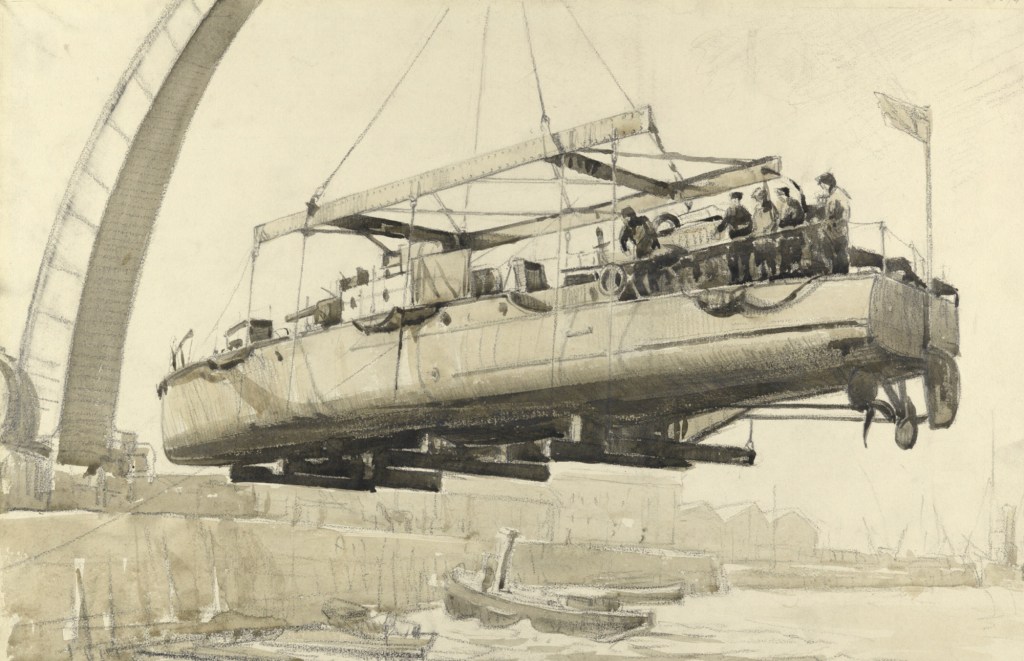
It was this harsh environment in which pre-war landlubber Harold Gaunt was thrust. Neither was it one immune from danger. Storms, enemy action and even fire (the petrol engine/wooden structure combination was a hazardous one) were all risks. Records seem to suggest that 24 MLs were registered as war losses.13
But Harold Gaunt succumbed to another deadly worldwide enemy in 1918 – the Spanish flu pandemic. On 17 October 1918 he died in the Haslar Royal Naval Hospital, Gosport, as a result of pneumonia, a complication of the influenza which struck him. His sister Sarah Sykes Gaunt, who he had named as his next of kin despite his father still being alive, was notified of his death.
Harold’s body was returned to Batley Cemetery for burial in the Gaunt family plot on 24 October 1918, in a Catholic service conducted by Fr John Joseph Lea of St Mary’s. Brother James Herbert, serving in Italy with the M.G.C., was unable to attend. Harold now lies alongside his three siblings who died in infancy, and his parents – his father dying in 1923.


Following his funeral his family placed the following thank you in the local paper:
GAUNT – The family of the late Harold Gaunt, H.M.M.L. desire to thank all friends for their kind expressions of sympathy in their sad bereavement; also for floral tributes.14
Harold was awarded the Victory Medal and British War Medal. In addition to St Mary’s, he is also remembered on Batley War Memorial.
And his name lived on in the textile industry, in the rag merchant firm started with his brother in 1914. On his return from the war, James Herbert continued the business under the unamended name of Messrs. H. and J. H. Gaunt.
Postscript:
I may not be able to thank you personally because of your contact detail confidentiality, but I do want to say how much I appreciate the donations already received to keep this website going. They really and truly do help. Thank you.
The website has always been free to use, and I want to continue this policy in the future. However, it does cost me money to operate – from undertaking the research to website hosting costs. In the current difficult economic climate I do have to regularly consider if I can afford to continue running it as a free resource.
If you have enjoyed reading the various pieces, and would like to make a donation towards keeping the website up and running in its current open access format, it would be very much appreciated.
Please click 👉🏻here👈🏻 to be taken to the PayPal donation link. By making a donation you will be helping to keep the website online and freely available for all.
Thank you.
Footnotes:
1. Batley Reporter and Guardian, 9 April 1892.
2. Batley News, 26 October 1918.
3. Although his baptism is not at St Mary’s, it is clear Harold Gaunt was a Catholic when he died, and his burial is in the St Mary’s burial register. Fr John Joseph Lea submitted his name for inclusion on Batley War Memorial as a parishioner. In Fr Lea’s letter he listed all his parishioners who died whilst serving, and Harold Gaunt is amongst these names. In a separate part of his letter he mentioned several non-Catholics who had links to the parish. Harold is not in mentioned in that part of the letter.
4. Bradford St Patrick’s baptism register.
5. London Gazette, Issue 28843, 23 June 1914.
6. Batley News, 26 March 1927.
7. Royal Navy Registers of Seamen’s Services, The National Archives (TNA), Ref: ADM/188/770/61835.
8. Ibid and Royal Naval Reserve Ratings’ Records of Service, TNA, Ref: BT 377/7/60133.
9. Royal Naval Reserve Ratings’ Records of Service, TNA, Ref: BT 377/7/60133.
10. A Few of the Many – Royal Naval Reserve (Trawler Section), https://livesofthefirstworldwar.iwm.org.uk/community/2812.
11. A further 30 MLs were ordered in April 1917.
12. Royal Naval Volunteer Reserve, Records of Service, First World War, RNVR Officers Records, Edward Conor Marshall O’Brien, TNA, Ref: ADM 337/121/379. It would also be interesting to view the log books of ML 511 held at the TNA to see if that indicates any service crossover between Harold Gaunt and Conor O’Brien.
13. Forgotten Wrecks of the First World War, Motor Launches by Andrew Daw, quoting from Janes Fighting Ships for 1919, https://maritimearchaeologytrust.org/wp-content/uploads/2021/03/MotorLaunches.pdf.
14. Batley Reporter and Guardian, 1 November 1918.
Sources:
• 1851 to 1921 Censuses (England & Wales).
• A brief history of agriculture in the UK by Professor John Wibberley, December 2004, https://nlaf.uk
• Batley Cemetery Burial Registers.
• Batley St Mary of the Angels Parish Registers.
• Birstall Methodist New Connexion Chapel, Adwalton Baptism Register.
• Birstall St Peter’s Marriage Register.
• Commonwealth War Graves Commission.
• Epic of the Motor Launches, https://www.shippingwondersoftheworld.com/motor_launches.html.
• Edward Conor Marshall O’Brien – Dictionary of Irish Biography, https://www.dib.ie/biography/o-brien-conor-a6464.
• General Register Office Indexes.
• Medal Award Rolls, RNR.
• National Probate Calendar (Index of Wills and Administrations)
• Newspapers – various.
• Pension Ledgers and Index Cards.
• The “Movies” The Ships and Men of the Royal Navy Motor Launch Patrol, 1914-19, http://www.motorlaunchpatrol.net/.
• US Built Elco Motor Launches, https://www.naval-history.net/WW1NavyBritishMLs.htm
• Wikimedia Commons


 Past To Present Genealogy