
Name: Clement Manning
Rank: Private
Unit/Regiment: No 1 Company, 3rd Battalion, Grenadier Guards
Service Number: 22862
Date of Death: 22 August 1918
Cemetery: Bucquoy Road Cemetery, Ficheux, Pas de Calais, France.

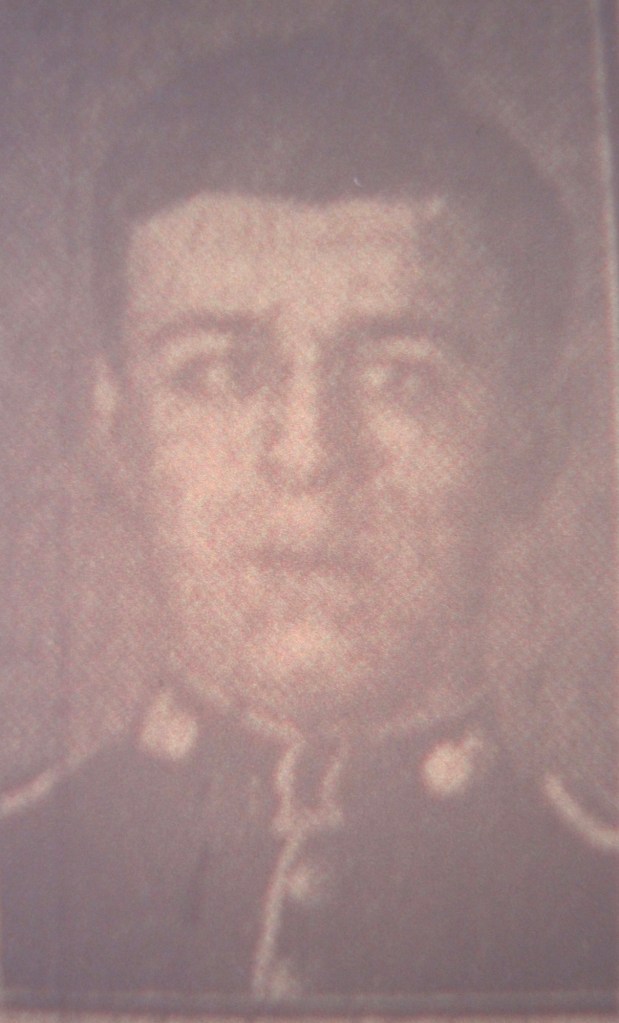
Guardsman1 Clement Manning’s had an unusual early childhood which marks him out from the other St. Mary’s War Memorial men. His Soldiers Died in the Great War record gives his birthplace as Batley, Yorkshire. This was stretching the truth – by over 600 miles. Whilst Clement did live in the town in the years leading up to the outbreak of war, his real birthplace was Niederschöneweide, a German industrial town which subsequently assimilated with Berlin. This is where he was born on 13 November 1895. Perhaps the nation against which Britain was fighting provided a reason for Clement to be reticent about his country of birth.
Clement in fact spent the first eight years of his life in Germany, before the Manning family made their home in Batley in 1904.2 It was a return to the town in which Clement’s parents married and spent the first years of their married life.
Clement’s parents were Michael Manning from Kilkenny, and Mary Eliza Manning (née Waterson). Recorded as Muriel in German records, she came from Triangle, near Sowerby Bridge, in Yorkshire. The couple married in Batley Parish Church in August 1881.3 Their first two children were born in Batley – Annie Elizabeth (b. 1881, d. April 1882, who is buried in Batley cemetery alongside Michael’s parents); and John Tynan (b. April 1883).
Michael worked as a rag grinder in the woollen textile industry, and it was this occupation which led to the family move to Germany.
Batley mill owners were operating in Germany during the second half of the 19th century, with John Blackburn opening a woollen cloth factory in the Niederschöneweide area by 1879.4 Another woollen factory, Anton Lehmann’s, followed in 1881. English employees with expertise in shoddy manufacturing were employed in these factories and they, along with their families, moved into the community. Consequently hundreds of Batley people are said to have left their native town and found very lucrative employment here. By the mid 1880’s there was quite a substantial Yorkshire colony in Berlin, with Yorkshire men working for either John Blackburn or Lehmanns, so this was the work magnet which pulled the Mannings to Germany. Education was at the village school, the Gemeinde-Schule, but English was spoken at home and at Sunday School, so the children would have had the advantage of being bi-lingual. Batley Feast was celebrated, as were festivities for Queen Victoria’s Jubilees in 1887 and 1897.5
And it was in Germany that the remainder of the Manning’s children were born. Michael Wilfrid was born in March 1886; Lillian, born October 1887 and died April 1889; Hester, born in February 1891; Cecil Tynan, born in July 1893; Henriette, born October 1894 and died February 1903; Helene, born March 1897 and who died the following month; and Walter Nicholas, born August 1900.
When the family came back to Batley they returned to worship at St. Mary of the Angels R.C. Church, and Clement attended the associated school to complete his education. Whilst at school was one of those listed as taking part in the 1907 Batley Hospital school’s pageant, when St Mary’s pupils represented Ireland – a move which attracted criticism in some quarters. He was amongst the boys depicting haymakers in the Queen of the Mountains section, dressed in a linen smock and rush hat, and carrying a hayfield implement.
Their 1911 census Batley address was 39, Bradford Road. This was in the Carlinghow area, with the precise location being Providence Terrace. The census describes 15-year-old Clement as a butcher boy. He continued in this field of employment because, before enlisting, his employers were the Batley branch of the Argentine Meat Company. He also played football with the Batley shop assistants team.
The Manning brothers were all much taller than average, with the eldest boys all being around the 6 foot mark and upwards. This explains why Clement enlisted with the Grenadier Guards in February 1915, meeting their height criteria. His enlistment meant three of the Manning boys had now entered military service.
Cecil Tynan joined the Royal Navy in 1911, and served with them throughout the war.
Michael Wilfrid enlisted with the King’s Own Yorkshire Light Infantry at the beginning of September 1914, but quickly switched to the Royal Naval Volunteer Reserve to serve with the Royal Naval Division (RND). His war came to an abrupt end in the RND’s hastily prepared and ill-equipped part in the Defence of Antwerp in early October 1914. By 9 October he was a Prisoner of War, along with around 1,500 other RND men, and spent the remainder of his war in captivity. The biographies of Cecil Tynan and Michael Wilfrid, along with brother John Tynan, will be covered in the Served and Survived section at a later date.
On 25 October 1915 Clement’s father died. This was just five days after Clement arrived in France, destined for action on the Western Front with the 3rd Grenadier Guards. A couple of months later a fourth Manning brother, John Tynan, signed his attestation papers under the Derby Scheme. A mechanic by trade he eventually received his call up to join the Army Service Corps (Mechanical Transport) in March 1917, going out to France the following month. But as John was going overseas, Clement was back home in England, after taking part in the 3rd Grenadier Guards’ action on the Somme in the Battle of Flers-Courcelette the previous September.
The summer of 1916 had been a particularly anxious time for the Manning family, who throughout the period were receiving a series of concerning updates from the captive Michael Wilfrid. These coincided with another wave of countrywide reports about the neglect and ill-treatment of Döberitz prisoners, where Michael Wilfrid was being held, as illustrated by the case of Pte. Tulley, a Royal Marine captured at Antwerp. 14 stone when taken prisoner he was sent back to England to die weighing only five stone. His case was widely reported in April 1916. His death, two weeks after arrival home, was attributed to exposure and insufficient food and clothing whilst held prisoner in Germany. Then in June 1916 Michael Wilfrid wrote to say he had been moved, further east to German-held territory in Russia.
In addition to fears around Michael Wilfrid’s treatment as a PoW, there was now the Flers-Courcelette injury to Clement, although he – at least for now – was back in England.
Commencing on 15 September 1916, this engagement during the Battle of the Somme marked the first use of tanks. The 3rd Battalion Grenadier Guards unit war diary recorded prior to zero hour on 15 September:
the ‘tanks’ which were allotted to the Division could be heard making their way up in rear of us.6
It also recorded the numbers of killed, wounded or missing when roll call was taken at the end of 15 September 1916: 413 officers and men. This was the largest single day’s loss for this battalion in the war. Amongst their dead was Lt Raymond Asquith, son of Morley-born British Prime Minister Herbert Asquith. It appears Clement was amongst those injured, receiving what was recorded as a gunshot wound to his left arm. He was evacuated back to England on board the HMHS Asturias on 17 September 1916.7
Incidentally six months later, on 20 March 1917, en route from Avonmouth to Southampton this hospital ship was torpedoed by a German U-boat. Fortunately she had already unloaded her cargo of wounded, otherwise the casualty count would have proved far higher. Nevertheless in excess of 30 crew, including two nurses, perished. The ship was declared a total loss.
Back in England, Clement recovered from his Battle of the Somme injury and was assigned to the Regiment’s home-based 5th (Reserve) Battalion to recuperate. This proved longer than anticipated with four further hospital admissions recorded whilst with the Reserve unit.
On 19 October 1916 he was admitted to Queen Alexandra’s Military Hospital, Millbank, suffering from indigestion. It was serious enough to need 12 day’s treatment, before returning to light duties.8
He was back there on 28 November 1916 after suffering an accidental foot injury and concussion. The lengthy stay involved treatment at St George’s Hospital, and Epsom’s Horton Hospital. He was not discharged until 14 February 1917.9
A week later he was admitted once more, this time suffering from rheumatic fever. It was a shorter stay, with his discharge date recorded as 21 April 1917, and involved treatment at the Royal Mineral Water Hospital, Bath.10
There was a further admission on 20 June 1917 when enteritis struck Clement down.11 He was able to undertake light duties from the end of July 1917, but it was not until 5 September 1917 that he was considered fully fit to return to duty, ultimately going back to the Front to rejoin the 3rd Battalion once more. He was able to make a final visit home before rejoining the Battalion, when on 12 September he told his mother that “if he went under he had left his will in her favour.”12 This was said in the presence of his brother Walter, and sisters Cecilia and Hester.
Clement was killed in action in the last 100 days of the war, with the Germans in retreat. The 21 August 1918 marked the start of the Second Battle of the Somme. From the 21 to the 23 August 1918 the 3rd Grenadier Guards were involved in what became known as the Battle of Albert, a phase of this battle, as part of the Third Army under the command of General Byng. The battalion were part of the Guards Division, VI Corps.
The official history of the Grenadier Guards describes the events of the battle, as does Reminiscences of a Grenadier by Captain E.R.M. Fryer, who was in command of 1 Company, the Company with which Clement served, for the crucial period. Clement was in 3 Platoon of that Company, the platoon led by 2nd Lt. Clough-Taylor.
On the 20th August 1918 they took up its assembly positions East and South East of Boiry. Their orders were to attack Moyenneville. The attack commenced in the early hours of an initially extremely foggy on 21 August. The fog veiled the Guards Division as they advanced towards their first objective. However, later it lifted, exposing the attack to enemy artillery and the inevitable accompanying hail of German machine gun fire. Surprisingly, the Guards reportedly incurred few casualties during this stage of the battle. By midday they had secured all their objectives, including Moyenneville, the 3rd Grenadier Guards taking a chalk pit to the south east of the village, whilst a platoon belonging to the battalion had advanced as far as the outskirts of Courcelles. By noon on the 21st V1 Corps had attained almost all of its objectives and were positioned along the Arras—Albert railway line where they came under intense artillery fire. At this stage of the battle it had been intended for tanks and the cavalry to take over from the infantry to exploit the situation, but none had appeared. Unexpectedly Number 1 Company of the 3rd Grenadier Guards, who were intended to have a reserve role that day, played a key part in events.
Captain Fryer described the aftermath of the 21 August and the events of the 22 August as follows:
That night passed off fairly uneventfully; we were content with our day’s work, the Commanding Officer had praised us, and we heard that the higher authorities were well pleased, and so we were contented. It is hardly necessary to say the men were wonderful they always were. Were it possible to mention them all by name in this book I would do so…..No one was more loyally served by the men under him than I was, from the C.S.M. to the youngest guardsman;…….
On the morning of the 22nd at dawn we were just getting ready to stand to arms in the ordinary way when the Germans opened a terrific barrage on us, and a messenger arrived from the front line to say the Germans were coming over; we raced out from our quarry, ran the gauntlet of innumerable shells, and reached the railway safely;…….
Someone on our right sent up the S.O.S., our artillery put down a very good and accurate barrage, and all was quiet; it was impossible to get communication with our front platoon during this time, and we had no idea how they were faring……it was an organised counter-attack with the idea of [the Germans] regaining all they had lost the day before. It failed completely, …..
The rest of that day was very trying; we were all tired, and the Germans shelled us relentlessly all day, and also trench-mortared us; they got on to our quarry, and it became far from healthy….13
Sometime during the day of 22 August 1918 Clement was killed, with the family receiving official news followed up by a letter from the battalion’s adjutant in late September/early October.
It seems that, despite this official notification, the Manning family clung to the hope that Clement was still alive. This hope was brought into sharp focus following the events of 11 November 1918. When many families across the country were celebrating the Armistice and the hopefully not too long in the future return home of loved ones, on 20 November 1918 the Manning family submitted an enquiry about Clement to the Red Cross. You can understand their failure to accept the official news of his death. They had not seen Clement’s body; they had not attended any funeral; there has been many mistakes with men falsely declared death; perhaps he was lying unconscious in some hospital, or prisoner of war camp, unable to communicate. But their hope was in vain. There has been no mistake. Clement was dead.
He is now laid to rest at Bucquoy Road Cemetery, Ficheux, France. This is a concentration cemetery with graves being brought in from the wider battlefield and smaller cemeteries in the neighbourhood post-Armistice. These re-burials included Clement, with the burial return dated 9 September 1919 indicating his original burial site marked with a cross was just south of Hamelincourt. His headstone bears the inscription chosen and paid for by the family “Rest in Peace.”
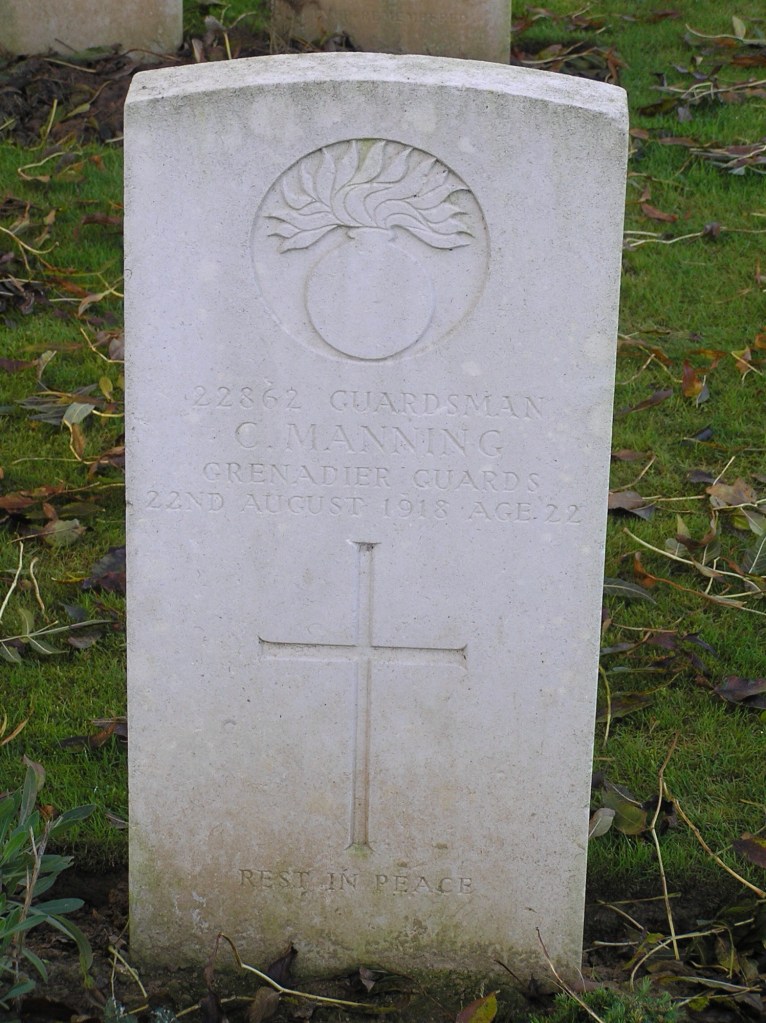
No written will was ever located for him. His verbal wishes that everything be left to his mother, communicated to the War Office by brother Walter, were accepted following correspondence with St. Mary’s parish priest Fr. John Joseph Lea. On 14 April 1919 Fr. Lea wrote to the War Office to say he had visited the family who had confirmed to him the words of Clement, and affirming:
Knowing the family so well for a long time I am convinced that they were telling me the truth. They are a family that keep very much to themselves and are very much attached to each other. It was a statement that was to be expected and I have every confidence that trusting to it you will not make any mistake but will be carrying out the wishes of the fallen soldier.14
His mother was also awarded a modest weekly pension of 8s. 6d. for the loss of her son.
Clement was awarded the 1914-15 Star, Victory Medal and British War Medal. In addition to St Mary’s, he is also remembered on the Batley War Memorial and the Memorial at St John’s Carlinghow.
Postscript:
I may not be able to thank you personally because of your contact detail confidentiality, but I do want to say how much I appreciate the donations already received to keep this website going. They really and truly do help. Thank you.
The website has always been free to use, and I want to continue this policy in the future. However, it does cost me money to operate – from undertaking the research to website hosting costs. In the current difficult economic climate I do have to regularly consider if I can afford to continue running it as a free resource.
If you have enjoyed reading the various pieces, and would like to make a donation towards keeping the website up and running in its current open access format, it would be very much appreciated.
Please click 👉🏻here👈🏻 to be taken to the PayPal donation link. By making a donation you will be helping to keep the website online and freely available for all.
Thank you.
Footnotes:
1. Guardsman was the Guards equivalent of Private.
2. Batley News, 6 March 1915 and 11 October 1930.
3. Batley Parish Church Marriage Register, West Yorkshire Archive Service (WYAS), Ref: WDP37/28
4. See Vivien Tomlinson’s family history website for more details about John Blackburn’s mill, https://vivientomlinson.com/batley/p1.htm#i49
5. Ibid.
6. 3rd Battalion Grenadier Guards, Guards Division, 2nd Guards Brigade, 1 July 1915 – 31 January 1919, The National Archives (TNA), Ref: WO95 1219/1
7. First World War Representative Medical Records of Servicemen, TNA, Ref: MH106/955.
8. Ibid, Ref: MH106/1790.
9. Ibid, Ref: MH106/1609.
10. Ibid, Ref: MH106/1623.
11. Ibid.
12. Clement’s Manning’s will, evidence of brother Walter N. Manning, 3 March 1919.
13. Fryer, E. R. M. Reminiscences of a Grenadier: 1914-1919. London: Digby, Long & Co, 1921.
14. Letter from Fr John J Lea to the War Office, 14 April 1919
Sources:
• 1871, 1881, 1911 and 1921 Censuses (England & Wales).
• Batley Cemetery Burial Registers.
• Batley St Mary of the Angels Parish Registers.
• British Red Cross and Order of St John Enquiry List – Wounded & Missing.
• Commonwealth War Graves Commission.
• General Register Office Indexes.
• Landesarchiv Berlin; Berlin, Deutschland; Personenstandsregister Geburtsregister, Berlin, Germany, Births, 1874-1899.
• Landesarchiv Berlin; Berlin, Deutschland; Personenstandsregister Sterberegister, Berlin, Germany, Deaths, 1874-1920.
• Medal Index Cards & Medal Award Rolls.
• Newspapers – various editions of the Batley News and the Batley Reporter and Guardian.
• Ponsonby, Frederick. The Grenadier Guards in the Great War of 1914-1918. London: Macmillan and, Limited, 1920.
• Service Records – Various.
• Soldiers Died in the Great War.
• Soldiers’ Effects Registers.
• The Long, Long Trail – The British Army I’m the Great War 1914-1918: https://www.longlongtrail.co.uk/
• Trench Map, Sheet: 57C.NW, Scale: 1:20000 Edition: 5A Published: December 1916. Trenches corrected to 27 November 1916.
• WWI Pension Record Cards and Ledgers.


 Past To Present Genealogy