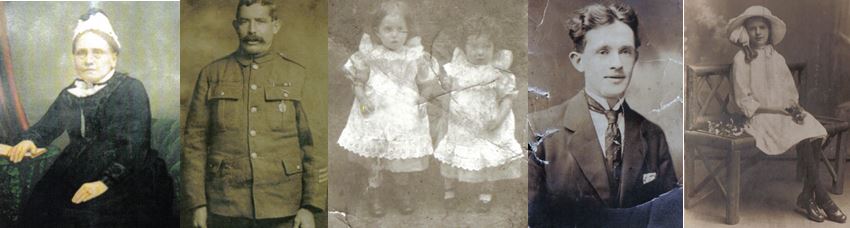
Name: Arthur William Bayldon Woodhead
Rank: Private
Unit/Regiment: 2nd Battalion, Seaforth Highlanders (Ross-Shire Buffs, The Duke of Albany’s)
Service Number: S/43194
Date of Death: 30 December 1916
Cemetery: Boulogne Eastern Cemetery, Pas de Calais, France

New Year’s Day 1917, the day the dreaded telegram arrived at 26, Hanover Street, Batley, the home of Walter and Kate Evelyn Woodhead. It notified them that their 19-year-old son, Arthur William Bayldon Woodhead, had lost his two-week fight for life in a Boulogne hospital two days earlier. During those anxiety-laden days, they never had the chance to see their son to say a final goodbye, despite him being dangerously ill. An earlier telegram had informed them he could not be visited.
At the time of Arthur’s death, the Woodhead family were well-known in Batley. Walter Woodhead was an insurance agent, selling fire and life insurance policies. Over the years he had worked for companies including the Prudential Assurance Company and Royal Liverpool. This work involved securing new policies and collecting premiums, bringing him into contact with a range of local people and businesses. As his income was derived on a commission basis, this local network would be crucial for family finances.
Kate Evelyn Bayldon, as she was before her marriage to Walter, was the daughter of Batley doctor William Bayldon. He lived at Hanover Street and ran a medical practice located towards the junction with Wellington Street for 40 years before his death in 1897. He also held the prominent public position of the Batley District Medical and Vaccination Officer for the Dewsbury Poor Law Union. The Bayldon family position in town in particular was emphasised by the rank or profession details Kate gave when she married Walter on 17 August 1896 at Batley parish church. She described herself as a ‘lady.’1 Indeed her family were reputed to have high connections, reported to have links to Sir Charles Wood, 1st Viscount Halifax, who held several political positions, including Chancellor of the Exchequer between 1846-1852.2
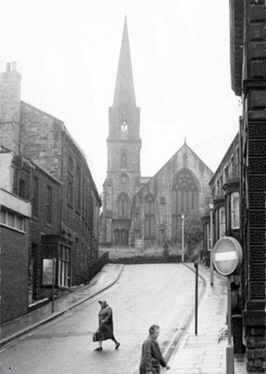
The Bayldon family were also affluent enough to employ domestic servants. Kate’s mother died in 1874, and prior to her marriage Kate stepped into her mother’s shoes, overseeing the domestic running of a middle-class household.3 These duties included managing the live-in domestic servants.
Following Dr Bayldon’s death, the Woodhead family are recorded as living at Hanover Street, but minus the live-in domestics of her father’s days. And it was in this home Arthur grew up.

Arthur William Bayldon was the couple’s first child, born on 5 May 1897, around three weeks before the death of his grandfather. Two further children followed, with the tradition of using the Bayldon name continuing. Kate Ella Bayldon was born on 19 October 1900, and Frederick Charles Bayldon on 24 August 1902.4
All three Woodhead children were baptised at Batley parish church, with Arthur attending Batley Parish Day Schools. Here, as an accomplished swimmer, he went on to represent the school in various competitions. His sporting interests went wider though, and he was particularly interested in cricket and cycling.5
After leaving school he assisted his father in his insurance work.6 But he also carried forward his cycling interests into his working life for, when he enlisted in the Royal Navy on 28 May 1915, he said he worked as a cycle mechanic.7
His Royal Navy records provide his description. Standing at 5 feet 5 inches, he had brown hair, olive eyes and fresh complexion. He also had several tattoos. On his right forearm these were a nude girl and a girl’s head. On his left forearm there was a rose, bird and the name mother.8
As a Stoker 2nd Class, he was assigned to Victory II, a land-based training establishment which in 1915 relocated from Portsmouth to Crystal Palace, South London. Stokers performed a physical job, shovelling coal into boilers in extreme heat. But it took more than brawn – it was also a highly technical job. Here at Victory II he began to learn the trade, with the 100 pages of the “Stokers Manual” being his bible. Coal boilers propelled the ships of the day, so Arthur started learning about boilers, furnaces, engines, turbines, registering temperature, and the steam, oil and water gauges.
He did not progress. Although his character was described as fair, and his ability satisfactory, his period of service on Victory II ended on 5 August 1915. Besides being prosecuted for making a false statement on entry to the Royal Navy, in not acknowledging previous army service, for which he was sentenced to one day imprisonment, he was discharged for writing a prejudicial letter.9 Unfortunately there are no more details about this intriguing letter.
Back home in Yorkshire after the abrupt termination of his spell in the navy, he is now recorded as being associated with St Mary of the Angels RC Church,10 a move away from the Established Church of his childhood.
But by December 1915 he was back in the military, enlisting in Dewsbury with the Seaforth Highlanders. Allocated Service Number 4771, Pte Woodhead’s initial posting was with the 3rd/4th Battalion of the Territorial Force at Ripon.11
His Service Number subsequently changed in mid-1916 to S/43194 with a posting to the Western Front to join the Seaforth Highlander’s 2nd Battalion on the Somme. This would have been in around June/July 1916, with the battalion taking on regular reinforcements throughout this period. One newspaper indicated he was at the Front in June.12 If so it is likely he took part in the 2nd Seaforth Highlanders action on 1 July 1916, the opening day of Battle of the Somme – though there is no other corroboration of this. He was certainly with them as winter closed in and the Somme offensive drew to a conclusion on 18 November 1916.
That did not mean an end to the casualties though. And these included Arthur Woodhead amongst their number. In December 1916, whilst serving with the battalion’s ‘A’ Company,13 he suffered multiple injuries, which were ultimately to prove fatal.
Marrying up medical records14 with the unit war diary,15 it is likely he incurred his injuries on around 12/13 December. They battalion had moved up to trenches just south of Sailly-Saillissel two days earlier. The diary during this period refers to the “deplorable state of the trenches”16 which by 10 December were “getting worse.”17 When they moved to the front line trenches later that day, these too were in:
…a very bad state, and A & B Companies spent their first night in digging men of the Irish Fusiliers out of the mud, where in some cases they had been stuck for ten hours.18
The weather also featured. 11 December was fine but cold, and:
the men were suffering very severely from the cold, and from exhaustion which was caused by them having to live in mud and water up to their thighs in almost all cases.19
Conditions worsened on 12 December, described as:
A very cold day with snow and rain. A lot of men went sick, but the battalion seemed to stick to it well on the whole considering the conditions.20
13 December refers to:
…a certain amount of artillery activity on both sides but otherwise quiet. The Battalion moved back into the Reserve line at night…21
The margin of the diary notes arrivals, departures and casualties. These included one man killed on 12 December, and one man killed and five wounded on 13 December.22
What is certain though, on 14 December Pte Woodhead was admitted to No 34 Casualty Clearing Station (CCS) at a location known by the troops as Grovetown. This was in the area just south of the village of Meaulte, and immediately south of the Albert-Picardie airport today. His injuries were catalogued as a gunshot wound to the right leg (this could indicate not only gunshot wounds, but shrapnel injuries) and ICT hands.23 ICT was the abbreviation for inflammation of the connective tissue. He was one of 409 admissions to the CCS that day.24
The following day he was moved further down the evacuation chain, on 2 Ambulance train, which set off for a Boulogne base hospital at 8pm that night. He was amongst the 519 other ranks who boarded, 79 of whom were classed as lying, and 440 sitting.25 He was bound for the city’s No 13 General Hospital,

Arthur’s injuries turned out to be far more complex than those initially recorded at the CCS. This quickly became clear as his family received updates. It is also apparent the conditions under which Arthur lived in the days leading up to his hospital admission had an impact.
The first intimation his parents received of their son’s condition came in a letter dated 17 December 1916, signed ‘An Anzac.’ The letter, which had been written for him, said he was wounded and hoped to be in England in a few weeks’ time.26
Subsequently the family received a letter from a Roman Catholic priest, the religion which Arthur now professed, who on visiting him found him to be progressing favourably.27 Confirmation of his progress also came from a Church of England chaplain, who wrote to say that Arthur was in hospital at Boulogne, and although his “body was filled with shrapnel he is very bright and cheerful and progressing satisfactorily.”28 This chaplain indicated an additional problem – Arthur had trench feet.29
Trench foot was a major problem in the trenches of the Western Front. This condition was caused by long hours, immobile, in trenches wearing leather boots which were not fully waterproof, After some days, or even as short as a few hours in some cases, the continuous exposure to the wet and cold caused the soldier’s feet to become waterlogged and chilled, circulation of blood to the feet became restricted, and the feet became painful. If exposure to these cold, wet conditions continued, the skin began to break down, the feet swelled and blistered, and they eventually became numb through nerve damage. Over time the skin could become infected by fungus. If action was not quickly taken to dry out the skin and re-establish circulation, gangrene could follow and in the worst cases this could necessitate amputation.
The issue was well known by 1916, with preventative action including frequent foot inspections of the troops, and additional pairs of dry socks made available to the infantry so they could be changed several times a day. Soldiers also paired up to vigorously rub whale oil into each other’s feet to stimulate circulation and help avoid skin being waterlogged. The total recorded cases of trench foot for the British in the Great War were 74,000.30 However, it is thought many other cases either went unrecorded – in many units it was a chargeable offence to neglect the feet – or were misreported.31. Also, according to another Western Front Association piece:
…frostbite was a common complication. In some BEF battalions on the Somme in 1916-17, about half the men were operationally compromised by these twin conditions of exposure. Overall, on the Western Front there were around 90,000 British hospital admissions due to trench foot and frost bite either alone, or in combination.32

Back in the 13th General Hospital, Boulogne, it seems Arthur’s feet were now causing real concern. The family received a further letter dated 26 December, this time from a Sister at the hospital. She stated that, although a little better, Arthur was still very ill. His feet were very bad and she was afraid he would lose part of one foot.33 Then on Friday 29 December 1916 a telegram arrived at the family home stating he was dangerously ill, as a result of trench feet, and could not be visited.34 This was followed by the New Year’s Day 1917 telegram informing them Arthur had passed away on Saturday 30 December.35
As for cause of death, the Commonwealth War Grave’s Commission records state he died of tetanus following wounds.36 The Pension Index Card recording the award of a 5s a week pension to his mother record his cause of death as trench feet.37.
Arthur was awarded the Victory and British War Medals.
In addition to St Mary of the Angels and Batley War Memorials, he is also remembered at Batley Parish Church and St Andrew’s Church at Purlwell,38 and the Scottish National War Memorial at Edinburgh Castle.
In the years immediately after the war Arthur’s family remembered him in the local paper on the anniversary of his death. The one published on the first anniversary of his death included the words which would later be inscribed on his CWGC headstone at Boulogne Eastern Cemetery.
Seeking nothing, giving all,
Answering to Honour’s call.
R.I.P.39

These words were repeated in the Roll of Honour commemoration piece in the Batley News of 3 January 1920:
WOODHEAD. —In loving memory of Private Arthur William Bayldon Woodhead, 2nd Seaforth Highlanders, son of Mr. and Mrs. Walter Woodhead, 26, Hanover Street, who died December 30th, 1916, aged 19 years, at 13 General Hospital, Boulogne, and was interred at Eastern Cemetery, Boulogne.
——————-
R.I.P.
——————-
Seeking nothing, giving all
Answering to Honour’s call.40
Postscript:
My website has always been free to use, but it does cost me money to operate. In the current difficult economic climate I’m having to consider whether I can continue to afford to keep running it as a free resource in the New Year. If you have enjoyed reading the various pieces, and would like to make a donation towards keeping the website up and running in its current open access format, it would be very much appreciated. Please click here to be taken to the PayPal donation link. By making a donation you will be helping to keep the website online and freely available for all. Thank you.
Footnotes:
1. Batley All Saints Marriage Register, West Yorkshire Archive Service (WYAS), Ref WDP37/33.
2. Batley Reporter and Guardian, 28 May 1897.
3. 1891 Census, The National Archives (TNA), Ref RG12/3719/48/20/144.
4. Batley All Saints Baptism Register, WYAS, Ref WDP37/10.
5. Batley Reporter and Guardian, 5 January 1917 and Batley News, 6 January 1917.
6. Ibid.
7. British Royal Navy Seamen Service Records, TNA, Ref ADM 188/919/26241.
8. Ibid.
9. Ibid.
10. Batley Reporter and Guardian, 5 January 1917.
11. Based on Service Number and his Soldier’s Will.
12. Batley Reporter and Guardian, 5 January 1917.
13. War Office: First World War Representative Medical Records of Servicemen, TNA, Ref MH 106/718.
14. Ibid.
15. 2nd Battalion Seaforth Highlanders Unit War Diary, TNA, Ref WO 95/1483/5.
16. Ibid.
17. Ibid.
18. Ibid.
19. Ibid.
20. Ibid.
21. Ibid.
22. Ibid.
23. War Office: First World War Representative Medical Records of Servicemen, Ibid.
24. 34 Casualty Clearing Station Unit War Diary, TNA, Ref WO 95/415/6.
25. 2 Ambulance Train Unit War Diary, TNA, Ref WO 95/4130/3.
26. Batley News, 6 January 1917.
27. Ibid.
28. Ibid.
29. Batley Reporter and Guardian, 5 January 1917.
30. “Trench Diseases of the First World War.” Western Front Association. Accessed December 31, 2022. https://www.westernfrontassociation.com/world-war-i-articles/trench-diseases-of-the-first-world-war/. Another article “The BEF, Human Diseases and Trench Warfare on The Western Front” puts it at 75,000.
31. Ibid.
32. https://www.westernfrontassociation.com/world-war-i-articles/the-bef-human-diseases-and-trench-warfare-on-the-western-front/
33. Batley Reporter and Guardian, 5 January 1917.
34. Ibid.
35. Ibid.
36. CWGC. “Private Arthur William Bayldon Woodhead: War Casualty Details 46549.” CWGC. Accessed December 31, 2022. https://www.cwgc.org/find-records/find-war-dead/casualty-details/46549/arthur-william-bayldon-woodhead/.
37. WWI Pension Record Cards and Ledgers, Western Front Association, Ref 683/04D.
38. “Arthur William Bayldon Woodhead – Batleysrollofhonour.com.” Accessed December 31, 2022. http://www.batleysrollofhonour.com/wp-content/uploads/w/Woodhead,%20Arthur%20William%20Bayldon.pdf.
39. Batley News, 29 December 1917.
40. Batley News, 3 January 1920.
Other Sources (not directly referenced):
• 1871 to 1921 England and Wales Censuses.
• Batley Cemetery burial registers.
• GRO Birth, Marriage and Death Indexes;
• The Long, Long Trail website.
• Medal Index Card.
• Medal Award Rolls.
• Newspapers, various.
• Parish Registers, various.
• Soldiers Died in the Great War.
• Soldiers’ Effects Registers.
• The Royal Navy and Yapton’s Stokers, Accessed December 31, 2022, http://www2.westsussex.gov.uk/learning-resources/LR/the_royal_navy_and_yaptons_stokers1f3d.pdf?docid=df63d7c9-fcbf-4c2d-89a4-845751a41aa2&version=-1.


 Past To Present Genealogy