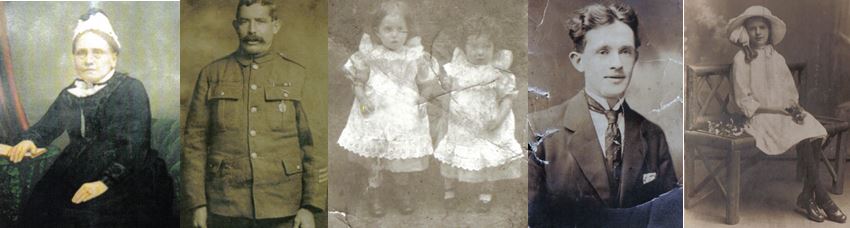
I don’t remember Skelsey Row but, like many with connections to St Mary’s, I’m aware of the important part it plays in the parish’s history. I am therefore grateful to Brian Foley for contacting me and sharing his memories of this long-gone, but not forgotten, area of Batley. It is a wonderfully evocative piece. I hope you enjoy reading it as much as I did. It is a brilliant write-up, which really brings the place, the community and era to life.
The greatest influence on a child’s upbringing is of course the home background. I remember with pride and affection the influences of my upbringing in Skelsey Row Batley, which I would describe as an Irish Catholic community of some 100 terraced back-to-back houses, one-up-one-down.
No inside toilet as they were centralised in sheltered blocks based in the middle of the street, alongside the dustbins. The one-up-one-down consisted of a cellar, a kitchen sink, a black cast-iron coal fireplace, with an oven where our Mam would carry out her baking. I can still smell the aroma of the beautiful fresh baked bread, scones, meat and potato pie etc. Weather permitting our Mam would leave them to cool off on the outside window sill.
We bathed in an old tin bath in front of the fire, and you scrubbed clean at least each Sunday for school. Mam would always check behind our ears to see if you did a proper job of cleaning yourself. Why behind the ears I will never know?
We had an old gas lamp by way of lighting. The cellar was where the coal was kept which was delivered via an outside open grate. When it rained, the water would get through the grate opening and dampen the coal. The cellars would be painted with whitewash. We would spend many an evening sitting around the coal fire. We sought excitement carrying our white tin buckets looking for pieces of coal left around the streets or pavements from the coal wagon. We would fill many a bucket which saved our parents money that would go to heating our homes.
During the dark winter evenings we sought our own brand of entertainment being imaginative and creative. Games were played, families would inter-mix with each other, songs were sang. Our Mam and Dad were good singers and would sing the old Irish songs. Dad, who was very funny and had a quick, dry sense of humour, would tell us stories. We didn’t have a TV, so the inventiveness and imaginativeness became the accepted way of a child’s upbringing, as we found our own source of entertainment. If we weren’t playing out (laking as we used to call it), we would be listening to the radio (wireless). I remember such programs as Dan Dare and The Clitheroe Kid. Workers playtime was the program the adults would listen to whilst they were grafting away.
Our uncle, Billy Maloney, was perhaps one of the first in Skelsey Row to get a TV. It was a small black and white box type with a small screen of around 12 inches. We would be so excited carrying our buffets, stools, baskets, chairs, running some 25 yards round the corner to the next street – Villiers Street – where uncle Bill lived. Robin Hood, Billy Bunter, Bill and Ben, Mr. Pastry were the programs I can recall. Every now and then the black and white screen would jump up and down. our uncle Bill would give a tap on top of the box and everything would be ok for a few more minutes.
Our Mam and Dad were so relaxed, happy, caring parents, who worked in the local mills, Dad was a big strong man, and very similar to all his brothers who were professional rugby league players, (they were all good boxers too). Dad, similar to his brothers, had his sporting career cut short having served in the Navy during the war. The other brothers served in the Army, as all brothers were not allowed to serve in the same service. The hardships such communities as Skelsey Row had to endure bred a special type of character – you learnt how to survive. Your make up/DNA was one of appreciation, where you cared for the people around you at the same time you had developed a characteristic of true grit and determination, where material things were valued but became secondary to the good person who you were to become.

Both our Mam and Dad were brought up in Skelsey Row, in Villiers and Ambler Street. Our Dad’s Dad died of gas poisoning as a result of military service during the war. Our Dad was only a young boy at the time. His mother brought a family of nine up on her own without any war pension or help from the state.
When our Dad completed his war service and returned home, it was not long after his mother died. So, in a way, at a young age after serving his country Dad was orphaned, as his older brothers and sister were married. Our Dad’s other older sister remained at home with my Dad in Villiers street, and she didn’t get married until after my Dad did. Our Dad always told us that Aunt Anne remained so loyal and caring to him, it was something as a family we respected and never forgot. We loved to listen to our Dad, with the poker in hand and stoking the coal fire, telling us stories about his growing up in Skelsey Row. Strangely, like many of his generation, he never spoke about the war.
We all followed on in our family tradition going to our local school, St Mary’s RC, which was a stone throw away. I think back with pride and affection to our formative years. Me, my brother and sister were born and brought up in Balk street directly across the road from Bertie Day’s fish and chips shop. A green, wooden building where the tasty, well-done fish and chips were fried via a coal fire, rated the best fish and chips for miles around. I can visualise the busy and friendly place which became an institution. Mr. and Mrs. Day were members of the Salvation Army, and were so kind and friendly to our family. The first time we ever had a ride in a car was when Bertie Day used to take us to collect his supplies. We felt we were posh.
At the bottom of Balk street was Bromley’s shop. They sold everything we needed. It was so exciting to be given money and, running down to the shop for a loaf of bread and some milk, I would be stepping in and out of the pavement flags en-route. I was only about six or seven years old, but you felt it was a good responsibility. Mr. and Mrs. Bromley, similar to Bertie Day, knew everyone and when you went in the shop they always knew what you would be buying. There was a black list in the window of people who owed money and had failed to pay in time. It was like a name and shame. People were to survive on low textile or pit wages.
Skelsey Row was an adopted nickname for the three main streets of Balk street, Villiers street and Ambler street. At the top of Skelsey Row was Melton Street which ran parallel to the parochial hall. At the bottom of Skelsey Row was Borough Road which led onto the Fleece Inn (Steps) and the Vic cinema.
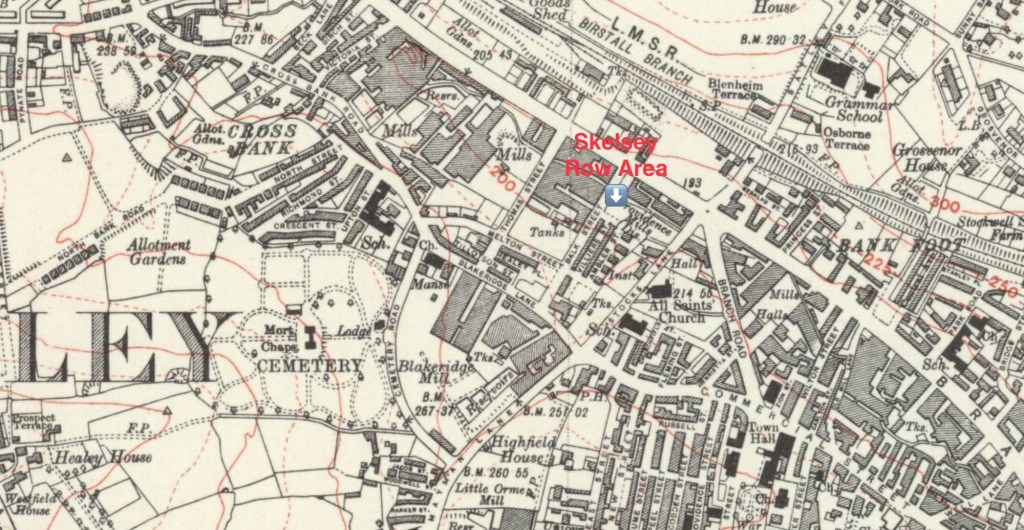
Re-use: CC-BY (NLS)
All our family – grandparents, aunts, uncles and cousins – lived in Skelsey Row. Quite a lot of the family worked in the pit or Taylor’s mill which still stands at the top of Balk street, which is the only surviving street of Skelsey Row.
Taylor’s Mill the buzzer would sound when the working hours come to a close and you hear the sound of the clogs on those cobbled streets of the workers going to and from work. We were told the story that during the war years, whilst the men were away serving their country, the women would be working all hours at Taylor’s mill making supplies for the war. Lord Haw Haw, the German spy, interrupted a broadcast on the radio to threaten the ladies by saying “This is Germany calling the workers of Taylor’s Mill Batley – we are aware of what you are doing,” then using words to the effect the Germans would “Bomb the Mill.” Needless to say it didn’t go down to well with the ladies, but it never dampened their spirits. My Mam confirmed this story as she was working in the mill at the time the broadcasts were made. How brave I thought, when our Mam told us they just got on with it, knowing they were offering a service, a duty to the country similar to their loved ones who were battling away in the war.
Yellands ice cream would come around in the shape of a hand push cart, and later on by way of an ice cream van, and a hand held bell would ring. People would flock for their ice cream. I remember once a dog running under the wheel of Yellands ice cream. Sadly it died. They placed it inside the van to take it away. It was many a year before I had another ice cream.
Prior to the ice cream van, most sales people would either be pushing a cart or riding a horse and cart, such as the rag and bone man. It must have been tough pushing those carts on those cobble streets. Whatever old clothes you may have had you would give to the rag and bone man and in return you would get something like a bow and arrow.
There of course was George Jackson’s sweet and paper shop, another wooden building which was situated opposite Taylor’s Mill at the corner of Stocks Lane. George Jackson, who must have been in his late 70s, would ride around on his cycle and deliver newspapers to the whole of Batley. He always had two heavy bag loads, one of newspapers one of comics, which we were excited to receive and read. Me and my brother usually read the Dandy and Beano, whilst our sister read the girl’s comic the Bunty. A small toy and some sweets were our treats for the week. With the occasional Film Fun comic thrown in, we were so happy and content, we appreciated whatever our parents bought us, for we fully understood money was scarce. Up to this day we don’t know how George Jackson managed to deliver day in, day out, in all kinds of weather. He collected the money too, which must have weighed him down. Sometimes we would get our comics, and Dad would get his papers a day or two later, as it depended on how George managed to get around .
Sundays were a special family day. We would go to St Mary’s church all in our Sunday best, which were kept tidied away the rest of the week as we always classed them as our new/best clothes, which we either got at Whitsuntide or Christmas.
The church was well attended, if you didn’t go to church you had to answer for it at school the following day. After church we would go on a family walk around Howley or Batley park. Mams would be at home cooking Sunday dinner. After the walk, Dads would then spend an hour at the nash.
Afterwards, at the bottom of skels on Borough Road on spare grass land near to the beck, the Dads would play touch rugby, which turned into tackle, all in their Sunday best. The game would turn out to be competitive as there was many a good sports person amongst the men. The older males of the families would also join in. They were physical too. Many a man would end up in the beck as the games became so furious. I remember once Georgie Fleming landing in the beck with his best suit, and his wife with a rolling pin in hand dragging him up Balk Street towards his home. George became some kind of cult hero after this game. I don’t think George was the first, or the last, of the men to fall foul of the rolling pin. The women were also a tough rare old breed, they had to be, for in many ways life was survival.
Come the winter months, we would spend the weeks up to Bonfire Night collecting piles of wood and any broken down trees, which we called chumping. Off we would go in our organised groups, being a member of Skelsey Row’s chumping squad we pride ourselves on having the best and largest bonfire around. We would raid other bonfires, and they would attempt to raid ours. Skels was a fearsome place to attack. We were certainly a rough and ready bunch, and well organised, who were prepared to defend our territory. Even though it was all kids stuff we took it seriously. You took it in turn to guard the bonfire. You would have an entrance to hide – it was our guardhouse. We would have a stick which would have been a branch from a tree, which we imagined was our gun. It was a trustworthy honour being a guard. You would stay at your post until being relieved, or until your parents called you in. No one did ever raid us. If they did perhaps me and the other guards would have shot them with our sticks. We would go on raids ourselves, attacking such as the nearby organised groups similar to ourselves taking their chumps. It was all innocent fun, I don’t think anyone ever got hurt. We would go up Batley Field Hill and go to what we would call behind the lines, also such places as Howley, and gather branches and parts of worn down trees. Bonfire Night was a huge family gathering where the whole of Skelsey Row would turn out. Potatoes, chestnuts and other items would be roasted on the fire, the usual fireworks were let off, and we as children felt proud as to our contribution to a community family evening.
The nearby Vic Cinema was another source of entertainment: the Saturday matinees where you could watch Roy Rogers, Hop Along Cassidy and other sources of kids entertainment – happy and yet so innocent days. We would be cheering the goodies and booing the baddies.
There was a pathway leading from Stocks lane opposite Batley Parish which ran along Melton Street up to the Parochial Hall and ending opposite St Mary’s Church, Our Nana, Granddad and Auntie Mary lived in Melton Street. It was only about 30 yards from our home. Opposite was a meadow which we called behind the sheds. It stretched to the right of the pathway up to Stocks Lane and Jackson’s sweets shop at the corner of Stocks and Blakeridge Lane. Taylors Mill would be overlooking the area. To the left of the pathway, past and our Nana’s house, leading up to Stocks lane there was an unkempt play area which we called “over the Bucks”, where we would spend time playing rugby. It was a hardened soiled type of area which was partly grassed. Outside our Nana’s home there was a gas lamp. Parts of the street were cobbled. We would spend countless hours playing in these areas, until the gas-man used to come round with a long lantern and put the gaslights out. It was then that or our parents would call us in. There was no health and safety in those days, as we would rough and tough it on those cobble streets flying into each other in games of touch rugby which always ended up in some kind of tackles, no injuries, just the accepted cuts and bruises. Such activities were the makings of us. Down the old sheds my brother would many a hour filling his wheelbarrow up with soil which we use to call muck. He would then empty it in an area, make a den and constantly go to-and-fro for hours on end with his wheelbarrow and small spade entertaining himself. When tired, he would nip into Nana’s and Granddads for refreshments telling them how hard he was working, then away he went again. My Sister would create her own shop on a stone slab selling such as dandelions and any wild growing plants. The muck and stones would be pretend sweets. Friends would buy into it, and imagine we were adults working and shopping. Parents and relatives would pay a visit, and with pretend money they played their part in seeing what they could buy. Cowboys and Indians, Japs and commandos, Rallio, British Bulldog were the games we would play and spend many an hour entertaining ourselves.
Our Uncle, Mick O’Rourke, lived next door to us. He was a very talented man. We knew that he worked for the government and kept going overseas. He would never say where, but we also knew not to ask him any questions. Uncle Mick made our sister a dolls house, and me and our brother a fort each in which we gathered our toy soldiers. Uncle Mick made us a transmitter with headphones. We could send Morse Code messages. He taught us out to read and transmit Morse Code. It was an amazing machine, in which we picked up the transmission of the first Sputnik which went into space.
Our cousins, Kath and Molly, lived with their parents our Auntie Mary and Uncle Joe on Borough Road. Kath and Molly went to Mount St. Mary’s Grammar School in Leeds. They were both very talented, bright and educated. It was a rarity for anyone out of Skels not to go to St Marys. Kath and Molly were some twelve year older than me my brother and sister were. We idolised them. So kind, caring and protective towards us, they would spend so much time entertaining and looking after us. Kath and Molly used to put shows on at the bottom of Borough Road. Kath could imitate and tell stories. Kath and Molly would also sing and get other kids to display their talents. Molly left Skels at the age of 16 years to join the Little Sisters of the poor and become a nun. We were heartbroken, but our highlight of the year was as a family going to see Molly at her convent wherever she was posted in such areas as Plymouth, London and Sunderland. They were so refreshing and heart-warming weeks spent amongst people who had devoted their life to the Catholic faith. It was so humbling and educational for me, my brother and sister. Molly would always write to us and send us holy cards, which I have kept with pride right up to this present day. Kath and Molly were very close to our Dad, who saved his chocolate rations he received in the war and gave it to them when he was home on leave.
The other source of holiday for us was the annual Nash trip, usually to Blackpool. At least twelve bus loads would set off from Batley Nash for a day out of fun at the seaside. Alongside the hundreds of excited children would be their parents and committee men from the Nash. It was a highlight of the year, and for many the only trip that they would be able to go on. You always wanted to be on the coach that would get to Blackpool or see the Tower first, Looking back it’s almost certain that each coach driver played their part in getting the kids excited in overtaking each other in sequence, as each coach would be cheered and booed by overtakers along what was then no motorway routes. It was the excitement of the trip as to what coach order you arrived at Blackpool, and on the return journey home. Half-way we would stop off for pop and crisps, concerned as not to lose your position in the race to Blackpool. We would encourage the coach driver to set off first.
We always liked to get on Johnny Brannan’s coach. Johnny was a long-serving committeeman. He and his wife, Gertie, were special friends of the family.
At the Pleasure Beach each child were treated to a free lunch, and were given five shillings spend for the day which was in a brown envelope. This was later increased to ten shillings for each child. Imagine the excitement on our faces as we trod the Golden Mile, as we felt rich and independent. They were so special days out with family and friends, and on return home it was extra special for there was a free and easy on at the Nash, where families would entertain each by getting on stage, singing, dancing and displaying what talents they had.
Money was certainly scarce, with little or no pay. What these families of Skelsey Row lacked in income they more than made up in pride and respect. They had pride in the way they kept their homes slick and spam, as spotless as they kept their children clean and dressed. We had so much pride in the way the families sorted out any problems and usually came up with the right answers. We all had a great deal of respect for each other, for the older generation and ourselves . We all had good examples to follow. Our neighbours, many who were related or interrelated, looked after each other and would help each other out.
As each child grew older, they too made their homes in Skelsey Row. Our families were strengthened and strong, for they were all surrounded by relatives and close neighbourly friends.
St Mary’s church was a major influence in which nearly all of Skelsey Row attended. The Parochial Hall and Batley IDLC (The Nash) were the nearby centres of the community. St Mary’s school, church, the Parochial Hall and Nash were all built mainly from the hard working Catholics of Skelsey Row and the surrounding area, who weekly would donate part of their hard-earned wages.
All our family attended St Mary’s school. We were taught by nuns. The teachers were local people who had taught each generation. Discipline was strict, but we all had great affection for the teachers and nuns. Any correction at school would be followed by correction at home.
Skelsey Row had a major influence on not only my life, but many more who were brought up in this tough, hardened, yet caring and friendly close knit community There is so much to reflect upon Skelsey Row and the community taught me the true education, survival, the kindness, the value, meaning and purpose of life. Our Mam and Dad would make ends meet and they would bring us up to appreciate things in life.
What happened to Skelsey Row and these important influences?
Paradoxically they have been ended by progression and urban renewal, brought in with the rehousing of the tightly knit community of Skelsey Row and other areas of the town. Our Grandparents moved to Healey; our Aunts/Uncles to Hyrstlands; we as a family moved to Staincliffe, in a three-bedroomed house with inside and outside toilets, an inside bathroom and gardens. What was progression, yet in some ways it became a backwards move, as families became spread around the town. The mills and pits were in decline, families became divided as they moved away in order to seek work. A Continental form of shift patterns came into being which also had a great bearing on family life. Families eventually became dependent on the state as opposed to being cared for by their own families. Changes to the education system brought in a much bigger school, St John Fisher’s Dewsbury. So St Mary’s school, which catered for each child from the beginning to the end of their school days, became a feeder school for St John Fishers from the age of 11 years, meaning to say the personal touch of the teachers who knew the families of each child they taught began to decline. The personal touch with families began to lose its way.
St Mary’s church, because of urban renewal and progression, began to find itself de-populated as areas such as Skelsey Row no longer physically existed. To those like me and my family and many more families Skelsey Row will always exist in each and every one of us who experienced such an upbringing, life skills, the warmth, kindness, community. We had not much in way of material but we were multi-millionaires in our hearts and minds.
Written by Brian Foley.


 Past To Present Genealogy