
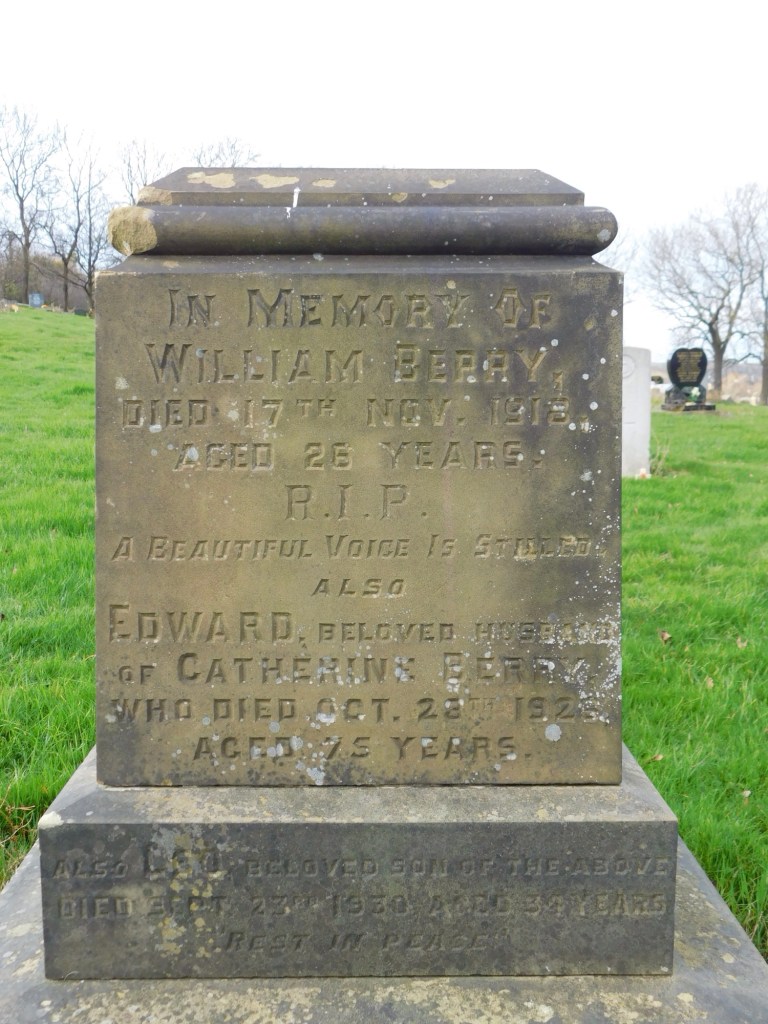
On a bleak mid-November day, I came across an evocative epitaph on a broken headstone in Batley cemetery. It read “A Beautiful Voice is Stilled.” This beautiful voice belonged to 27-year-old William Berry, and standing before the headstone, now snapped in three with the broken cross lying at its foot, I realised it was the eve of the anniversary of his death.1
St Mary’s parishioner William Berry died on 17 November 1918, less than a week after the signing of the Armistice. After more than four years of bitter conflict with Germany and her partners, Britain was finally able to contemplate a future of peace. Families up and down the county were dreaming of the imminent return home of their relatives drawn into supporting the war effort, be it directly on the battlefield, or behind the front lines in the myriad of ancillary structures like hospitals, or in the recreation and refreshment centres organised by many religious organisations such as the YMCA. Many other families would be parted from loved ones forever or, for those of faith, until they met up once more in a better place.
But though the horrors of the Great War might be concluding, the country was still in the midst of another battle, this one against an unseen, deadly enemy. For, like other countries across the globe, Britain was in the grip of the Spanish Flu pandemic. For more information about its impact, particularly locally, click here.
November 1918 marked the middle of the second wave of the virus in Britain. Those particularly badly affected were the young, and – surprisingly – those in the 15 to 35 age group, young adults usually better able to withstand respiratory infections. At 27 years of age, musical student William Berry was therefore in the high-risk age category.
William contracted influenza, and like so many of the pandemic victims he did seem to be recovering from the initial illness. But, as was typical of this virus strain, he developed a secondary infection, pneumonia, which he succumbed to, dying at Birstwith, near Harrogate.
His body was brought home to Batley where, after a full Requiem Mass at St Mary’s on 23 November – a church which played a pivotal role in his life and career – he was interred in Batley Cemetery.
William’s obituaries in local newspapers illustrate what a remarkable vocal talent he had. As the Batley News put it:
Competent judges were agreed that in a very short time he would have been fitted to take a high place amongst the tenor singers of the country, and are unanimous that his untimely death has deprived both the town of Batley and the whole of the musical world of a gifted artist of exceptional ability.2
Willie Berry, as he was known, was born in Batley on 28 January 1891. He was fifth of Edward and Catherine Berry’s six children. Wool and card cleaner Edward Berry hailed from Leeds, but by 1881 was lodging with the Delaney family of Taylor Street, Batley. Catherine (Katie) Doogan3 was born in Dublin, but her family subsequently moved to Batley.
The couple married at St Mary’s in 1884, and their other children were Mary Elizabeth, John Edward, Agnes, Margaret and Leo.
The Berry family lived at various Batley addresses, including Churchfield Terrace, Richmond Street, Providence Street and Bradford Road. Latterly Edward worked as a confectioner in the Berry family business he established after retirement from the textile industry. It was located on Branch Road, in Batley town centre. Later still, the family business further expanded to include a newsagents shop on Commercial Street.4
From an early age, William displayed a prodigious musical talent and stage presence. One early performance was on 18 and 19 March 1901, when he took part in the St Mary’s schools annual concert to raise school funds. Along with Joseph Mullins, James Cox, Richard Kelley, Thomas Scanlon, Robert Mullins, John Hudson and James Munns, he performed in a charade called “Little Pickle.”5 This was a low-key start, but perhaps an early indication of the bigger things to come.
By January 1904, the Batley Reporter and Guardian, in its report of two concerts under the auspices of Batley Old Band, wrote:
A great deal of interest centred about the appearance for the first time on the theatre stage of Master Willie Berry, the boy soprano, and the son of Cross Bank parents. He possesses a voice of rare sweetness and useful register; and the manner in which he performed his allotted task not only reflected credit upon himself, but also upon Mr. J. Wilkinson, who has been and still is responsible for his training.6 Master Berry, who is a member of the choir at St. Mary‘s Catholic Church, will be heard again.7
He was heard again, and frequently, featuring in several more concerts throughout the year.
Then, in February 1905, his trajectory to musical stardom received a major boost in the 17th annual Mrs. Sunderland musical competition, named in honour of a Brighouse soprano famous across Yorkshire. The 1905 contest, held in Huddersfield, for the first time had a competition for choir boy soloists. The heats were held on 10 February at Huddersfield Technical College. The 13 competitors sang a test piece “The Flocks of my Master” from C. H. H. Parry’s Job. In an evenly-balanced contest, all boys came out with credit.
Three boys were chosen to sing in the final, held the following day at a packed Huddersfield Town Hall. It was standing room only in some areas of the building. Those finalists were 12-year-old Isaac Sykes from Batley; 14-year-old Bradford boy Ernest Flather; and Batley St Mary’s choir boy Willie Berry, aged 14.
In the final of the choir boys section William performed what was described as a florid “Ave Maria” by Cherubini.8 He utterly charmed the audience, earning huge plaudits. The Leeds Mercury said “he performed with much beauty of voice and singular maturity of manner.”9 The Yorkshire Post declared “his singing was remarkable for purity of tone and right feeling.”10 The Brighouse News described his voice as “very bright and pure” and his performance having “perfect intonation and beautifully matured style and devotional feeling.”11 These sentiments were echoed by the Huddersfield Examiner.12 He was awarded the first prize of £1 1s.
Less than three months later he was appointed principal boy chorister at St Anne’s RC Cathedral, Leeds, taking up his duties on 7 May 1905.
In February 1906 he was back in Huddersfield for the choir boys section of the Mrs. Sunderland musical competitions. The test piece this year was Bennett’s “May Dew,” and William’s performance got him through the field of 19 to perform once more in the final three, along with Batley’s Thomas Wright, and Ilkley boy William Green.
For the final, all three boys were required to sing “O for the wings of a dove” from Mendelssohn’s “Hear my prayer,” which they did so creditably. All though made errors, and whilst William sang beautifully, his phrasing was all wrong.13 It meant he came third, with the other Batley boy claiming first prize.
William’s singing career continued, his name regularly featuring in concerts across Yorkshire. He remained as principal soprano in the St Anne’s Cathedral choir until his change of voice, always an anxious time for any male singer. But William need not have feared. He began to develop a tenor voice of remarkable promise, and his ambition to pursue a career in music remained undimmed.
During his working hours he was employed as a law clerk, but his passion throughout remained singing.
He became a pupil of renowned vocal teacher Charles Edward Patrick Wilson, whose 1911 census entry grandly describes the Kensington, London resident as a ‘Teacher of Voice Production.’14 The description though was no idle boast. C.E.P.W., as he was known to his fellow-artists, was a well-known West-End stage actor in Victorian and Edwardian Britain. Retiring at the height of his career, he opened studios in London and the North of England, where he taught singing.15 It was a mark of vocal achievement to say that you were a pupil of the illustrious C. E. P. Wilson. William Berry rapidly fulfilled the expectations of his new vocal coach.

In adulthood, despite being offered many lucrative singing appointments, William turned them all down. He wanted to continue with his musical studies and become a complete master of his art, before taking that final step to professionalism. Which is why the cemetery register describes his occupation as ‘musical student.’
But his ambitions and promise were never fulfilled, cut down by the influenza pandemic of 1918/19. His headstone epitaph is the enduring testimony of a remarkable talent lost.
Postscript:
I want to say a big thank you for the donations already received to keep this website going. They really do help.
The website has always been free to use, and I want to continue this policy in the future. However, it does cost me money to operate – from undertaking the research to website hosting costs. In the current difficult economic climate I do have to regularly consider if I can afford to continue running it as a free resource.
If you have enjoyed reading the various pieces, and would like to make a donation towards keeping the website up and running in its current open access format, it would be very much appreciated.
Please click 👉🏻here👈🏻 to be taken to the PayPal donation link. By making a donation you will be helping to keep the website online and freely available for all.
Thank you.
Footnotes
1. Note the headstone age is incorrect. Born in January 1891 he was 27 when he died.
2. Batley News, 23 November 1918.
3. Duggan is another variant of her surname.
4. 1921 Census of England and Wales, The National Archives, Ref: RG15/22349/66.
5. Batley Reporter and Guardian, 22 March 1901.
6. The J. Wilkinson mentioned in the piece was Joseph Wilkinson, the organist and choirmaster of the Purlwell Wesleyan Chapel.
7. Batley Reporter and Guardian, 22 January 1904.
8. Leeds Mercury, 13 February 1905.
9. Ibid.
10. This according to a feature in the Batley Reporter and Guardian of 17 February 1905.
11. Brighouse News, 17 February 1905.
12. Huddersfield Daily Examiner Supplement, 18 February 1905.
13. Colne Valley Guardian, 16 February 1906.
14. 1911 Census of England and Wales, The National Archives, Ref: RG14/94/166
15. Gloucestershire Echo, 29 December 1948.
Other Sources Not Directly Mentioned
• Batley Cemetery Registers.
• Batley St Mary of the Angels Parish Registers.
• Censuses – Various.
• Newspapers – Various.
• PastToPresentGenealogy – Various Blog Posts


 Past To Present Genealogy