I was thrilled last week to discover an article about the founding of the Catholic Church in Batley. The piece described the St Mary of the Angels’ humble beginnings, and how it – and the school – developed and grew, swelled by men, women and children from Ireland settling in the town.
Published in 1898, it is the earliest account I’ve come across of the parish’s history. The phraseology is very much of the period. I had to read it very carefully, and more than once, to follow some of the points. But it is of interest to anyone with parish connections it, and the original wording only adds to the history of the piece. I’ve reproduced it in full here.
S. Mary’s Roman Catholic Church.
Entertaining Records.It was not until the year 1853 that a Roman Catholic Mission was founded in Batley, but for about fifteen years prior to that time a considerable number of persons – about a couple of hundreds – who had embraced the Roman Catholic faith had a place of worship in the upper chamber of a stable in Fleming Street. The work [in 1853] was carried on under the ministry of Father Wells, who is at present a Canon in the diocese of Middle-borough [sic] at the Convent of the Poor Clare’s, York. This initial step towards the formation of a Roman Catholic Church in Batley, seems to have been the direct outcome of the establishment of the Church of St Paulinus in Dewsbury, in the year 1841. Before this time, the adherents of the faith who desired to be present at mass had to journey to Wakefield or to Leeds. Hence, it follows, that after the opening of the mission at Dewsbury, it was largely attended by people from Batley. The priest then in charge at that place was Father O’Leary, who subsequently retired on a pension and who died about three years ago in Dublin, his native town. In an
Interesting Communication
from Father Wells, addressed from Convent House, Lawrence Street, York, he gives a brief sketch relative to the successive priests who have had charge of the Batley Mission. He it was who pioneered the movement in its early days, and he states that he went on the Mission in 1852. He supplied for a few weeks at Dewsbury and Huddersfield for Fathers O’Leary and Father Arnold during their holidays. Later, he was appointed curate to Father Hostage at Halifax, where, unfortunately his health broke down, and, in consequence he was confined to his home for six months. This was in the spring of 1853, and, about October of that year, he was transferred to Mossley, near Manchester. But to one who was in an indifferent state of health, the presbytery was at too great a distance from the mission, and so it came about that he was moved to Batley, where for a time, he says he lodged at the residence of a chemist, named Oldfield, in Wellington Street, this at that time being, he believes, the main street in the town. It so happened that Father Kirby O.M.I., of St. Mary’s Richmond Hill, Leeds, said the first mass. The place set apart for worship, was, he says, an upper room which had been previously used for the work of rag sorting, and was reached by an outside wooden staircase. The sanctuary walls were papered, and at each end of the altar was a curtain, behind one of which he heard confessions. Prominently associated with the movement at that time were Mr. Tom Welsh (Chapel Fold), Mr. T. Connell (an old soldier), Mr. McNamara (Staincliffe), Mr. Charlesworth (Birstall), Mr. Ned Mara, Mr. Michael Osborne, Mr. Tom Smith, and a few others. He says he remained in Batley five years at the end of which he left for Bradford, this being on December 4th, 1858; and Father O’Connell, of the St. Mary Mission, Bradford, who had exchanged places with him, then commenced to assume the duties of priest at Batley. Father O,Connell was succeeded here by Father Lynch; next, in order, came Father Rigby, an energetic priest, greatly loved by his flock. The accommodation then consisted of a school chapel – which, by the way, is now used as an infants’ school, and it was during his ministry, that, consequently upon the largely increased number of adherents, it was found necessary to build a Church. The
Tragic End of Father Rigby
caused a painful sensation in the town at the time. It occurred at Lancaster Railway Station in 1872, after his return from the funeral of a school fellow. Through some cause he fell on the rails and a train passed over him. It was principally through his efforts that the scheme for erecting a commodious Church was carried into effect. The structure was erected in 1870, from plans by Messrs. Adam’s and Kelley, of Leeds and London, and was dedicated to St. Mary of the Angels. The cost of the building was £4,000, and there is at present resting upon it a debt of about £2,500. The vacancy caused by the sad death of Father Rigby was filled by Father Wm. Gordon, now Bishop of Leeds, and who prior to his removal to Batley had been chaplain to Lord Herries at Everingham. He was consecrated Bishop on February 24th, 1890, by Bishop O’Reilly, of Liverpool, and was appointed a colleague of the then Bishop of Leeds, Dr. Cornthwaite, at whose death he succeeded to the bishopric. During his residence in Batley the Mission received a great impetus, and he was instrumental in leading several young men to take priestly orders, among them being Father John Brannan, now a curate at Ripon, and Father Edward Scott, who is now labouring in the Diocese of Northampton. Both have relations in Batley. In the year 1874, Father Wm. Gordon was joined by his brother,
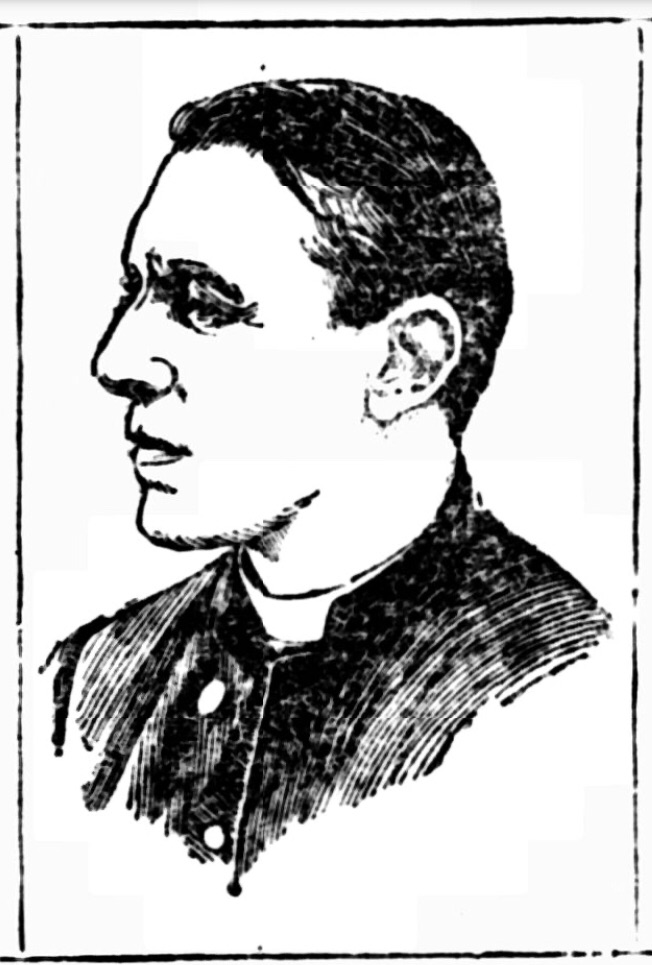
Father Charles Gordon
the priest at present in charge of the Mission; and shortly afterwards, was promoted to be the rector of the Ecclesiastical Seminary at Leeds; this being the occasion of Father Charles being appointed to the sole charge of St Mary’s. As he has now laboured in the town for close upon a quarter of a century a brief personal account relative to him will not be uninteresting. He was born in Ripon in 1844, and entered Ushaw College at the age of twelve years. Here, for a long period of twelve years, he underwent a course of training. He matriculated at the London University. But an indifferent state of health at the time prevented his taking the honours which, otherwise, he undoubtedly would have done. After completing his course of training he remained in the college for six years as Professor in the junior department, and, during the same time, he officiated as choirmaster. In August of 1874 he was ordained by Dr. Chadwick, Bishop of Hexham, and the entered upon his priestly duties at Batley as coadjutor to his brother. His personality and work in the town since that time are too well known to need any extended comment. He is beloved by his flock, and the tolerant and kindly spirit ever exhibited by him have won him the respect and esteem of many friends outside the lane of his own church, the progress the mission since he undertook the charge of if is testimony to his energy and abilities as an organiser, owing to the large increase of population in the neighbourhood of Cross Bank, where the mission is situate, his labour and responsibility have largely increased. When he came here originally he had charge of about a thousand persons; at the present time, there are about three thousand persons associated with the Mission. At the
Outset of His Labours
here, he had as his assistant, Father Meyer, who was transferred to Barnsley eight or nine years ago, when his place was taken by Father Bray, who retired from active work about six years ago on account of ill-health. He was succeeded by Father Kalb, who still remains a valued assistant of Father Gordon. Not only have they oversight of the Mission at Batley, but also the one at Birstall; and lately Father Gordon has been the means of establishing a similar Mission in Fountain Street, Morley, which was within it all the elements of success. So great has been the work undertaken with these three Missions that, some time since, Father Gordon was compelled to apply for assistance, and Father Dobson of the Leeds Seminary, was then sent there. It is worthy of note that until recently a brother of Father Charles was priest-in-charge of St. Mary’s, Sheffield, and was lately transferred to the “English Martyrs,” York.
The Church at Cross Bank
will accommodate about 500 persons. Above the high altar, within the sanctuary, are stained glass windows containing figures of Our Lord and Our Lady of the Sacred Heart, and among the saints portrayed here are St. Patrick St. Francis, St. Agnes, St. Bridget, etc. On the two side altars are representations of Our Lady and St. Joseph, and it is noteworthy that the first named altar is the one which was used for a considerable number of years in the original school chapel. On the north side of the church are three stained glass windows, placed there by Mr. Simeon Colbeck, of Boyle Hall, near Wakefield, and which are inscribed as follows, respectively:—“Pray for the good estate of Simeon and Ann Colbeck 1890”; “Pray for the soul of Agnes Colbeck, who died April 12th, 1883”; “Pray for the soul of Sister Mary Xavier (Edith Colbeck).” The two latter died at St. Mary’s Convent, York, and the windows typify the pattern saints of St. Agnes and St. Edith. On the south side of the edifice are other stained glass insertions symbolising the Annunciation and the adoration of the Magi. Displayed on the walls around the church are pictorial representations of the several stations of the Cross, which were presented by a captain Colbeck, formerly of West House, Gomersal, but now of New Zealand. Near the entrance to the sanctuary are emblematical representations of the Sacred Heart of our Lord and St. Patrick. A handsome font, with marble base, situated in a niche at the northwest angle of the Church is the gift of Mr. Benjamin Hepworth, of Spring Grove, Barnard Castle, a gentleman well connected in this locality. The organ is conveniently placed at the north-eastern angle of the church. It was erected about seven years ago at a cost of £300 by Messrs. James Conacher and Sons, of Huddersfield.1 Father Gordon was at that time a liberal contributor to the fund which was raised for the instrument. It has two manuals and contains about a score of stops. For a long period Mr. Robinson Carr ably officiated as organist, but he recently resigned, and his place has been taken by Mr. A. Busfield2 who has proved himself to be a very able and efficient organist. Near the instrument is the pulpit which is carved in oak and embodies much chaste and delicate workmanship. It is of Belgian manufacture, cost £30, and contains representations of four evangelists with Our Lady in the centre panel.
The Roman Catholic Schools.
With the increased growth of the congregation, increased school accommodation became an absolute necessity. In 1853, when the Mission was founded, there was a small school in existence but there is no official record of it until 1867, when a government inspection of it was made. The trustees were Father Rigsby, Dr. McFadden, Mr George Connolly, and Mr. James Connolly. The 70 scholars were accommodated in one class room, and had for their teacher Miss Downey.3 Passing to the year 1894, we find that the school roll contained the names of about 600 scholars, and as pressure for more accommodation was brought to bear upon the trustees from headquarters, plans for an enlarged building were prepared by Mr. J. W. Burrows, of Birstall and Morley, and the scheme then entered upon was carried out under his superintendence. Operations were commenced nearly three years ago; the buildings were completed at the close of 1896, at a cost, including building alterations, approximating £4,000. They are of Morley stone and in their internal fittings are admirably equipped with everything which is requisite for scholastic work. This is carried out under the superintendence of the Sisters of St. Paul. The large assembly room is generally considered to be one of the very best in Batley, and in many respects is a model of airiness and comfort. There are also several subsidiary rooms, most of which are fully occupied. The joinery work is in pitch pine and all the new floors are laid with wrought blocks of wood laid in concrete. There is a cookery classroom; this with the senior school, provides accommodation for 444 scholars, and the infant school for 185 scholars. The original infant school is now utilised as a classroom. Special attention has been paid to heating, lighting, ventilating, and drainage of the buildings, which include all model school improvements. For the purposes of carrying out this costly and comprehensive scheme, there was purchased from the executors of the late John Taylor a plot of land which extended from Cross Bank Road to the Cemetery boundary. The cost was £1 500 and the new schools, presbytery, etc., now stand on that ground. Dr. Gordon showed much business foresight in securing this purchase, as it has been ample for all needs and enabled the trustees to fulfil all the requirements of the government authorities. Not only did he do this, but, foreseeing future possibilities he likewise secured land in Kirkgate, Birstall, on which the Birstall Catholic Schools at present stand. With regard to the Batley schools, documents are in existence which show the preliminary statement, with a view to applying for government aid was made on December 4th 1867. The document is signed by Father Rigby. Dr. McFadden, Mr. G. Connolly, and Mr. James Connolly, the then trustees. The application was ultimately granted, and it appears that on the occasion of the first government inspection in the year 1868, there were 86 scholars in the mixed department, and 17 scholars in the infants’ department, making a total of 103. There are at the present time in average attendance in the mixed schools 263, and in the infants’ school – formerly the old school chapel – 115 scholars making a total of 378. And this increase is all the more significant when it is remembered in the meantime the Birstall school has been opened. The inspector’s reports on the education given are highly satisfactory, and the last ordinary annual grant was £376 0s 6d. It may be remembered that the schools were opened in July of last year by the Bishop of the diocese, and that a few months since a grand bazaar was held to reduce the debt existing in the estate. This by the way is worth approximately £12,000 but on these and the schools at Birstall – which cost £800 there is owing a sum of about £7000. The entire absence of everything in the form of endowment increases the financial responsibility of the trustees, but the capital and interest is being paid by regular instalments, and in order to meet these demands a generous and sacrificing spirit is being manifested by all who have at heart the welfare of the church and schools.
Postscript:
I want to say a big thank you for the donations already received to keep this website going. They really do help.
The website has always been free to use, and I want to continue this policy in the future. However, it does cost me money to operate – from undertaking the research to website hosting costs. In the current difficult economic climate I do have to regularly consider if I can afford to continue running it as a free resource.
If you have enjoyed reading the various pieces, and would like to make a donation towards keeping the website up and running in its current open access format, it would be very much appreciated.
Please click 👉🏻here👈🏻 to be taken to the PayPal donation link.
By making a donation you will be helping to keep the website online and freely available for all.
Thank you.
Footnotes:
1. Conacher and Co was a well-regarded firm of British organ builders, based in Huddersfield. Established in 1854, the organ they built for the Yorkshire Exhibition of 1866 was awarded a grand medal.
2. Arthur Busfield was a local music teacher.
3. Irish-born Anastasia Downey.


 Past To Present Genealogy