
Dominic Tarmey, the caretaker of the Oakwell Smallpox Hospital, died on Wednesday 28 December 1921. Five days later his wife Honora, who assisted him at the hospital, was also dead. Both passed away in the hospital adjacent to their home, the Oakwell Infectious Diseases Hospital, situated about a quarter of a mile down the road from the smallpox facility. Their deaths resulted from a bizarre set of coincidences.
Dominic Tarmey, was born in County Mayo in around 1860.1 In the 1891 census he was recorded as working as a labourer, lodging in Goole. By the early summer of that year he had made the move to Batley where, at St Mary of the Angels, on 22 June he married Maria Henry. She too came from Ireland. The couple’s only child, Mary Josephine, was born in July 1892.
The family lived in a two-roomed house on Back Richmond Street in the Cross Bank area of Batley, in close proximity to to St Mary’s church and school, with Dominic working in a stone quarry as a quarryman, or delver. This work involved loosening and extracting the blocks of stone from the solid rock of the quarry, either by digging, blasting, sawing, or with a pick. It would also have involved splitting the extracted blocks with hand tools to reduce them to convenient sizes. It was hard, manual labour.
But there was far more to Dominic Tarmey than these first appearances. For he was deeply committed to standing up for the rights of local working classes, as well as the Irish and the Catholics in Batley. He did this in both a private and official capacity. He wrote to the paper when slurs against the Irish were made, challenging attitudes voiced by Councillors and countering them with erudite arguments.2 He was vociferous in support of education and Catholic schools.3 He was Financial Secretary for the Batley (John Dillon) branch of the Irish National League,4 and went on to be elected as Secretary to the cross-district Heavy Woollen District United Irish League.5 He was also involved with local sports organisations.6
He became involved in local politics, addressing meetings in support of Labour Party candidates who he felt were best placed to represent working people, having a far better understanding of their plight than the local mill and coal owners who traditionally dominated local politics and positions of authority. It was a view he expressed to much popular acclaim, with loud applause greeting his statement at one meeting. Neatly summing it up he simply stated:
Up Batley Field Hill the best gas lamps are erected for your aristocratic masters and city fathers. The highways there have been made to make their palaces look picturesque and grand, while you in Skelsey Row are neglected altogether.7
He was a committed Trade Unionist too, being a friend of Ben Turner – a fellow Trade Unionist, founder member of the Independent Labour Party, Batley Councillor, and Batley Mayor.8 With Turner, Dominic formed a local branch of a trade union, going on to represent the Builders’ Labourers’ Union on the Batley and District Trades and Labour Council.9 Dominic’s esteem was such that some described him as a gentleman.10
In March 1902 Dominic’s wife died. He married again at St Mary’s on 27 July 1911. His new bride was 29-year-old Batley-born Honora Cunningham. She had known Dominic since his arrival in Batley. For a while after his wife’s death, besides working as a rag sorter, Honora (or Annie as she is occasionally recorded) helped with housework at the Tarmey’s.11
March 1916 brought a change in career and residence for Dominic and Honora. The couple left Cross Bank for Birstall, having been appointed caretakers at Oakwell Smallpox Hospital. Besides a joint salary of 26s. a week, they were also supplied with a house, coal and gas – quite a significant job perk.12 This accommodation was based further down Owler Lane, in the administrative block of the linked Oakwell Hospital for Infectious Diseases.

Oakwell Joint Hospital Board Smallpox Hospital and Infectious Diseases Hospital locations, Ordnance Survey Maps – 25 inch England and Wales, 1841-1952, Yorkshire CCXXXII.3, Revised: 1915, Published: 1922 – Re-use: CC-BY by NLS
Under the management of the Oakwell Joint Hospital Board, the Infectious Diseases Hospital formally opened in December 1903, admitting its first patients the following month. On the Foxhall Farm site, and covering about eight acres, the hospital stood in an elevated position away from the general population, making it ideally suited for the treatment of patients suffering infectious diseases such as scarlet fever, typhoid and diphtheria. Despite its isolation, it was not too far away from the Howden Clough and Drighlington Great Northern Railway Stations, and the Birstall, Birkenshaw, Drighlington, Gildersome and Gomersal urban areas it served. Later it became the Oakwell Geriatric Hospital, which finally closed in 1988. Its rough location is where the IKEA complex stands today.
The building of a specific smallpox hospital followed in 1906. Also part of the Oakwell Joint Hospital Board, this was a far smaller complex. It gained widespread attention during smallpox outbreaks in 1953 and 1962, when it treated patients from across West Yorkshire. The smallpox hospital complex was demolished in 1984. As I understand it, the land on which it stood cannot be used for house building because of the contamination risk. In terms of present day location, it stood on the waste ground off Owler Lane, near Asbestos Yorkshire.

Dominic and Honoria were recorded still in their “caretaker smallpox hospital” posts on 19 June 1921, in the census. A little over six months later both would be dead.
Part of Dominic’s duties included taking patients to the hospital and taking away their clothes. Around three weeks before his death, he loaded the van and delivered the clothes to a location in Birstall. In doing so he slipped and caught his right hand on the brickwork of the building’s door, grazing it to the point of drawing blood. Birstall cab proprietor John Edwin Thornton (the reports incorrectly give his name as John Edward) drove the hospital van for Dominic that day, and was with him several times after that incident. Not once on those later occasions did Dominic complain of any ongoing problem with his injured hand. The inference from this being it was causing no discomfort or concern.
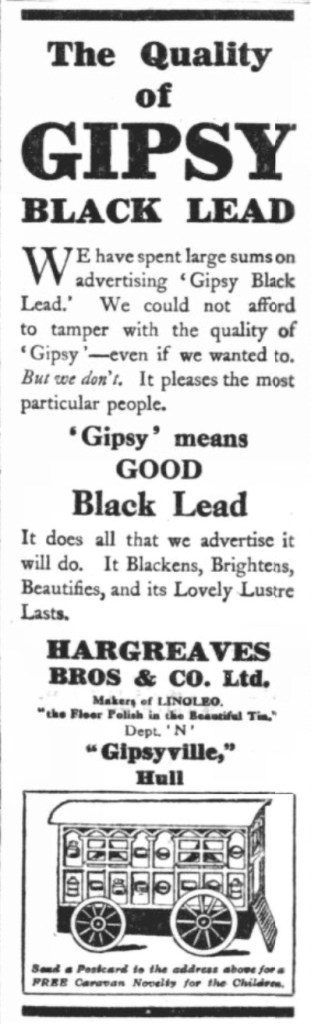
Then, on Saturday morning, Christmas Eve, Honoria knocked the thumb on her left hand whilst black-leading. This was the process of applying black-lead graphite to fireplace grates and cooking ranges to clean and polish them, an especially important job at this time of year for those wanting to get their home spick and span for Christmas. It was a tedious job, applying the black lead with a damp rag, ensuring every crevice was pasted, allowing it to dry, then brushing or polishing it off. Other variations included making the black lead into a paste with copperas, bone black and water, then applying it. Vinegar was another suggested addition to the paste, to increase shine. All ingredients were rough and chapping for the hands, the work could be fiddly, and the with the amount of rubbing and polishing needed, no wonder Honoria caught her thumb breaking the skin.
As part of their Christmas preparations, the couple received a consignment of geese and turkeys from Ireland. Despite suggestions from some quarters to the contrary, hospital officials were adamant in their assertions at the couple’s subsequent inquests that these fowl were for the Tarmey’s own festive table, and had nothing whatsoever to do with the hospital.
Unlike our supermarket fare today, these geese and turkeys had to be plucked and drawn – the latter task sounds particularly unpleasant, involving removing the bird’s digestive system and other entrails and inner organs, e.g., crop, gullet, windpipe, heart, liver, gizzard, kidneys. This task was undertaken once Honoria had completed the black-leading – and therefore with her recently-injured thumb.
On Boxing Day, Mary Josephine visited her father and step-mother. Dominic’s right arm was inflamed, and Honoria complained about the cut on her hand. That afternoon, in great distress, Honoria phoned Matron Ann Ludlham Newbould at the hospital. She told them to come across. Despite Honoria explaining that the pain from her thumb extended up her arm, and this pain had only come on after drawing a turkey, she was sent back home.
In contrast, delirious, with a high temperature, and aching all over Dominic was admitted on the ward at 4pm, where Dr. Alexander Dick attended him. Initially, and somewhat surprisingly from my reading of the inquest notes, he diagnosed influenza. It was not until the following day – Tuesday – that Dr. Dick noted Dominic’s right arm was swollen up to the shoulder, he had blisters on his forearm, and a superficial wound on his right hand. Most of these signs and symptoms had been noted the previous day by others – including those with no medical expertise like Mary Josephine Tarmey. Dr. Dick now amended his diagnosis to septicaemia.
That day, Tuesday 27 December, Honoria deteriorated to such an extent that she too was admitted to the hospital. Dr. Dick diagnosed her with septicaemia.
Dominic died on Wednesday 28 December 1921. His funeral service, conducted by St Mary’s priest Fr. Peter McBride, took place on 1 January 1922. The following day Honoria died, with Fr. McBride once more officiating at the funeral, which took place on 5 January. They are both buried in an unmarked grave in Batley cemerety, alongside Dominic’s first wife.

The 2 January 1922 happened to be evening of the Batley and District Trades Labour Council’s annual conference, an organisation with which Dominic was long associated. They expressed their condolence with Dominic’s bereaved daughter by rising for a moments silence. Ben Turner expressed admiration for his friend.
In both Dominic and Honoria’s inquests, the respective juries reached a verdict of accidental death. Husband and wife did die of the same cause, septicaemia. But their blood poisoning was contracted under different circumstances.
The District Coroner, Mr. C. J. Haworth stated in Dominic’s case it was the result of the graze on his right hand caused by slipping against the brickwork of a house whilst delivering clothes some 3+ weeks earlier. In Honoria’s case it was due to infection contracted from animal contamination through the wound in her hand, the contamination occurring after plucking and drawing the Christmas fowl.
It does, however, seem an unfortunate – and possibly improbable – set of coincidences.
Postscript:
I may not be able to thank you personally because of your contact detail confidentiality, but I do want to say how much I appreciate the donations already received to keep this website going. They really and truly do help. Thank you.
The website has always been free to use, and I want to continue this policy in the future. However, it does cost me money to operate – from undertaking the research to website hosting costs. In the current difficult economic climate I do have to regularly consider if I can afford to continue running it as a free resource.
If you have enjoyed reading the various pieces, and would like to make a donation towards keeping the website up and running in its current open access format, it would be very much appreciated.

Please click 👉🏻here👈🏻 to be taken to the PayPal donation link. By making a donation you will be helping to keep the website online and freely available for all.
Thank you.
As a professionally qualified genealogist, if you would like me to undertake any family, local or house history research for you do please get in touch.
More information can be found on my research services page.
Footnotes:
1. The 1911 census indicates Castlebar, County Mayo.
2. Batley Reporter and Guardian, 7 September 1900.
3. Batley Reporter and Guardian, 2 March 1906
4. Batley Reporter and Guardian, 26 January 1900.
5. Batley Reporter and Guardian, 3 July 1903.
6. Batley Reporter and Guardian, 26 October 1895.
7. Batley Reporter and Guardian, 25 October 1907. Skelsey Row being one of the areas where the Irish community lived.
8. In 1922 he was elected as the local MP.
9. Batley News, 7 January 1922.
10. Batley Reporter and Guardian, 18 August 1905.
11. Ibid.
12. Batley News, 4 March 1916.
Other Sources:
• Batley Cemetery Burial Register.
• Batley St Mary’s parish registers.
• Censuses England and Wales, various dates.
• National Library of Scotland Maps.
• National Probate Calendar, England and Wales.
• Newspapers – Various.


 Past To Present Genealogy