
On 8 May 1878 Batley St Mary of the Angels priest, Father Charles Gordon, officiated at the funeral of Dublin-born power-loom weaver William Doogan. Living in Batley for around 14 years, at the time of his death William resided in the Clark Green area. He was around 68 years old when he died (not 63 as indicated in his death registration and the cemetery records), following an illness lasting around three months.
But this was no ordinary funeral, far surpassing the scale you would associate with one for an Irish Catholic textile worker in the Victorian era.
William’s funeral cortège left his home. The procession was headed by a firing party of 14 from the Batley Rifles Corps, with arms reversed, and followed by a band which played the “Dead March” in Saul all the way to the cemetery. Next came other members of the Batley Rifles Corps (with the firing party and coffin bearers, almost 70 of these were present), including commandant of the Corps Captain Hemingway, Assistant-Surgeon McFadden and Lieutenant Ellis. Next in the procession came William’s friends, followed by William’s black cloth-covered coffin which was borne on the shoulders of four members of the Rifle Corps. Behind it came the chief mourners. They all made their way to the cemetery gates, where Father Gordon, accompanied by a cross-bearer and four acolytes, met them.
All along the route the streets were lined with spectators paying their respects, and the cemetery was nearly filled with people. Estimates put the numbers present at not less than 15,000 to 20,000.
At the end of the funeral service, Rifle Corps drill instructor Sergeant Ottaway gave the command, and the firing party fired three volleys over the grave.
So why was so seemingly humble a person given such an impressive send-off?
The answer was simple. On 25 October 1854, Private William Doogan of the 13th Light Dragoons, had taken part in the iconic Charge of the Light Brigade. This event, seared into Victorian British psyche, was part of the Crimean War’s Battle of Balaklava. William Doogan was one of the 600 immortalised in Alfred Lord Tennyson’s eponymous narrative poem, published only six weeks after the Charge.
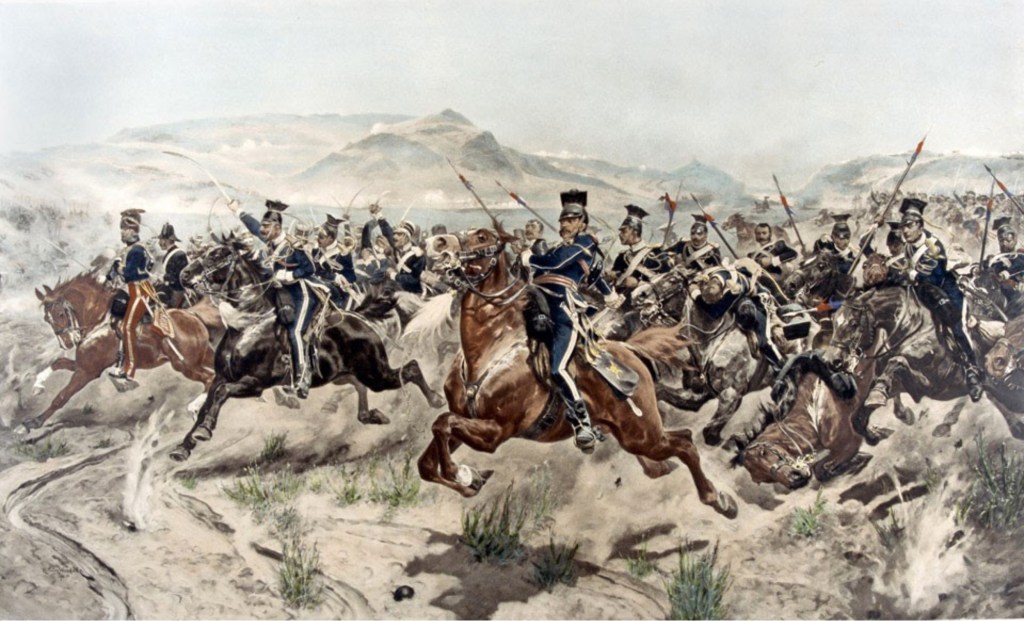
The Charge of the Light Brigade by Richard Caton Woodville Jr., oil on canvas, 1894, Wikimedia Commons
The Light Brigade was a British Army light cavalry force, made up of several regiments. Designed for the speed needed for reconnaissance, skirmishes and driving off a retreating enemy, their horses were unarmoured and the men carried lances and sabres. The Charge was a case of orders being misinterpreted and the wrong objective being attacked. Displaying incredible bravery, the men and horses charged into a valley. To either side and in front of the valley slopes they faced an overwhelming Russian force – whose weaponry included 30 or 40 canons.
It was carnage. Although not wiped out, the brigade suffered catastrophic casualties, with later calculations putting figures at 118 killed, 127 wounded and around 60 taken prisoner.1 A contemporary figure at 2pm on the day of the Charge, by war correspondent William Howard, put the 13th Light Dragoon figures at 130 going into action and only 61 returning.2 That count put the total number who went into action across all regiments of the Light Brigade at 607.
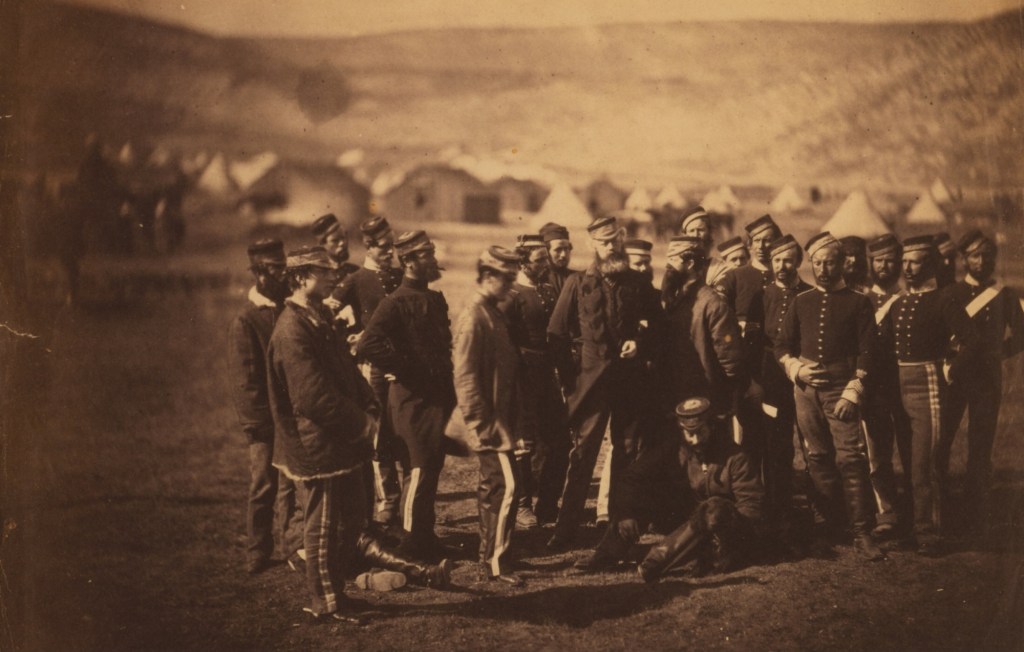
Wikimedia Commons, United States Library of Congress‘s Prints and Photographs division
under the digital ID cph.3g09230,
William Doogan enlisted with the 13th Dragoons on 8 March 1831. Despite the 21-year-old weaver being born in the Dublin parish of Chapeleazie [sic],3 his enlistment place was Leeds. His enlistment papers describe him as 5’ 7’’ tall, with a fair complexion, grey eyes and brown hair. He made his mark rather than signing his name. His assigned service number was 605. Part of the incentive for William to sign up was financial. There is an enlistment bounty of £2 12s., detailed in his records. On taking his oath of Allegiance and Fidelity he received the sum of two shillings and sixpence.
He served as a Private throughout his military service, which ran from his enlistment date through to the decision to discharge him on 5 September 1855.
His physical description on discharge he was 5’ 8” tall, with dark brown hair, grey eyes and a sallow complexion. His trade was expanded to a broad cloth weaver.
The decision to dispense with his services was made on grounds that he was deemed unfit for further military service, because of his failing strength and activity. By the time he was finally discharged on 2 October 1855, he had amassed 24 years and 53 days service, over nine months of which had been in Turkey and the Crimea.4
According to newspaper reports at the time of his death, he had obtained a discharge prior to the Crimean war, having almost served his time, but he chose to go out there with his regiment. Those reports also falsely claim he took part in the Indian Mutiny – he had already received his army discharge by 1857.5
However, there were also over 220 more days deducted from his military entitlement, because time served in prison. For the official assessment made of William’s character and conduct was bad.
His record shows three spells of imprisonment. One between 26 January 1844 to 9 March 1844; another between 17 February 1845 and 19 May 1845; and the final one between 10 and 30 July 1850.
A notation relating to the first two of these explains more. The first states he was tried by a Regimental Court Martial at Hounslow on 31 January 1844 for being drunk and using disrespectful language towards a non-commissioned officer for which he was “corrected” and sentenced to 40 days imprisonment with hard labour.
The second notation states he was tried by a District Court Martial at Exeter for being drunk and using disrespectful language towards a non-commissioned officer. Again, he was corrected and sentenced to three months confinement with hard labour.
Needless to say, he earned no good conduct badges. But for his service in Crimea he was awarded the Crimean Medal, with four clasps for Alma, Balaklava, Inkerman and Sebastopol. Against his Balaklava and Sebastapol medal roll details are notes that he was invalided to England. Another source states he was sent to Scutari, famed for the place where Florence Nightingale established her military hospital, on 11 December 1854 and invalided to England on 10 February 1855.6

Credit: Crimean War: Florence Nightingale at Scutari Hospital. Coloured lithograph by E. Walker, 1856, after W. Simpson. Wellcome Collection. Source: Wellcome Collection.
Upon discharge he was also awarded a daily army pension of 1s.
He did marry. His wife Mary was a widow of a soldier from the Scots Greys. She was around nine years his junior, and originally from Bristol. They never had children. The 1871 census records the couple living at Cross Street, Purlwell. By now, William had employment as a woollen weaver. She was a dressmaker.7
In Batley he forged a close friendship with grocer John Harrop, who had served as a farrier-major in the same regiment as William. During his final illness, John was said to have been “unremitting in his attentions to him, and scarcely ever left his bedside…and the gallant soldier died in that gentleman’s arms”.8
A little over a year after his death, on 29 July 1879, his widow died. She was buried alongside her husband.
Despite all the pomp surrounding his funeral, William Doogan, one of Tennyson’s so-called 600, lies in an unmarked grave in Batley cemetery.
When can their glory fade?
O the wild charge they made!
All the world wondered.
Honour the charge they made!
Honour the Light Brigade,
Noble six hundred!9

Postscript:
I want to say a big thank you for the donations already received to keep this website going. They really do help.
The website has always been free to use, and I want to continue this policy in the future. However, it does cost me money to operate – from undertaking the research to website hosting costs. In the current difficult economic climate I do have to regularly consider if I can afford to continue running it as a free resource.
If you have enjoyed reading the various pieces, and would like to make a donation towards keeping the website up and running in its current open access format, it would be very much appreciated.
Please click 👉🏻here👈🏻 to be taken to the PayPal donation link. By making a donation you will be helping to keep the website online and freely available for all.
Thank you.
Footnotes:
1. Paget, Henry (1975) A History of the British Cavalry 1816 – 1919 Vol 2. London, Leo Cooper.
2. Wikimedia Commons, 14 November 1854 “The Cavalry Action at Balaclava 25 October” The Times No 21898. These figures were also re-published in the Illustrated London News of 30 October 1875.
3. This was the spelling in his service records. I suspect it should be Chapelizod, Dublin.
4. This ‘over nine month duration’ comes from William Doogan’s entry in the E. J. Boys Archive, Lives of the Light Brigade https://www.chargeofthelightbrigade.com/
5. Batley Reporter and Guardian, 7 May 1878.
6. The specific dates for being sent to Scutari and invalided to England are taken from the E. J. Boys Archive.
7. 1871 Census of England and Wales, The National Archives, Ref: RG10/4583/55/18/97.
8. Batley Reporter and Guardian, 7 May 1878.
9. Final stanza of Tennyson’s poem The Charge of the Light Brigade.
Other Sources:
• Batley Cemetery Burial Registers.
• Batley St Mary of the Angels Burial Register.
• Campaign Medal and Award Rolls.
• Newspapers – various.
• Royal Hospital Chelsea Pension Records
• WO97 Army Service Records.


 Past To Present Genealogy