Have you ever wondered what your ancestor’s ate in wartime Batley, as food shortages kicked in? This piece may give some idea.
By April 1917, almost three years into the war, food and ingredient shortages were becoming increasingly noticeable. Restrictions were being introduced, like the Bread Order 1917 and the Cake and Pastry Order 1917. This led to confusion reigning over what bread and bakery products were now allowed. One of the burning issues making headlines that Easter, which fell at the beginning of April, was “WILL HOT-CROSS BUNS BE AVAILABLE?”1
Later that month the Yorkshire Bakers’ Association lobbied successfully to have the ban on the Yorkshire tea-cake removed – but with caveats such as a prohibition on inclusion of sugar and currants, and a 50 per cent maximum content of wheaten flour. That meant half the weight of the ingredients used must consist of something other than wheat flour.
Puff pastries were banned, along with jam pastries, vanilla sandwiches and custards. Other restrictions also applied. Whilst bakers were allowed to make “long buns” with currants, they could not contain more than 10 per cent of sugar and 50 per cent of wheaten flour. Cakes like “Madeira” were permitted, only if no edible substance was used externally – even the use of citron peel, which was placed on top of the loaf, had to be discontinued. All attempts of ornamentation were to be avoided. And housewives across the country were urged to follow the example of commercial bakers in their home-made products.
As spring progressed, so-called Local Food Economy Campaigns gained impetus. Groups such as the Batley Food Substitute Committee identified alternative ingredients to replace items which had limited availability. For example, with potatoes in short supply, the Committee promoted various alternative rice recipes in the local press. Sugar substitutes included treacle and corn syrup, the obvious alternative of honey being scarce too in May 1917. The food economy push even trickled down to schools, with it being a central topic of the Batley school celebrations of Empire Day in May 1917.
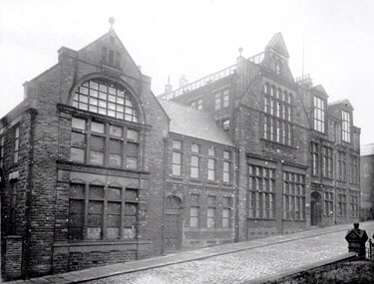
Another initiative was a communal kitchen. After weeks of planning this opened in June 1917 initially in Batley’s Technical School, aimed at providing workers with hot meals at a cheap price. An example of the fare, as advertised for the first few days of opening, was:
- Wednesday – Irish stew 3d., date pudding with custard 2d.
- Thursday – Meat and potato pie 3d. and 4d., rice pudding (with or without fruit) 2d.
- Friday – Tripe and onions with vegetables 3d. and 4d., liver and onions with vegetables 3d. and 4d., roly-poly pudding 2d.2
Recipe suggestions abounded. Some collections, like A Yorkshire Cookery Book published in the latter part of 1916, were wartime fundraisers. With almost 750 ‘useful and economical’ recipes collected by Mary Milnes Gaskell – many submitted by Yorkshire people – the book was sold to raise funds for the a branch of Queen Mary’s Needlework Guild at Wakefield. These monies were then used to purchase materials to make garments for soldiers at the Front and in hospital. Recipes included ones for damson cheese, oatmeal biscuit, marrow lemon curd, green tomato chutney, vegetable marrow jam, Christmas cake and Yorkshire Parkin. Contributors included public figures such as the Mayoress of Wakefield, to the lesser-know M. Greenwood of Mytholmroyd, Mrs Mitchel of Ossett, Mrs Capewell of Wakefield and E Burnett, near Leeds.

At a national level Dr Edmund Ivens Spriggs, who advised at the Ministry of Food, devised household meal planning guidance. Extracts were published in the 28 April 1917 edition of the Batley News. The planner read as follows:
WEEKLY BUDGETS.
Practical Advice on Meals.
By E.I. Spriggs, M.D., F.R.C.P.The quantities of food given below are suggested for families doing light continuous work. If a family is composed entirely or mainly of tall thin men, or men or women doing hard work, one-fifth more may be added to these figures; if entirely of women and girls, less will be needed.
Examples of diets, such as are found below, must not be followed too closely. Meals should always be varied as much as possible, both from day to day and week to week.
In the first two diets the amounts are calculated for a family of four. A simple sum will reduce them for a family of two or three, or increase them for six, eight or more.
Plain Diet, 4 Persons (Cost About 8s 8d per Head per Week)
PURCHASES.—Bread 15 lbs., flour ¾ lb., meat 10 lbs., sugar 3 lbs., fish 2¼ lbs., 7 eggs, milk 8¼ quarts, margarine 1½ lbs., dripping ½ lb., oatmeal 6½ lbs., barley 1lb., rice 1lb., lentils and beans 1lb, potatoes 3½ lbs., vegetables 1lb., tea 6ozs., syrup 1¼ lbs., cocoa 2 ozs., stock 5¼ quarts.DAILY FARE.—There is bread at each meal, but little or none is eaten at dinner time unless there is soup or broth. Breakfast: Porridge, margarine, tea, sugar, milk. Tea should only be taken if supper must be late. It includes oatcake, margarine, golden syrup, tea, sugar, milk. Those taking only three meals eat these foods at dinner or supper. Supper: Oatcake, margarine, cocoa, milk, sugar.
OTHER DISHES (Breakfast, dinner, tea and supper are shortened to B., D., T., and S.)— Sun. B. Boiled eggs. D. Boiled mutton, white sauce, potatoes, treacle pudding. S. Mutton pie. Mon. D. Fish, soup, boiled sausages, onions, barley. S. Potted meat. Tues. D. Hot pot, tapioca pudding. S. Cold mutton pie. Wed. D. Broth, potted meat, potatoes. S. Curried mince. Thurs. D. Broth, beefsteak pie, beans. S. Stewed mutton. Fri. D. Lentil soup, kedgeree, rice. S. Curried fish. Sat. D. Broth, stewed liver, onions, barley. S. Cold mutton.
Medium Diet, 4 Persons (Cost 10s 5d per Head per Week)
PURCHASES. —Bread 11 lbs., flour 2½ lbs., meat 10 lbs, sugar 2 lbs., fish 1¼ lbs, and 16 kippers, 2 dozen eggs, milk 11½ quarts, cheese ¾ lbs., butter 2 lbs, suet and dripping ½ lb., oatmeal 4 lbs., barley ¼ lb., rice 1½ lbs., lentils and beans ½ lb., potatoes 3 lbs., vegetables 4 lbs., fruit 2 lbs, jam, jelly and marmalade 2 lbs., syrup ¼ lb., (stock 4 quarts).DAILY FARE. —Bread at each meal. Breakfast: Oatcakes, butter, marmalade, tea, sugar, milk. Tea (if supper is late): Oatcake or barley scones, butter, jam or jelly, tea, sugar, milk, plain cake.
OTHER DISHES. —Sun. B. Bacon. D. Stuffed mutton, peas, potatoes, treacle pudding, figs, milk. S. Macaroni cheese, bread, oatcake, butter, jam. Mon. B. Poached eggs. D. Fish soup, boiled sausages, onions, barley, milk pudding, milk. S. Cold tongue, oatcake, butter, jelly. Tues. B. Kippers. D. Lentil soup, cod, rice, ginger pudding, milk. S. Macaroni cheese, oatcake, butter jelly. Wed. B. Scrambled eggs. D. Broth, stewed beef, turnips, potatoes, custard, dates, milk. S. Curried mutton, rice, oatcake, butter, jelly. Thurs. B. Fish cakes. D. Jellied beef, beetroot, potatoes, rice pudding, milk. S. Mutton cutlets, oatcake, butter, jelly. Fri. B. Boiled eggs. D. Irish stew, apple dumpling, milk. S. Kippers, oatcake, butter, jam. Sat. B. Fried eggs. D. Broth, mince, haricot beans, sage pudding, milk. S. Beef mould, beetroot, oatcakes, butter, jam.
To my mind the plain diet does seem beyond the means of many working class Batley residents. But it gives some indication of meals, and the influence of Empire with the appearance of curried meals and kedgeree. And seeing the differences between the plain and medium diet laid out in this format is interesting, with the latter having a wider variety of food, and more of it. The lack of fruit and vegetables in the plain diet is particularly noticeable.
But back to the tea-cake controversy, which did not end in April. The debate over its wartime permitted size and contents continued to rage, including frequent prosecutions. Essentially, the wartime version included ground rice to replace some of the flour, a milk/water mix of liquid, and a reduction in yeast. It did not produce a “grand brown tea-cake”. Rather the baked product was of a whitish nature, which was described as none the less wholesome!
And if you want to try a Yorkshire tea-cake recipe from 1928, once it had been restored to its pre-war glory, here’s a 1928 version:3
- 2lb of four.
- 3oz of lard.
- 1 pint or more of old milk.
- 1oz of yeast.
- A pinch of salt, and a little nutmeg to taste.
Warm the ingredients; then mix together the flour and lard, salt and nutmeg in a basin. Make a hole in the middle, pour in the yeast – dissolved in a little warm milk – add sufficient sour milk to make the whole into a smooth paste and knead it well. Let it rise near the fire. When it cracks, work lightly with the hand and keep lifting it up with the fingers to let the air get into it. Put it in a warm place to rise again for an hour. Make into flat round cakes, allowing 1½ oz to each cake. Put on warm baking sheets; let the cakes rise about ten minutes. Bake in a fairly hot oven about 15 minutes.
Adding a few currants and a little sugar after the paste is moistened – about ½oz of mixture for each cake – will produce sweet, small tea-cakes.
P.S. I am not responsible for any resultant baking disasters!
Footnotes:
1. Yorkshire Evening Post, 2 April 1917.
2. Batley News, 2 June 1916.
3. Yorkshire Post, 7 September 1928.


 Past To Present Genealogy