
It is easy to fall into a trap of thinking the Irish who came to Batley in the early days were a homogenous group, united in religion and beliefs, especially when considering migration to Batley was largely from County Mayo.
However, as I have been finding in the course of my research about those early migrants, this is an oversimplification. See for example my piece about the 1870s Privy Riots and the Death of a Policeman.
As I’ve researched further, it appears a factor underlying some of these inter-Irish tensions which sparked trouble – especially in the period from the late 1870s and early 1880s – are a result of developments in populist Irish nationalism. Claims of links to Fenianism (militant Irish Republicanism) are overtly made in connection with disputes involving the Batley Irish community. There are also references to the Irish National Land League influences.
This organisation was founded in 1879 as a result of the drive and energy of Michael Davitt, fuelled by his own childhood memories as the son of an evicted tenant farmer from County Mayo. Charles Stewart Parnell, who became head of the Home Rule League the following year, was elected its President, thus drawing together two major issues – government and ownership of land in Ireland.
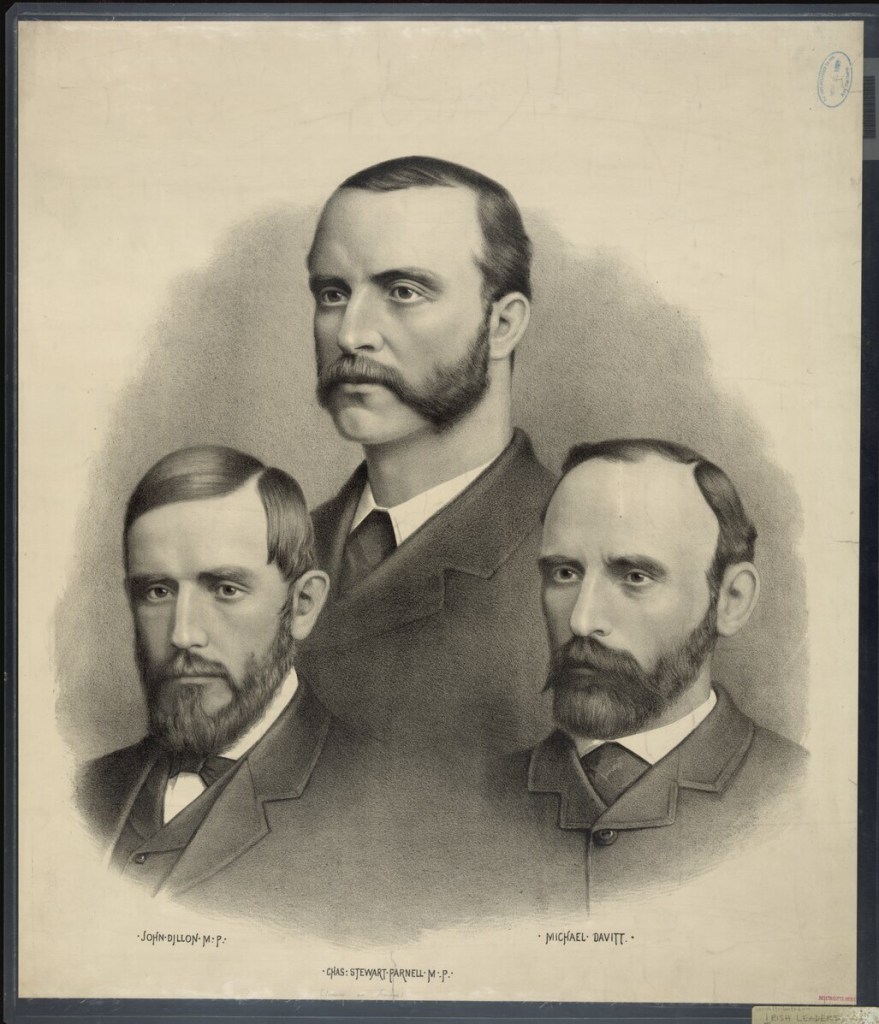
Considered one of the most important movements in Irish history, the Land League struck a chord across Ireland. It’s aims were
- fair rent;
- fixity of tenure to allow farmers to stay on their land without threat of eviction;
- and free sale of a tenant’s interest in a property which would grant the right to farmers to work towards full ownership of the lands they tilled.
The Land League set about achieving its aims in a variety of ways, including the widespread use of civil disobedience with acts of arson, cattle-maiming and intimidation. It also led to a new word in the English language – boycott. A landlord’s agent in Co. Mayo called Captain Charles Cunningham Boycott refused to lower the rents of tenants who were facing hardship because of bad harvests. For this reason, the tenants refused to have any dealings with him. This social ostracism term was coming to attention in late 1880.
At around Christmastime of 1880 fears of militant Fenianism (Irish Republicanism) were rife in Batley.
The existence of a so-called Fenian society connected with the Irish Land League came to light following an assault on Michael Gavaghan on 18 December. Additionally there were allegations of threats and intimidation against his brother John, who said he was in fear of his life because he would not join this secret society. As the case progressed documents showing the existence of this illegal society at Batley amongst the Irish were said to have been found in the possession of some of the accused.1
The society was called “The 98”, and it was alleged Patrick Foley, a 50-year-old gas stoker of Hume Street headed it.2
Although its members claimed it was a religious society, aimed at commemorating the achievements of their Irish forefathers, others asserted it was a secret organisation with far more sinister undertones. Society members were said to have employed threats and intimidation against non-members – including specific threats of ‘boycott’ – to coerce them into joining.
Far from being religious in nature, it was said to be named “The 98” to specifically commemorate the Irish rebellion against the English in 1798.
The case was reported across the country, with newspapers like The Globe, based in the London, carrying headlines of “Fenianism in Yorkshire”.3
Patrick Brannan, a 21-year-old labourer, and John Cairns, aged 30 and also a labourer, were initially charged with wounding Michael Gavaghan. Then on 21 December Patrick Foley and his son John of New Street were arrested too. Patrick’s house was searched and 95 cartridges with conical heads bullets, used in Colt revolvers, were seized. It was believed the arms themselves had only recently been removed.4 It created a local sensation.
Finally another New Street man, 26-year-old collier Thomas McManus, was also arrested, along with Patrick Mulligan, a 23-year-old labourer. This brought the number of arrests to six.
The case against Thomas McManus was discharged. It transpired he was not involved with the events of 18 December, having only been released from prison that day. Neither was a member of “The 98” Society. John Foley was also dealt with in Batley by the magistrates, bound over to keep the peace for six months.
However, the other four men (Patrick Foley, John Cairns, Patrick Mulligan and Patrick Brannan) were tried at the West Riding Quarter Sessions held in Leeds Town Hall on 4 January 1881. They were all found guilty of unlawfully and maliciously wounding Michael Gavaghan, and were each sentenced to 18 months imprisonment with hard labour at Wakefield Prison.
A little over 30 years later, some of these surnames would feature amongst those from St Mary of the Angels parish fighting in the British Army,
Postscript:
Finally a big thank you for the donations already received to keep this website going. They really do help.
The website has always been free to use, but it does cost me money to operate. In the current difficult economic climate I do have to consider if I can continue to afford to keep running it as a free resource.
If you have enjoyed reading this post (along with the hundreds of others), and would like to make a donation towards keeping the website up and running in its current open access format, it would be very much appreciated.
Please click 👉🏻here👈🏻 to be taken to the PayPal donation link. By making a donation you will be helping to keep the website online and freely available for all.
Thank you.
Footnotes:
1. Leeds Times, 24 December 1880
2. Note there is some confusion over the occupation of Patrick Foley. This is the occupation taken from Calendar of Prisoners, Prison Registers, The National Archives, Ref: HO140/56. Other newspaper sources say he was a labourer, and it was his son John who was a gas stoker. However Patrick’s occupation in the 1881 census, whilst in Wakefield prison, was indeed given as a gas stoker.
3. The Globe, 5 January 1881
4. Batley Reporter, 24 December 1880


 Past To Present Genealogy