
Less than a year after the success of the first Batley St. Mary of the Angels Torchlight Procession, a second procession was planned for Monday 29 September 1952.
It was hoped this second demonstration of faith and prayer would match the scale of 1951, which attracted 4,000 procession participants, with an estimated further 20,000 spectators lining the streets and market place.1
To that effect Father Gallon, the parish priest who inaugurated the event, through the medium of the Batley News extended a cordial invitation to the town’s non-Catholics to join in the procession.2
And, in the days before the event, around 3,000 new torches arrived in Batley. The design of those torches will be very familiar to Torchlight Procession participants decades later, as seen in the photograph, below.
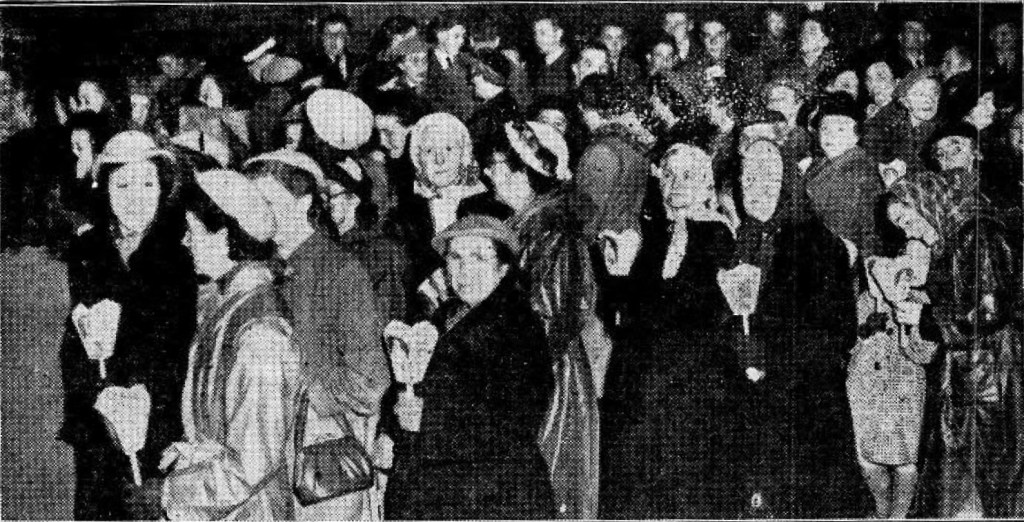
What is not so familiar in today’s disposable world, but a large percentage of the 4,000 who attended the previous year’s event brought their torches back in 1952. Britain was still haunted by the shadow of the Second World War, with rationing still in place. It illustrates even cardboard torches and candles were valued and retained, a combination of the religious significance attached to them, Yorkshire thrift, and tight family finances.
The 29 September weather proved unkind, it being a cold, dismal night, with periods of heavy drizzle. Yet this did not dampen enthusiasm for the occasion. Catholics from beyond the parish, including Birstall, Batley Carr, Ossett, Lupset and the wider West Yorkshire area, came to Batley. An estimated 6,000 to 7,000 men, women and children took part in the procession itself, walking the route from the church to the market place, brandishing their torches. Non-Catholics responded to Father Gallon’s invitation too, thousands lining the route.
Setting off at 7.30pm, the procession was accompanied by the Ravensthorpe Prize Band. Escorted by police they made their way along Cemetery Road, Clerk Green, Wellington Street and Commercial Street. As they approached the Town Hall the strains of the “Ave Maria” could be heard distinctly, and the melody was taken up by the hundreds waiting in the Market Place. For near the brightly-lit, flower-laden altar erected here, seats had been set out for the old and infirm – many of whom had waited patiently for over one hour for the procession to arrive.
Led by cross-bearer Tom Brannan and a host of white-surpliced altar boys, the approaching procession made for an ethereal sight. Thousands of tiny figures, each lit by the glow of a single candle, wove a web of lights as – mirroring the pilgrims to Lourdes – they crisscrossed the market place in their ascent to the altar. The “Aves” grew ever louder, and the chimes of the library clock striking 8.45pm were almost drowned out by the thousands of voices.

When all had arrived in the Market Place and taken their positions, Father Gallon gave his address. He explained the three-fold reasons for the event, all linked to peace – worldwide, countrywide, and locally.
Peace would be a subject which resonated with the audience, with many lives being impacted by the War which had ended only seven years earlier – indeed some lives would never be the same with the loss forevermore of loved ones, or health permanently affected through injuries incurred.
The first aspect was to pray for universal peace. He pointed out there was no peace in Korea or Malaya, and there was the danger of our own boys and girls being called to take part in a most terrible war. As he said, if we were able to get help by prayer, we would be foolish not to pray. With the shadow still being cast by the previous War, this fear of further conflict would have been all too real to those present in the Market Place that night, standing only yards away from Batley’s War Memorial.
Secondly it was to ask that the reign of Queen Elizabeth II be blessed in a most wonderful manner, and that it would not be as hard and difficult as her father’s had been. To put that into context, the Queen acceded to the throne only months earlier, following the death of her father, George VI, on 6 February 1952. Her father’s reign had started under a cloud. His brother Edward VIII abdicated in 1936, within months of becoming King, in order to marry twice-divorced American socialite Wallis Simpson. It did not get easier, for George VI had then been the country’s monarch throughout the dark and worrying days of the Second World War.
Father Gallon said the third and final aim of the evening’s devotions was to ask God to bless all the families in Batley so that the peace of God might reign in their homes. He went on to say:
There may be some foolish man or woman who will say ‘We don’t want prayers.’ Every man and woman wants the blessing of God on his household and children. We ask that our fathers and mothers might be characterised by the great virtue of fidelity – the fidelity of husband and wife and the fidelity of children to their parents.3
Other priests who participated in 1952 event included Father Moloney of Birstall, the celebrant of Benediction. He was assisted by Father Creed and Father Monaghan.
The event proved to be an outstanding success, eclipsing the mammoth spectacle of 1951.
Postscript:
I may not be able to thank you personally because of your contact detail confidentiality, but I do want to say how much I appreciate the donations already received to keep this website going. They really and truly do help. Thank you.

The website has always been free to use, and I want to continue this policy in the future. However, it does cost me money to operate – from undertaking the research to website hosting costs. In the current difficult economic climate I do have to regularly consider if I can afford to continue running it as a free resource.
If you have enjoyed reading the various pieces, and would like to make a donation towards keeping the website up and running in its current open access format, it would be very much appreciated.
Please click 👉🏻 here 👈🏻to be taken to the PayPal donation link. By making a donation you will be helping to keep the website online and freely available for all.
Thank you.
Footnotes:
1. Batley News, 20 October 1951.
2. Batley News, 20 September 1952.
3. Batley News, 04 October 1952.


 Past To Present Genealogy