
The 1841 census showed 284,128 Irish-born people lived in England, around 1.9 per cent of the population. Adding in Wales increased the number to almost 290,000, or around 2 per cent of the population. In the West Riding of Yorkshire, those born in Ireland totalled 15,177, or 1.3 per cent of the population. A crude calculation using Ancestry, shows 118 Irish-born people in Batley which equates to 1.66 per cent of the town’s 1841 census population.
By 1851, there were 519,959 Irish-born people in England and Wales, out of the total of 17,927,609 inhabitants. They now made up around 2.9 per cent of the population. Using Ancestry again for the rough and ready calculation, there were 189 Irish-born people in Batley, a shade over 2 per cent of the town’s population.
The Great Famine of circa 1845 – 1852, (An Gorta Mór), provided the impetus for this increase between 1841 and 1851, but it seems work reasons drove the initial batch of migrants to Batley.
Over a decade before The Great Famine, Irish migrants were already arriving in Batley. According to Samuel Jubb, writing about the history of the shoddy trade, the 1832 textile worker’s strike in Batley was instrumental in bringing a considerable number to the town. He wrote:
They formed quite a colony at first, and have increased numerically ever since. For a considerable time, the presence of the Irish was felt irksome by the natives, who regarded “paddy” as an intruder, and looked down upon him as an inferior race. The relations between the two parties were of a very unfriendly nature; and the serious “rows” and collisions resulting from their antagonism, which occurred, kept the town in a state of excitement, apprehension, anxiety, and, we may add, of alarm…but once here, they became fixed on the spot, and as matters have turned out, it may have been for the best.
Friends and family networks now also became a pull. County Mayo, an area particularly badly affected in The Great Famine, was where many of the Batley Irish community had their origins. Areas in the east around Charlestown/Hagfield were strongly represented.
As it grew, the Irish community tended to live in specific areas of the town. These included Cross Bank; in the ‘The Streets’, which was an area around the library behind Commercial Street, consisting of Spring Gardens/East Street, Providence Street, Hume Street, Peel Street, Russell Street, New Street and Cobden Street; also in the now gone Skelsey Row area of Villiers Street, Ambler Street and Balk Street, which stood opposite Blakeridge Mill in land between Melton Street and Batley Parish Church; and Calico Lane, which stood to the rear of Upper Commercial Street, the area around where Batley Nash is located today.
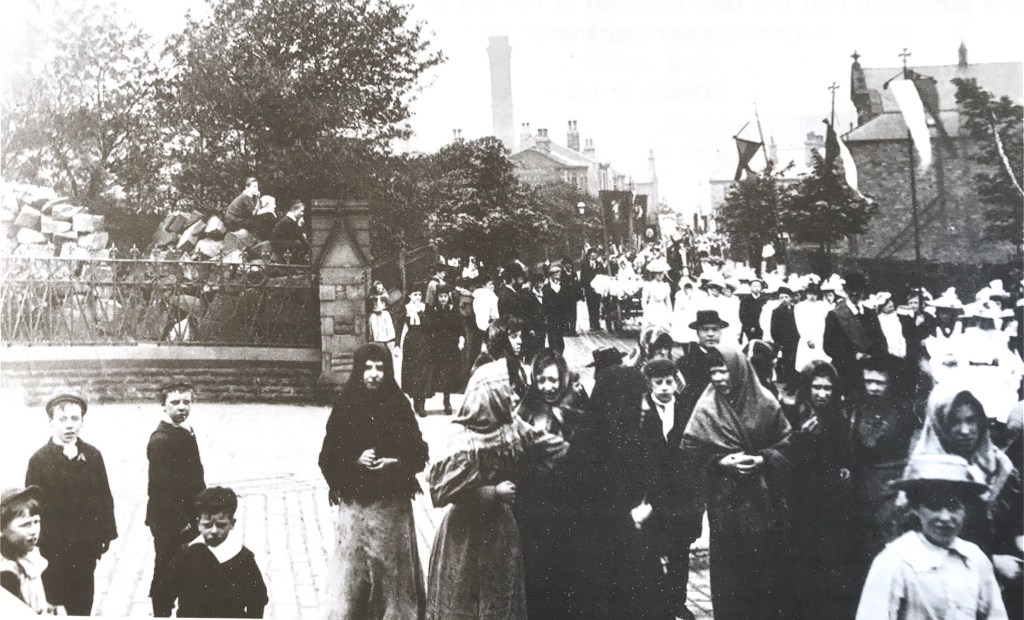
It was not until 1853 that the Rev. Canon James Wells arrived in Batley, dedicated to serving the religious needs of the growing Catholic community. He performed the first baptism on 11 January 1854. The baby was Thomas Burke, son of Patrick and Catherine Burke (formerly Frain), born on the 21 December 1853.
It is said these early services and sacraments were performed somewhere in the Calico Lane area. Exactly where is not known. Speculation is that it was in a loft over a mineral water warehouse, or above a forge. However, an account of the early history of St Mary’s, published in 1898, and containing the reminiscences of Canon Wells , states prior to the founding of the Mission in 1853 Roman Catholic worship took place in the upper chamber of a stable in Fleming Street. Once the Mission was founded the place of worship was in an upper room previously used for rag sorting and reached by an outside wooden staircase. Given this account came from the priest at the founding of the mission, this is the most reliable source. For more details read The Earliest Published Account of Batley St Mary’s Church and Schools.
By 1858, Batley had a Catholic population of around 600 to 700 people, although only 200 attended Sunday Mass. And this was still in makeshift accommodation. Again there is nothing definitive, but there are theories that Up Lane Sunday School, a non-denominational establishment, might have provided a temporary home. However, more likely is it was still in the same former rag sorting room used from 1853.
By the time Fr. Rigby came to Batley in September 1867, the town’s growing Catholic community still did not have a church in which to worship, this despite the land to build it having being obtained in 1863 at Cross Bank.
A letter dated 7 December 1863 in “The Irishman”, from the then incumbent Rev. P. Lynch, confirmed the land purchase, and indicated that the 1,500 Catholics were using a former rag and shoddy warehouse accommodating just 150 as an interim chapel. Unfortunately it does not pinpoint its location.
The letter, which can be read in full here, was an appeal for donations from Ireland. It said the hope was to lay a foundation stone for this new permanent church for Batley’s Catholics on 17 March 1864. But no foundation stone ceremony had materialised by the time Fr. Rigby took up post.
The newly arrived Fr. Rigby felt it his bounden duty to remedy this. He immediately set about helping with raising money, and putting plans into motion for a permanent place of worship for his flock, who it appears were now attending worship in what the Dewsbury Chronicle termed the Chapel of St Mary, which also doubled up as a school. He quickly achieved his goal, assisted by generous donations from woollen manufacturing brothers Capt. W.H. and Simeon Colbeck (a convert to Catholicism).
On 17 May 1869, the Diocesan Bishop of Beverley, Rt. Rev. Dr. Robert Cornthwaite, finally laid the foundation stone, Beverley being the diocese under which Batley fell during this period. On 15 December 1870 the church of St Mary of the Angels at Cross Bank, Batley finally opened its doors to parishioners. The church was built on a plot of land at the rear of the chapel of St Mary, mentioned in The Dewsbury Chronicle.
Not only was there a church, but with his passion for education Fr. Rigby also established a Day School for the community’s children.
But less than 16 months later, on 18 March 1872, 38-year-old Fr. Rigby lost his life in particularly horrific circumstances.
Thomas Rigby, son of James and Ann Rigby, was born in the Ellesmere district of Manchester in 1834. His family had a very strong Catholic pedigree. His mother’s cousin Dr. John Briggs, was the first Bishop of Beverley, and Bishop Cornthwaite’s predecessor.
With a fondness for books and learning, Thomas also determined to become a priest and went to the English Catholic Benedictine school at Douai, in northern France between 1849-1856. From there he moved on to the English College in Rome where he spent a further four years, being ordained in 1860.
Described as “always good”, not tempted by the splendour and art on offer in Rome, and according to the testimony of one “never late for morning prayers”, the impression given is of an unassuming, quiet, very studious individual, totally devoted to his learning and vocation. He excelled at mathematics, travelled extensively, was linguistically adept in Greek, Latin, Hebrew, French, Italian and German, and had friends worldwide.
Returning to England, he moved parishes frequently in the early days of his ministry. Posted initially to Burton Constable, Hull in 1860 he went on to serve at Bradford in 1861, North Kilvington 1862, Goole in 1864, Sheffield in 1865, St Patrick’s, Leeds in 1866 before finally coming to Batley to assist Rev. Patrick Lynch in September 1867. Soon after his arrival Fr. Lynch died whilst in Ireland, and Fr. Rigby succeeded him.
It is particularly ironic that only weeks before his death Fr. Rigby informed his friend and fellow-priest Fr. McCarten, that after all his earlier moves he felt at home in the town of Batley. He wanted to work there for the remainder of his life, so he might leave the church unencumbered by debt and lead the people he loved so much further advanced in their knowledge of Almighty God.
His efforts have indeed had a lasting impact on generations of Batley Catholics, in the shape of the wonderful Grade II listed building where countless services, baptisms, marriages and funerals have taken place, and still take place to this day.

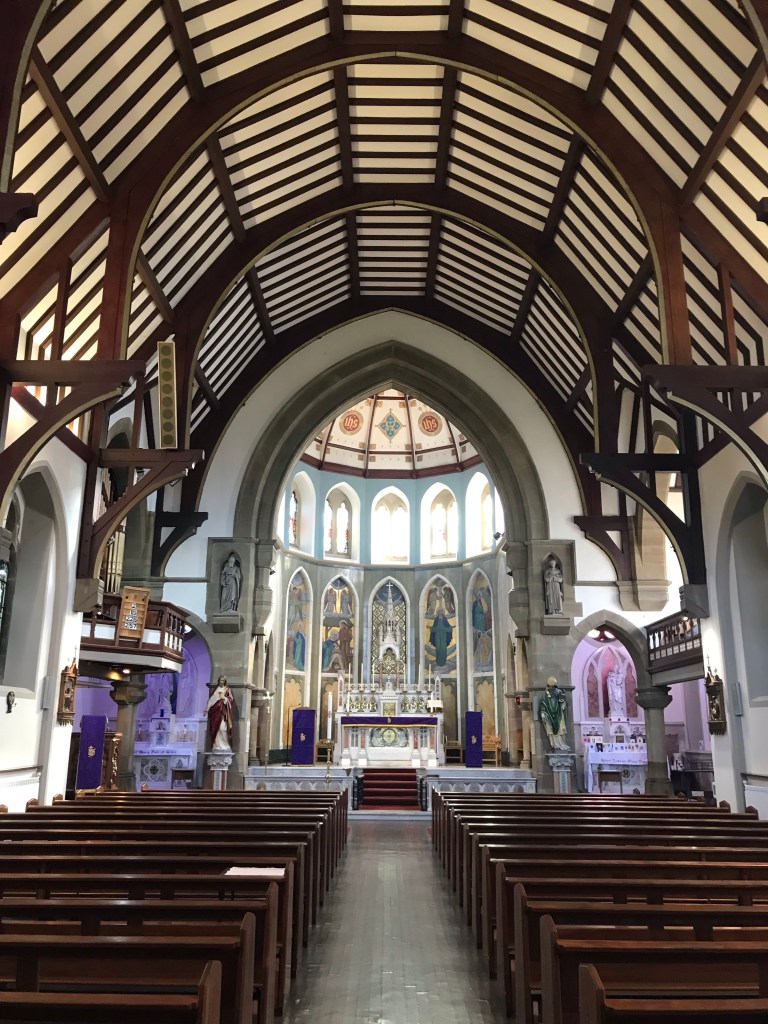
Designed by John Kelly of Leeds-based architects Messrs. Adams and Kelly, at a cost of around £2,364, the church was constructed in a Gothic Revival style, using stone from neighbouring quarries. Seating 650 on wooden benches, the internal walls were plastered and painted in a salmon tint, and the majority of the roof between the rafters painted in grey. There were also panels in the chancel roof painted blue, and powdered with gilt stars.
The slated roof, with a red earthenware ridge, was constructed by Messrs Pyecock of Leeds. The apex of the apse roof was finished with leaded finial and a wrought iron cross; the copings of the gables with stone crosses.
Of the other main contractors, according to newspaper reports, only one Batley firm – that of Mr J. W. Hey, plasterer – was involved. Alterations to the church took place in 1884 and 1929, but the building is essentially the same as in 1870.
A full description, as published in The Dewsbury Chronicle, and taken from the official plans, read:
The stone dressings in the building are of boasted Finsdale,1 and have been worked in a very creditable manner. The plan consists of a nave, measuring 34ft. 6in. in width, and 73ft. 3in. in length, with transepts on the east and west sides. The chancel, on each side of which a handsome chapel has been erected, and which has been placed at the south end is 20 feet wide and 24 feet long, is so built to terminate with a polygonal apse. The baptistery, which is semi-octagonal, has been placed at the north end of the nave, and in the east transept has been erected the organ and choir gallery which will accommodate a large number of vocalists. The principal entrance to the church is by a porch in the first bay of the nave. A sacristy for the use of the clergy – 19ft. by 21ft. – communicates with the east transept by the acolytes’ sacristy and also with the presbytery, which is to be built in close proximity to the church, by means of a passage, and will be fitted with vestment closets and other complete appurtenances. The church is well lighted by means of traceried windows, placed high in several walls, glazed with cathedral glass laid in church lead quarries by Mr. Graham, of Leeds. The floors of the chancel, baptistery, and chapels, which by the way are dedicated to the Blessed Sacrament and St. Bruno, have been laid with encaustic tiles3 by workmen in the employ of Mr. James Taylor, of Leeds, in ornamental patterns, wood floors being placed beneath the seating. On each side of the chancel are comfortable seats for the use of the acolytes who officiate at high mass, and there are also sedilia2 for the priests. The seats for the use of the general congregation are open deal benches with veneering, and book boards are affixed to each row. The roof, which is very lofty, is formed of principals, with curved braces resting on hammer beams, and framed rafters, with purlius, [sic]4 &c. The roofs of the nave and transepts are plastered between the rafters, the roofs of the chancel, chapels and baptistery being boarded on the underside, and divided by chansferred [sic]5 ribs into panels, embellished with a moulded cornice. The whole of the building is covered with Welsh slates…and the presbytery, which will immediately join the church, will be built in similar style, with like materials as the main edifice. There are several portions…which are not as yet completed, and amongst these…the presbytery…It will be a commodious place, including, on the ground floor, a dining room, study, kitchen, scullery, store room, entrance hall, passage, and other conveniences; in the basement there will be wine and beer cellars, larder, coal place, &c, and on the first floor there will be four bedrooms, bath-room and linen closet. It is also, we understand, intended to place the confessionals of framed woodwork in the transepts, a pulpit of open wood-framed woodwork will be erected on a stone base near the chancel; and the chancel chapels and baptistery will be separated from the nave by wrought iron railing, with gates and oak rails. The high alter will be of stone, the latter being raised nine steps above the floor of the nave. These and several other details about the work have not been finished, because it is stated that the Rev. T. B. Rigby and his friends wished to have the church opened before Christmas Day. For the evening service, the building has been artificially lighted by several elegant gasaliers from Messrs. Heaps and Robinson, ironfounders, &c., of Leeds, being suspended from the roof. On each side of the arch dividing the chancel from the nave, are niches into which two figures representing St. Bruno and St. Joseph, carved by Mr. Boulton, of Cheltenham, have been placed, and they materially add to the appearance of the church….

Many dignitaries attended the opening High Mass at 11 o’clock on Thursday 15 December. Diocesan Bishop and foundation stone layer, Robert Cornthwaite, returned to officiate, aided by clergymen from throughout Yorkshire. Cardinal Henry Edward Manning, Archbishop of Westminster, gave the sermon, along with a subsequent one at 6.30pm Evening Vespers, honouring a promise made to Fr Rigby that whenever he opened a church he would come to preach not once but twice. In between services, they repaired to the Station Hotel for a formal lunch.
So, with a magnificent new church to house the congregation, Fr. Rigby continued his ministry in the town. His enthusiasm for education shone through, urging the poorer members of his congregation not to neglect their children’s schooling because they could not afford the fees. Such was the value he placed on learning, he even paid out of his own pocket for a number of poorer children to attend the Catholic school. This in the wake of the 1870 Education Act, when parents paid schooling fees.
He did not take part in broader local affairs to any great extent, but one of his last forays on the wider Batley arena was in connection with education, in particular that of the poor. The whole experience left him very bruised and disillusioned, with a feeling he had been unfairly treated and he had not been listened to in the same way other speakers were. A proud Englishman, his friends detected as a result of the encounter, he was beginning to realise the way in which Catholic priests were actually regarded by some compatriots.
The meeting of the Batley School Board and ratepayers took place at the Town Hall on the evening of 20 February 1872 and lasted until 10.30pm. Described as a largely attended and excited meeting, it was called by the Mayor to discuss the contentious decision of the School Board to pay the fees of children whose parents could not afford them, at the local school of their choice rather than Board Schools – in other words public money potentially going to Established Church and Catholic denominational schools. Essentially ratepayers would be funding an element of religious education. The alternative, to restrict them to Board Schools, risked poor parents not sending children to school for reasons of conscience. The Board itself was divided on the issue, which they passed with the slimmest of margins.
Batley was a mixed religious town, with a significant Dissenting population, alongside the Established Church and Catholics. The acrimonious debate, peppered with raucous cries from the ratepayers, saw Catholic Fr. Rigby and J. Wilberforce Cassels, vicar of St Thomas’ presenting a united front when speaking from the platform, much to the sarcastic amusement of those opposed to denominational schools. Mr Marriott’s jibe of “This man (addressing Rev Cassels and pointing to Fr Rigby), consigns you to eternal damnation as a schismatic – and you, I believe send him to a very warm place” typifies the comments.
The heated debate ranged from objections to paying fees for children whose parents by their dissolute habits had brought themselves to a paupered condition, to freedom of choice and persecution; from accusations of seeking to use public money for their own religious purposes, to arguments about time spent on religious teaching detracting from education in reading, writing and arithmetic. Over 140 years later and nothing much changes!
Fr. Rigby came in for particularly harsh treatment as illustrated from this account of proceedings in the Dewsbury Reporter.
Mr Wormald Waring [from the secular camp] and the Rev T.B. Rigby, Roman Catholic priest, now rose together to address the meeting, and while the former was received with applause by a majority of those present, the latter was assailed with a storm of howls. The denominational party however cheered him.
The meeting concluded with a vote against the decision of the School Board and a warning that if the bye-law was enacted “it will produce the same animosity and irritation which was produced by the enforced payment of church rates”.
The events weighed heavily on the mind of Fr. Rigby, touching upon his religion, the possibility that one man could force another man’s child into a place against his conscience, and his strongly held belief in education of the poor. He wrote to Fr. McCarten on the subject.
When Fr. Thomas Bruno Rigby preached his last sermon at his beloved church of St Mary of the Angels on Sunday evening of St Patrick’s Day 1872, he prophetically exhorted the congregation to be prepared for death, observing there were so many unforeseen accidents that either he, or any of them, might be suddenly called away at any moment. Little did he know how true it was to prove for him.
The following morning he set off from Leeds to Lancaster to attend the funeral later that day of Ripon priest, and old college friend, Rev. Wilson. By the evening he was dead, the result of a horrific train incident.
On the fateful evening of 18 March 1872, Fr. Rigby was making his way back from that Lancaster funeral, held in the city’s St Peter’s church. Rather than returning direct to Batley, he and Fr Thomas Loughran of Leyburn made a life-ending choice. They decided to take the 7pm train from Lancaster’s Green Ayre station to Morecambe, to visit a friend. Some reports refer to it as Green Area, replicating the error in railway timetables up to around 1870.
They arrived shortly before departure time. Fr. Rigby stopped to talk to two ladies, whilst Fr. Loughran enquired of porter William Walker how long they had before the train left. Upon being told it would go in a minute or so, they decided they would have time to go to the toilet.
Fr. Loughran made it back to the train in the nick of time, the whistle blew, the doors closed, the guard gave the signal and train set off, driven by John Winter (who hailed from Hunslet, Yorkshire). Before getting into the brake van, Northamptonshire-born guard Thomas Sturman noticed Fr. Rigby and warned him not to attempt to board.
The platform was brightly lit, well maintained and, as William Walker oddly described it, there were no pieces of orange peel lying around. The short-sighted Fr. Rigby was still seemingly trying to ascertain his companion’s carriage. He spotted Fr. Loughran and made an attempt to reach him. Another Northamptonshire-born man, foreman porter Edward Garley (some reports incorrectly say Richard Gorley) saw Fr. Rigby walking sharply down the platform as the train set off and cautioned him twice to keep back. He and labourer George Allen saw the priest miss his step and stumble between the platform and moving carriages. Garley, only a yard away, tried unsuccesfully to catch him. He immediately called out for the station officials to switch the signals to stop the train, which quickly drew to a halt. But it was too late. A carriage had passed over the priest’s chest and arms. By the time William Walker reached him, he was dead.
His body was conveyed back to the presbytery at St Peter’s, where the inquest headed by coroner Mr Holden returned a verdict of “Accidental Death”.
On the evening of Thursday 21 March his remains arrived back in Batley by train. Several hundred people processed from Cross Bank Batley to join the crowds already waiting at the station. Shops closed their shutters as a mark of respect and thousands lined the route as the hearse containing Fr. Rigby made its way back to church, where his oak, flower-strewn coffin was placed on a bier in front of the black draped wooden altar. The church was full. Those unable to get in were allowed to walk through the church, past the coffin and out via the sacristy.
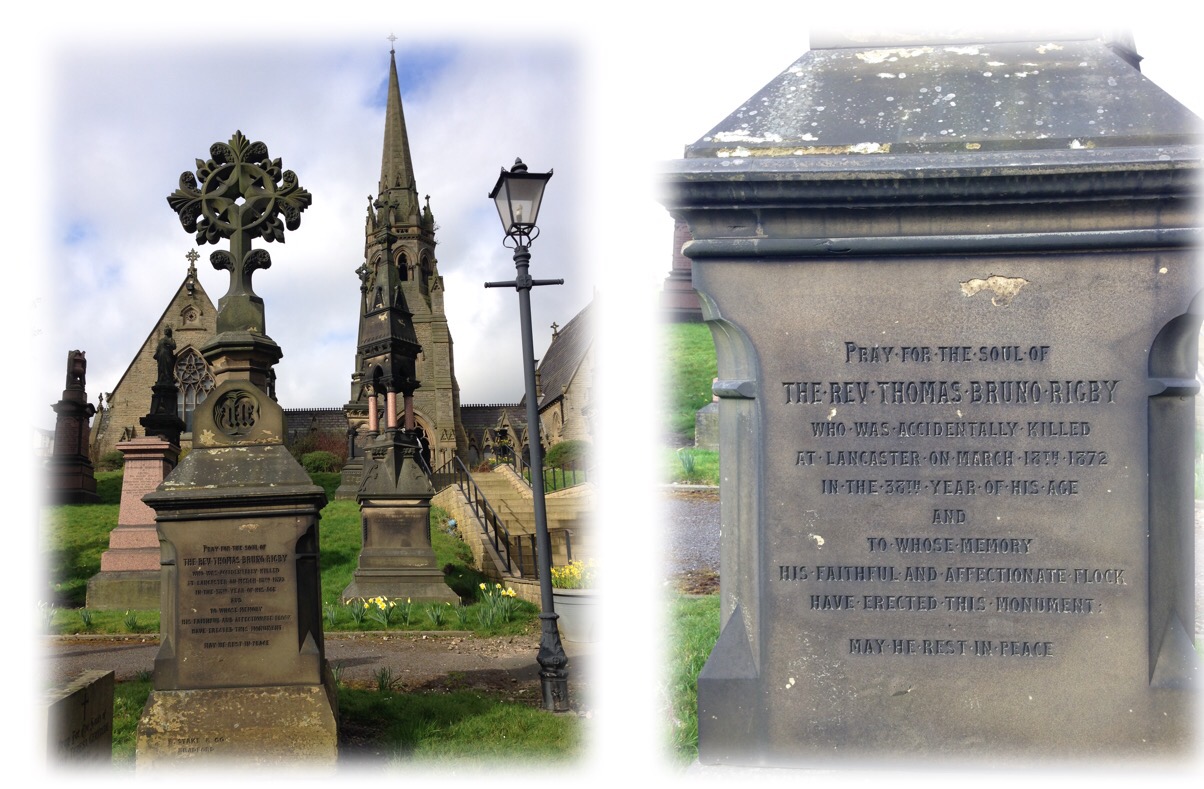
The church was similarly filled to overflowing for the funeral, held the following morning at 11 o’clock. Over 30 priests attended, and long-time friend Fr. McCarten preached the sermon during which almost all the congregation shed tears. He expressed gladness, in the midst of sorrow, hearing it was in the exercise of charity, attending the funeral of another priest, he had met his death. He went on to say he had built his parishioners a church “where they would have consolation administered, and where they would be carried at last”.
Postscript:
I want to say a big thank you for the donations already received to keep this website going. They really do help.
The website has always been free to use, and I want to continue this policy in the future. However, it does cost me money to operate – from undertaking the research to website hosting costs. In the current difficult economic climate I do have to regularly consider if I can afford to continue running it as a free resource.
If you have enjoyed reading the various pieces, and would like to make a donation towards keeping the website up and running in its current open access format, it would be very much appreciated.
Please click 👉🏻here👈🏻 to be taken to the PayPal donation link. By making a donation you will be helping to keep the website online and freely available for all.
Thank you.
Footnotes:
1. Boasted is a masonry term, and Finsdale I presume refers to a light brown sandstone from the Howley Park and Great Finsdale quarry in Morley.
2. Sedilia are seats usually made of stone.
3. Encaustic tiles are a type of tiles made from cement and crushed marble.
4. Purlins are part of the roof framing.
5. Chamfered is a carpentry term meaning cut away (a right-angled edge or corner) to make a symmetrical sloping edge.
A good description of the various parts of a Catholic Church (transept, chancel, nave etc can be found by clicking on this link https://www.fisheaters.com/churchbuilding.html
Sources:
- 1841 – 1871 Censuses, England and Wales.
- 1841 Census England and Wales Enumeration Abstract.
- 1851 Ecclesiastical Census Returns, West Riding, Dewsbury, Ref HO 129/502, Folio 79 and 80.
- 1851 Population tables II, Vol. I. England and Wales.
- CONNOR, Peter. 150th Anniversary of the Dedication of St Mary of the Angels Church. https://www.stmarybatley.co.uk/wp-content/uploads/2020/12/150dedication.pdf
- Dewsbury Chronicle, 17 December 1870.
- Dewsbury Reporter, Various editions including 17 December 1870, 10 February 1872, 24 February 1872, and 23 March 1872.
- JUBB, Samuel. The history of the shoddy-trade, 1860.
- Lancaster Gazette, Supplement – 23 March 1872.
- St Mary of the Angels 1853 – 2003, 2003.
- Taking Stock: Catholic Churches of England & Wales – http://taking-stock.org.uk/Home/Dioceses/Diocese-of-Leeds/Batley-St-Mary-of-the-Angels.
- The Hierarchy of the Catholic Church – http://www.catholic-hierarchy.org/.
- The Irishman, 12 December 1863.
- WALSH, Denis. A Hundred Years 1870 – 1970: St Mary of the Angels, Batley, 1970.


 Past To Present Genealogy