
For many growing up in Batley, the hospital was an integral part of the town, one of the buildings symbolising Batley’s civic pride. It was such a part of everyday life that, in the later years of its existence as a hospital, residents probably began to take it for granted. Knowing what a vital part it played in Batley’s history, it has been hard for many now to witness the derelict, crumbling shell of a building of recent decades. In fact, those born in Batley from the late 1980s onwards will possibly not realise the building’s former significance. This piece will serve as a reminder of its former glory, with a look at the first fifty years of a hospital in Batley.
The town did not have its own hospital until the last quarter of the 19th century. By then, the lack of such a facility was a cause for local concern on at least three levels. Firstly, with a growing population driven by the success of the textile industry, the district needed more medical service provision. Secondly, Batley residents believed that they were regarded as second-class citizens when it came to treatment at the newly built cottage hospital in Dewsbury, this despite contributing financially to it. And thirdly, quite simply, local rivalry kicked in – Batley did not wish to be outdone by Dewsbury. The town wanted its own hospital.
On 8 March 1878 a meeting was held in Batley Town Hall, attended by nominated delegates from mills, workshops and collieries across Batley. There, it was agreed:
…that in the opinion of this meeting, the interests of persons resident in this borough requiring surgical assistance in case of accidents will be best promoted by the establishment of a cottage hospital and dispensary in some healthy and central part of the borough.1
It marked the start of the movement to establish Batley district’s public hospital. A committee was formed to put in train arrangements for a town meeting. All the local medical professionals were contacted to get them on board. As a result, Dr. Robert Dex Keighley joined the committee to provide medical backing and input.
The town’s meeting took place on 1 April 1878, and the cottage hospital part was unanimously approved but, on the advice of the medical profession, the dispensary element was ditched.
The first hospital officials appointed at that meeting were: President, Mr. Thomas Brearley; Vice Presidents, Mr. Samuel Jubb, J.P., and Mr. James Joshua Carter; Committee, Messrs. Henry Brooke (Mayor), Joe Fox, J.P., Thomas Taylor J.P., R. I. Critchley, J.P., Michael Sheard (Treasurer), Robert Talbot, George Blackburn (joint Hon. Secretary), W. J. R. Fox (joint Hon. Secretary), G. M. Hirst, John Stubley, Edwin Wilson, James Bywater, David Blakeley, Joseph Thurman, Thomas Hirst, Jonathan Graham, George Rushby, Joshua Burnley, Joseph Galloway, David Midgley, James Johnson, Alfred North, Thomas Harrison and W. H. Childe.
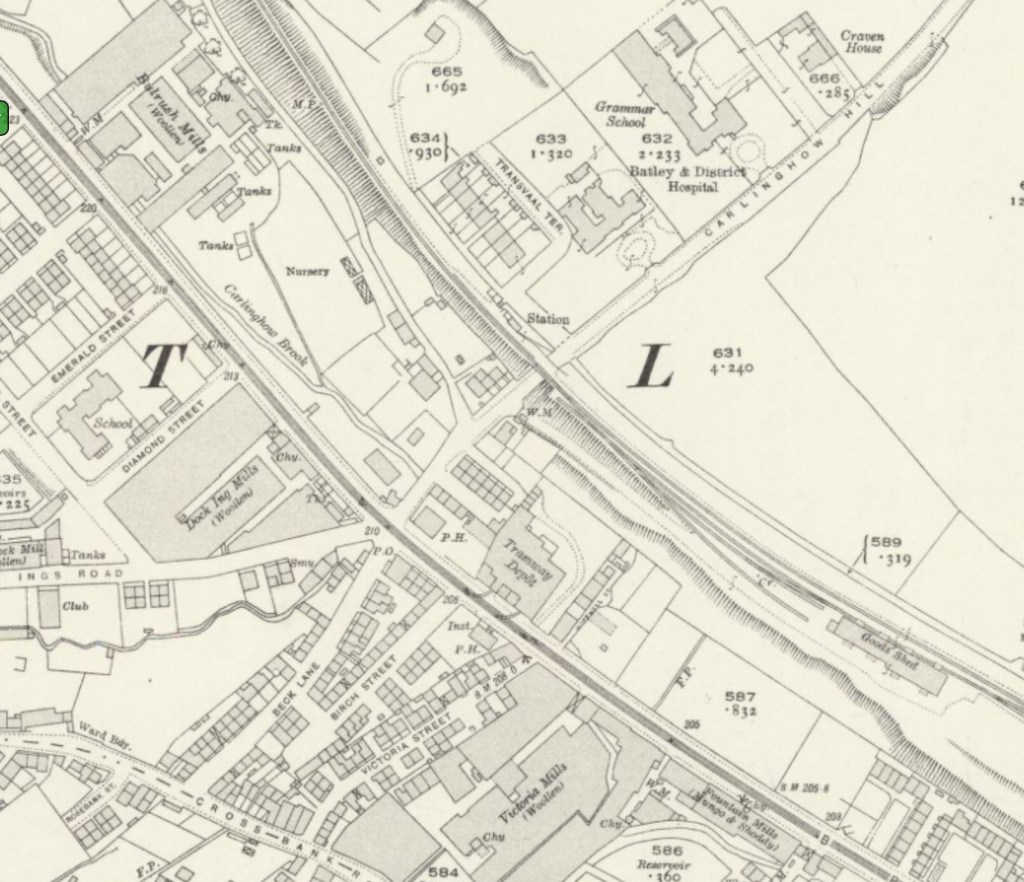
Wanting to establish a Batley facility quickly, the main initial decision was to secure premises for a temporary cottage hospital to serve the town until a permanent hospital could be built. The building earmarked for this stop-gap facility was Hill Field House, located on Norfolk Street, in the Clerk Green area. This is pinpointed on the map below.
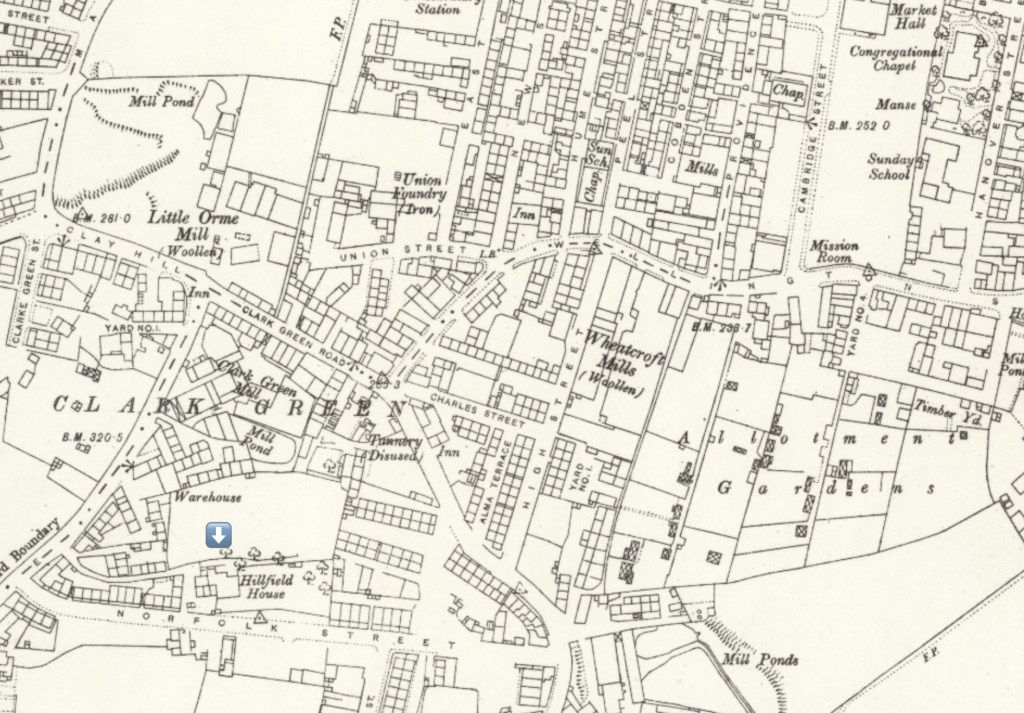
Showing the Location of the Temporary Cottage Hospital.
Re-use by CC-BY (NLS)
Described as a large and commodious dwelling, it had been occupied by the late Mrs. Knowles. The owner, Samuel Jubb, had recently placed newspaper adverts to let the house, with immediate possession offered.2 It offered a potential solution, with the arranged inspection confirming its suitability for a temporary hospital. The lease terms discussed were two to three years, at £30 per year.3 The offer was accepted, and a sub-committee tasked with making it ready for use got to work promptly.
Fundraising now began in earnest for the Batley Cottage Hospital, with subscriptions pouring in from residents across the whole of the Batley area. Events such as concerts, bazaars, galas and athletics festivals were organised. A collection was held across workplaces on a day designated as Hospital Saturday. Later came Hospital Sunday, targeted at collections from churchgoers. The images below refer to Hospital Saturday in 1879.
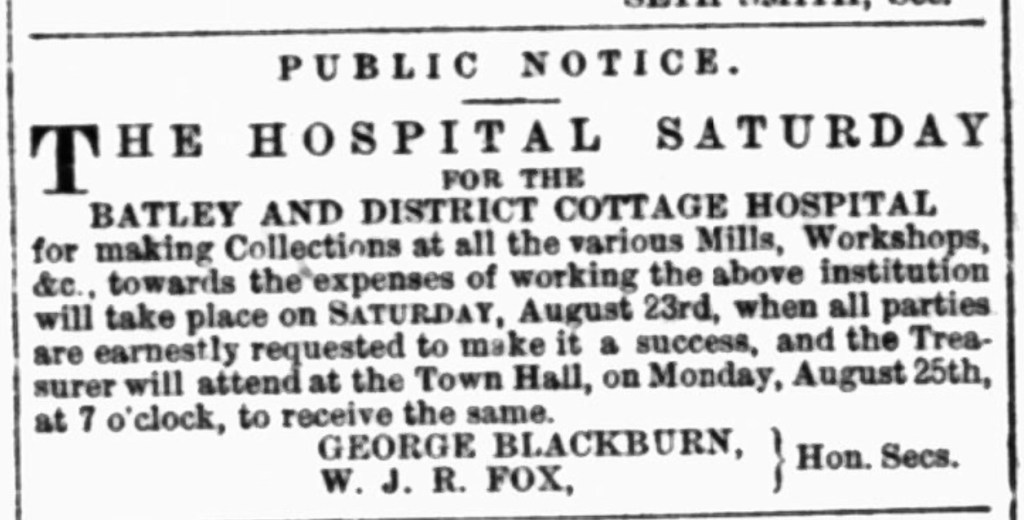
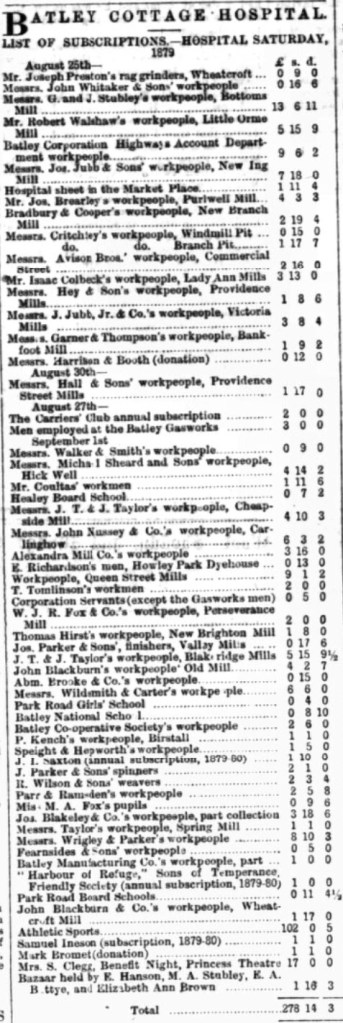
These money-raising efforts became the norm, as Batley residents would be responsible for the ongoing funding of their hospital, even once built. These efforts ramped up in periods when specific building works were needed. Celebrations were arranged when milestones were met. See my write-up for the one such celebratory pageant in August 1907, where the participation of St Mary’s schoolchildren proved so controversial.
On 23 August 1878, less than four months after the initial decision to go ahead, the temporary facility had been kitted out to a usable standard. That day, St Mary’s parishioner James Laden became the first patient admitted. A textile worker in his early 20s, he was employed at Messrs. John Jubb and Son’s Phoenix Mill. That morning, whilst removing dust from a fan behind a rag machine at which he was working, his smock got caught in the machine, ripping his left hand off just above his wrist. Drs. Stockwell, Bayldon and Keighley operated on him, amputating part of his arm. As a result of James’ surgery, the scheduled public viewing of the facility had to be cancelled.
Note, all these doctors had their own practices in the Batley area. None were directly employed by the hospital in the early days. One of the features in this first years, in addition to it being entirely supported by voluntary contributions, and with patients being admitted on recommendation, was that the medical practitioners gave their services gratis.4
Under the care of Dr. Stockwell and Matron Miss Bainbridge (who was appointed in late July 1878 from a field of almost 20 applicants, and came from New Bridge Street Hospital, Manchester),5 he was finally well enough to discharge on 30 October 1878.
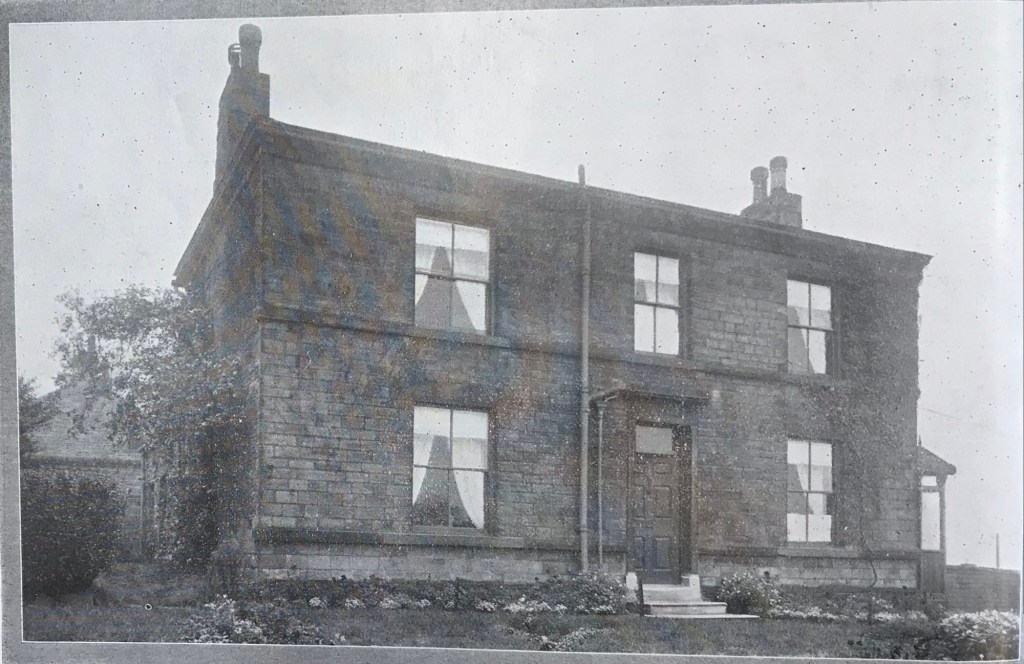
Shortly after opening, a description of the temporary hospital read:
…the arrangements are all that could be desired for a small hospital. The two front rooms on the ground floor are fitted up, one as an accident ward, and the other as a surgery and operation room. The former at present contains two beds. Behind the accident ward is a large furnished room for the use of the matron, and on the opposite side is a spacious kitchen. Upstairs, one of the front rooms is set apart as a female ward. It is light, airy, and comfortable, and at present contains two beds. Opposite to this is the committee room, which is neatly fitted ul with a table, couch, and chairs; between these, and over the passage, is a small room, which will be used as a store room. In the rear of these is No. 3 Ward on one side, and a bathroom and a servants’ room on the other. When thoroughly complete there will be accommodation for seven beds for patients. All the rooms are beautifully papered and carpeted, and all the furniture is of the most approved style The locality of the hospital is one if the best that could have been selected in Batley for invalids, standing as it does in an elevated position, and a large garden to the front. A new street is being constructed from Purlwell Lane to Dark Lane, which comes close to the gates, and when this is completed the hospital will be easily accessible from all parts of the borough.6
By the beginning of November 1878, although the temporary hospital was described as being in working order, up to this point only four patients had been admitted.7 By January 1879 it was in full working order
…and the necessitous poor of the district, who are suffering from curable diseases, and cannot be treated efficiently at their own homes, or who are unable to pay for medical attendance, can be admitted, as well as cases of accident, so far as the accommodation will allow.8
The final lines were pertinent. The first annual report stated 50 patients had been treated.9 Patient numbers were therefore increasing, with bed capacity being reached regularly, especially given the length of some patients’ stays – James Laden’s two-month sojourn was not untypical.
The success of the temporary facility meant the building of a permanent hospital became more vital than ever.
Potential building plots were being scoped as early as mid-April 1878. An early front-runner which they deemed to be conveniently located was Batley Corporation land in the Market Estate with frontage on Wellington Street, and adjoining property belonging to Dr. Bayldon.10 Another plot of land on Blakeridge Lane was also considered.11
But on 5 February 1880 the Committee convened at the Town Hall for the final decision. Land at Carlinghow had been offered by the Earl of Wilton on advantageous terms. This was considered to be excellent, not being surrounded by houses so the air was fresher. It also meant gardens could be laid out for convalescing patients. Importantly, it was accessible for the bulk of mill workers, located about 3/4 mile from the centre of town. The Committee duly passed a resolution:
That it is highly desirable and also advisable to proceed vigorously with the scheme for providing on a suitable scale for Batley and the district a cottage hospital; that an effort be made forthwith, and that a sum of not less than £4,000 will be required for the erection of the proposed hospital; and when the subscription promised have amounted to £2,000, the site for the proposed hospital, viz., the land situate on the low side of and adjoining the Grammar School at Carlinghow, to the extent of an acre, be secured at once, if possible from Lord Wilton’s agent and the works commenced at once.12
By the end of May 1880, subscriptions and promises amounting to £2,300 has been secured, and architect Walter Hanstock’s offer to prepare plans free of charge was accepted. He brought these before the Committee on 19 August 1880 “and they were examined by all present and gave great satisfaction.”13
On Easter Monday, 18 April, 1881 in what journalists described as a day which would be “long remembered as a red letter day in the history of Batley, as affording another proof of the public spirit, enterprise, and liberality of its inhabitants”,14 Committee President Thomas Brearley J.P., who had given £1,000 to the building fund, laid the foundation stone of the Hospital in Carlinghow Field Hill.
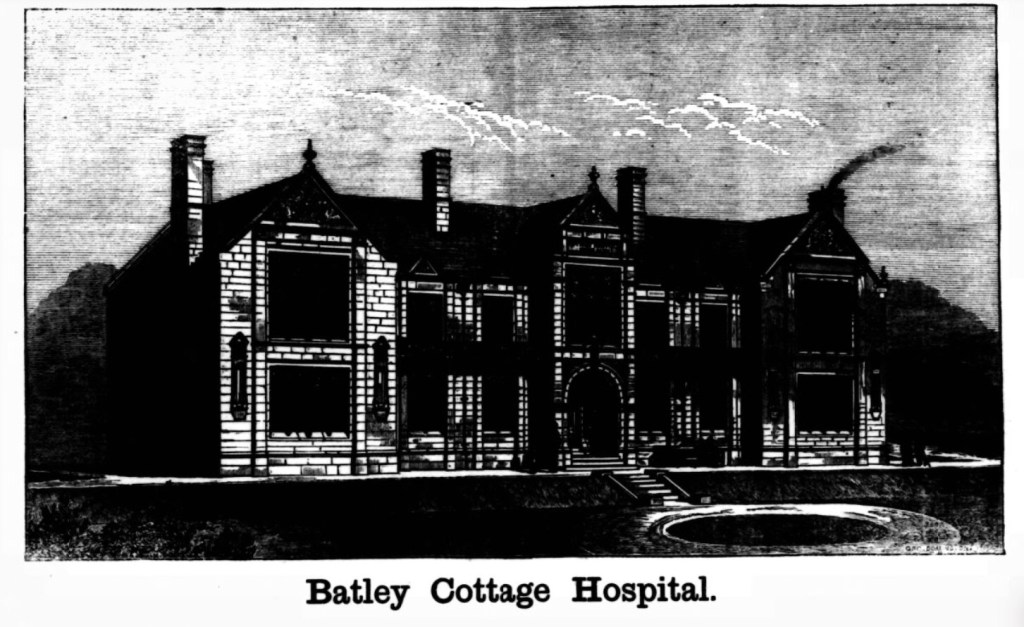
Two years later, on Easter Tuesday 1883 (27 March), the Earl of Wilton formerly opened the Batley and District Cottage Hospital. A description of the building read:
The building has an imposing frontage to Carlinghow Hill, 114 feet in length, the total depth back being 80 feet, and the building in plan is in the form of the letter “T”. The principal entrance is in the centre at the front, and in the vestibule are two folding doors, with stained glass windows, and a stained glass window on each side. In these windows are emblematical windows representing respectively “religion,” “health,” “prosperity,” and “temperance.” There is a triple staircase, 15ft. wide with matron’s room and waiting room on each side, 15ft. by 12ft. each, and adjoining these are two accident wards, each 15ft. by 14ft.; a board room 20ft. by 18ft., and a make convalescent bedroom 16ft. 10. I . by 10ft 1in., a matron’s bedroom 11ft. by 10ft., a servant’s bedroom, 11ft. by 10ft., water closet, lavatory, and housemaid’s closet, surgery 10ft. by 9ft., matron’s storeroom 9ft. 7in. by 9ft., an operating room direct through from the front 17ft. by 15ft., scullery, 15ft. by 9ft., kitchen 17ft. by 15ft., and pantry 9ft. by 8ft., with detached warehouse and mortuary closets. There is ample cellaring provided in the basement. On the upper floor in the front is a spacious children’s ward 22ft. by 17ft., female convalescent bedroom (2 beds), 15ft. by 12ft., female convalescent sitting-room, 15ft. by 12ft., nurse and servants’ room 15ft. by 14ft., female ward (4 beds) 22ft. by 18ft., male ward (4 beds) 22ft. by 18ft., special male ward (1 bed) 11ft. by 10ft., special female ward (1 bed) 11ft. by 10ft., linen closet 10ft. by 9ft., bathroom 10ft. by 9ft., and a water closet, lavatory, and housemaid’s closet to each side. The front of the building is of Holmfirth ashlar, and is very handsomely treated. The style is of the Renaissance period, with mullioned and lofty windows. The front is well broken up, and the pediment of each gable is filled by carving and scroll work. There is an ornamental iron balcony on the chamber floor, with doors to some of the wards, and over this an inscription carved in stone, “Batley Cottage Hospital, erected 1881.” The sides of the building are of delph stone, and the back of local stone. The roof is principally of Westmoreland slate. The corridors are lined with glazed bricks. The floors are principally of pitched pine, polished, and the same material has been freely used for the joiners’ work. The top parts of the front windows are of stained glass in leaden lights, and in most of them are appropriate scripture mottoes. The rooms are lofty, the principal wards being 15ft. high, clear for breathing room. The hall, staircases, and passages are heated with hot water pipes, and the principal wards by Captain Gaston’s patent warm air stoves. The ventilation is provided for by Tobin’s inlet supply and extraction flues from the ceilings and wall ventilators. The grounds have been very tastefully laid out, and the fence wall in front is surmounted by ornamental iron palisades. The entrance gates are also of iron, and present a neat appearance.15
A few days later patients were transferred across from the temporary building, which was eventually demolished in the 1960s.
The total cost of the new building was £5,050.16 One Bazaar held at Park Road Board School, during Easter week 1882 raised a phenomenal £2,600.17
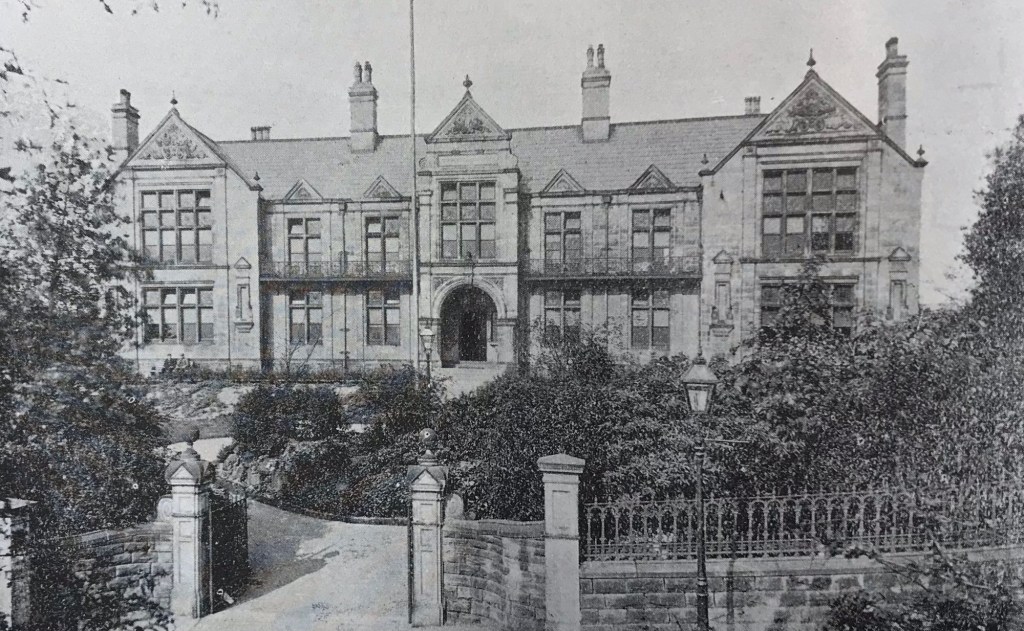
For the next decade or so the new hospital proved largely adequate for the needs of the district, with some years being better than others. 1895, for example, was a good one, with the annual report presented at the annual meeting of subscribers in February 1896 stating that the year had been one of “substantial improvement and progress” and after a rocky three years financially between 1891-1893, in 1894 “the tide turned, and at present the financial prospect was very promising.” 185 inpatients has been treated in 1895 (14 carried over from 1894, 171 admitted) of whom eight had died. The number of minor accidents treated as out-patients rose from 213 in 1894 to 221 in 1895. The average number of patients in any one week had been 15 “and though on several occasions every bed had been occupied, in no instance had a serious case of accident been unable to find admission.” Among the medical cases, bronchitis, heart disease, and rheumatism appeared most prevalent, the latter being common among miners, and something which had been treated very successfully.18
This meeting adopted a formal change in name. It was felt the word ‘Cottage’ was inappropriate given the hospital could now accommodate 22 patients. The small scale implication of ‘cottage’ was also holding them back financially, deterring donations. It now became ‘The Batley and District Hospital.’
That good report of 1895 perhaps gave a false sense of security, because troubles were brewing, as the report for 1892 had hinted at, with the sentence:
It has frequently happened that all the beds have been occupied and sometimes the Committee have been unable to admit applicants for want of room.19
Despite the positive of 1895, there was no shying away from the facts. It was a growing problem. Year on year, the hospital was dealing with an increasing number of patients. In 1904 many patients were having to wait for admission. The Committee had no option but to reach the inevitable conclusion:
…not only must more beds be provided, but other important additions are required, including better accommodation for the nursing staff.20
All the while, fundraising continued and donations were made. This money allowed for less radical, but nevertheless important, technological improvements, including in 1905, the installation of electric lighting and new X-Ray equipment.
Major change, and the next phase in Batley Hospital’s history, was looming. In August 1906 contracts for a new extension were let, with the foundation stone being laid on 3 November 1906, and the building being formally opened on 25 January 1908. The total cost of the extension, including the furnishing of two new wards, the nurses’ new quarters, and the new operating theatre amounted to £4,670. It meant bed capacity was increased to 50.21
In 1913 an anonymous donation provided for more new, up-to-date X-Ray department equipment, facilitating new radium treatments for cancers.22
During the Great War a large portion of the hospital was handed over to military authorities for the treatment of wounded soldiers, the first batch arriving on 16 October 1914. Such was their appreciation of the treatment provided at Batley Hospital, the 1918 report included:
It will ever remain a source of satisfaction to your Board, and they feel sure it will be to the subscribers, that during the war they did everything in their power to assist in the work of relieving the sufferings of our wounded soldiers. The men have invariably been reluctant to leave the institution, and evidences shown by them of their appreciation and kindness and attention received have been many and varied.23
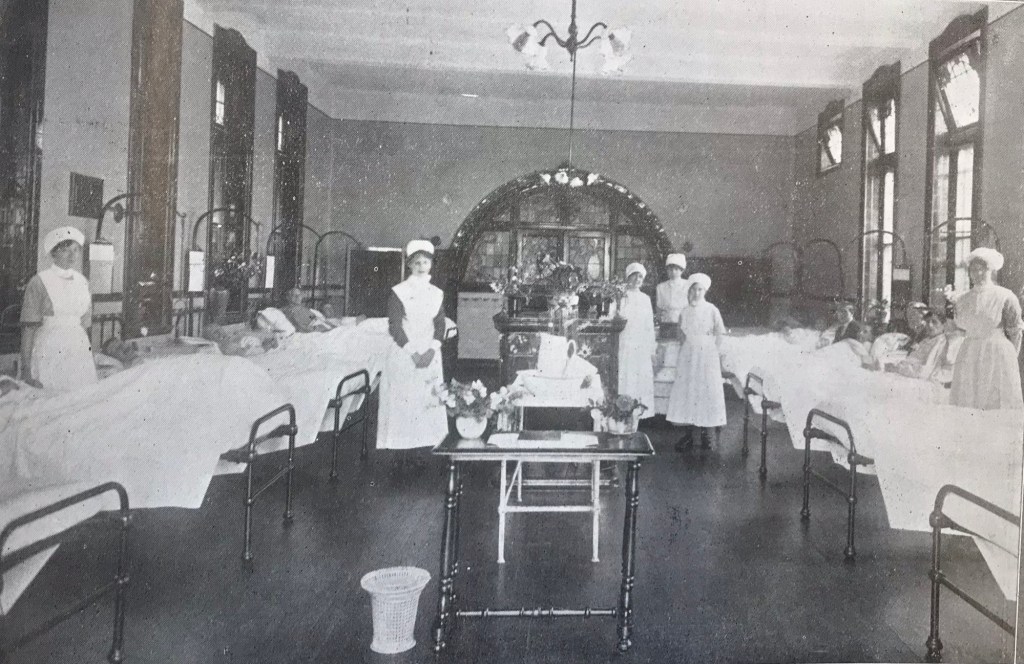
Despite the military demands, treatment of civilian patients continued throughout the war years. This was facilitated by nimble improvisations, for example by converting rooms such as the board room and waiting room to temporary wards.
And throughout, demand continued to grow. One illustration of this was the number of operations: 149 in 1908, compared to 1,086 (of which 524 were classed major) in 1925.24
To give some more detailed indication of demand, the fuller statistics for year ending 31 December 1925 showed:
- 2,636 patients were treated, 1,743 being out-patients, and 893 in-patients.
- 56 beds were available.
- The cost of each bed occupied per annum was a little over £102.
- The average duration of treatment of in-patients was 19.57 days, and the cost of each in-patient was £5 10s.
- 524 major operations, and 562 minor operations were performed. 686 X-Ray cases were treated.
- The average number of patients resident in the Hospital daily throughout the year was 45.32.
- Income for the year was £4,815 14s. 6d. Expenditure was £4,822 10s. 5d. Administration costs were £240 18s. 1d.
- The annual “Egg Day” resulted in over 9,000 eggs being sent to the hospital in 1925. The “Pound Day” led to the donation of 1240lbs of provisions. The Ladies’ Hospital Association organised both.25
It was once more becoming abundantly obvious that further extensions and improvement schemes were essential.
Plans drawn up by architect Mr. A. W. Hanstock, son of the original hospital architect Walter Hanstock, were initially delayed in the economic downturn in the aftermath of the First World War. But the pause was short-lived, with promises of money in 1923 enabling the go-ahead.
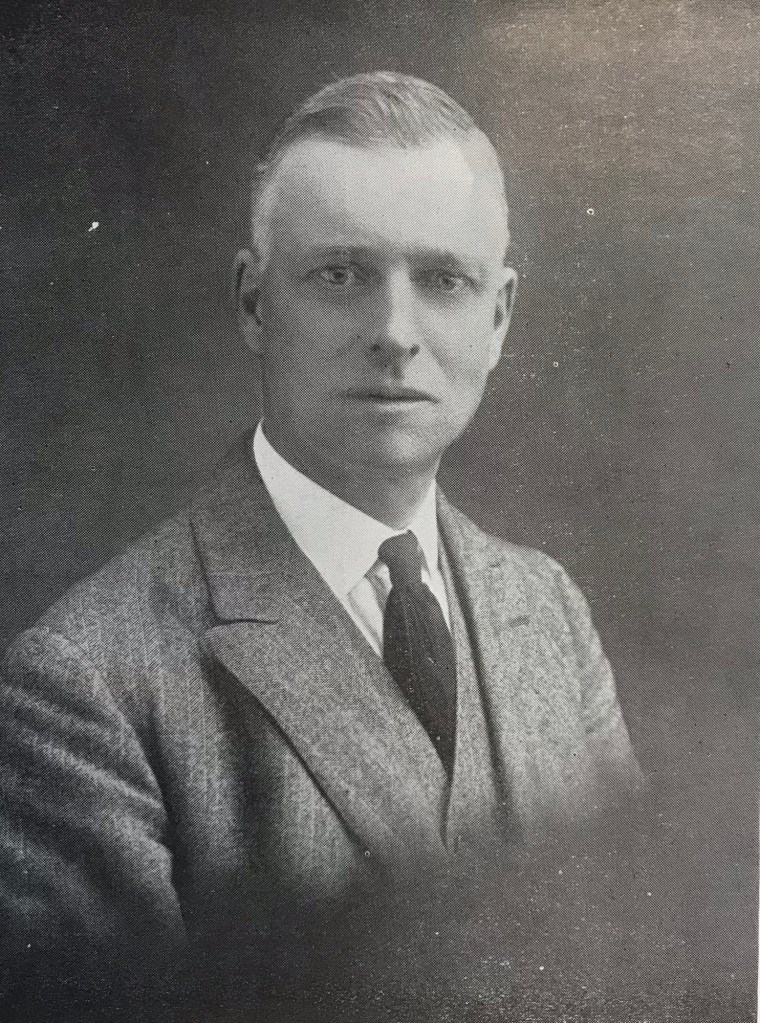
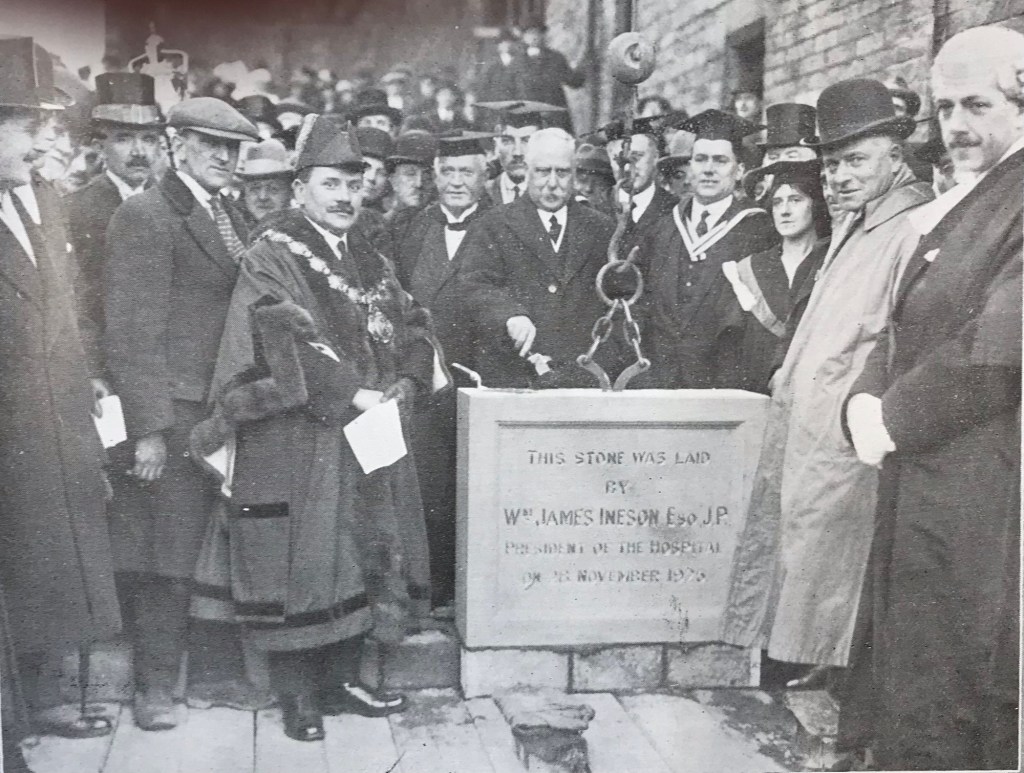
With building work already underway for some months, 28 November 1925 marked another Memorial Stone laying ceremony, with President, Mr. W. J. Ineson, performing the official ceremonial duty in awful weather. It meant most of the speech-making took place in Batley Boys’ Grammar School.
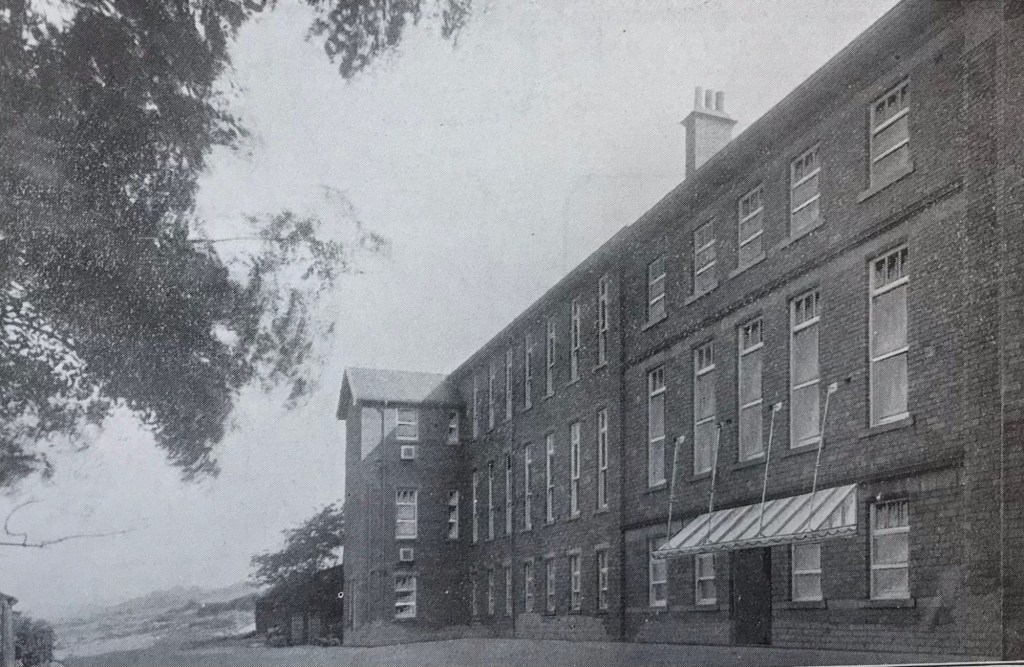
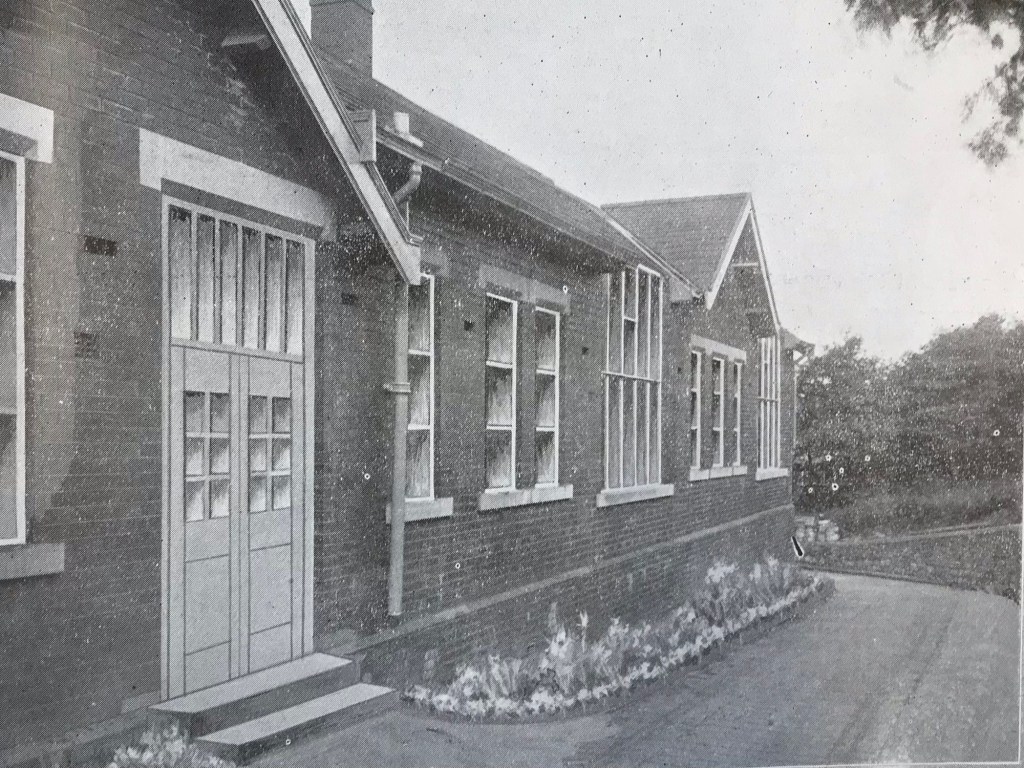
The new works involved an awning-covered new entrance, providing direct access for vehicles and cover for patients. The entrance would be fitted with a modern lift large enough for stretcher cases. Two new wards, with accommodation for 32 patients, as well as a ward kitchen and nurses’ room in each, plus bathrooms, sanitary conveniences etc., would also be built. These wards would have a verandah, which could double up as extra ward space if the need arose. At the basement of the ward building would be more X-Ray department, consulting and waiting rooms. The works crucially included a new dedicated one-storey operating wing, with tiled walls and floors, comprising two 18ft. by 14ft. operating theatres, separated from each other by an anaesthetic room and sterilising room. This section would also include a surgeons’ room, store room and lavatory. Other elements of the scheme included a modern, one-storey kitchen fitted.26
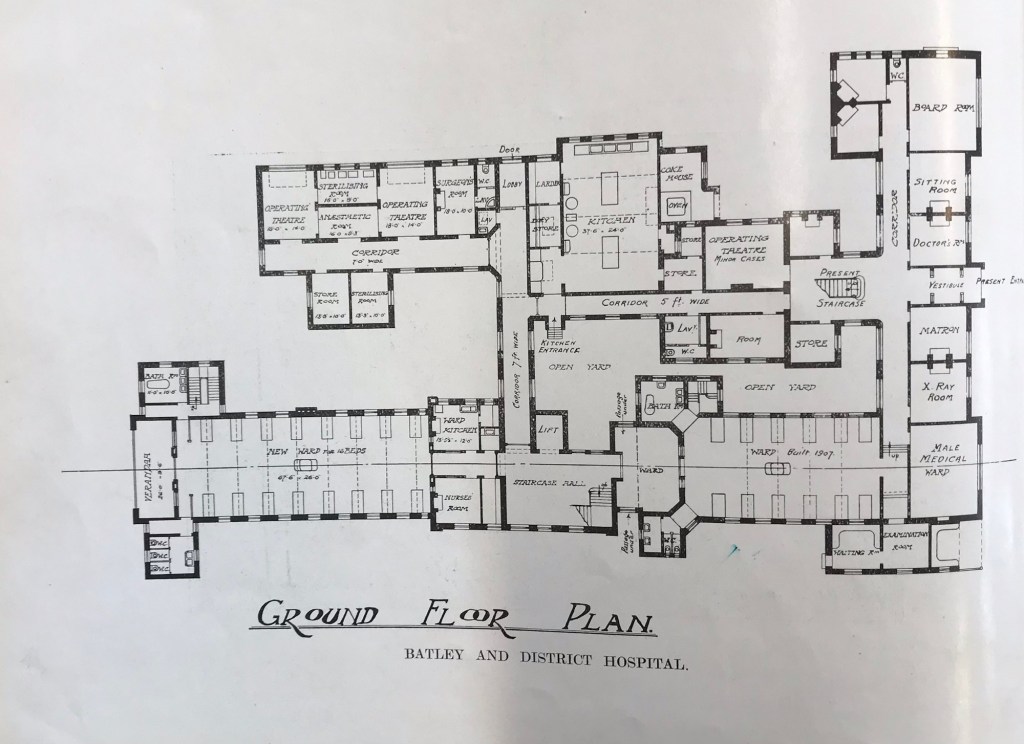
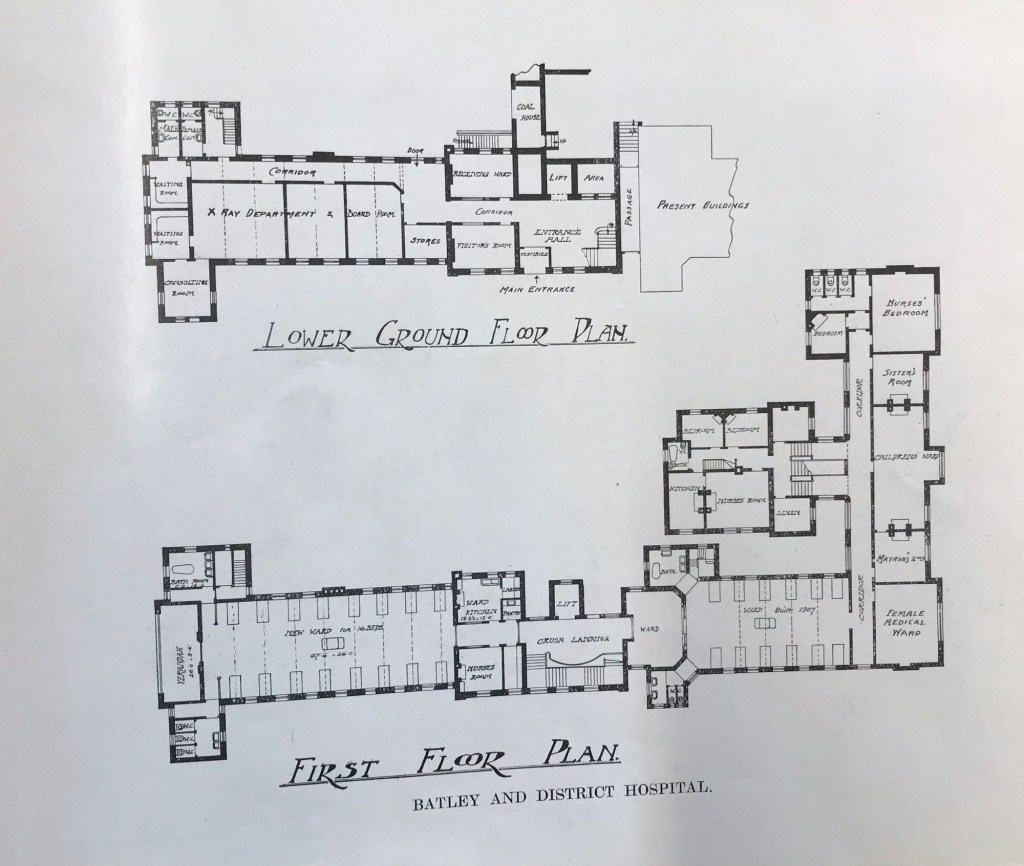
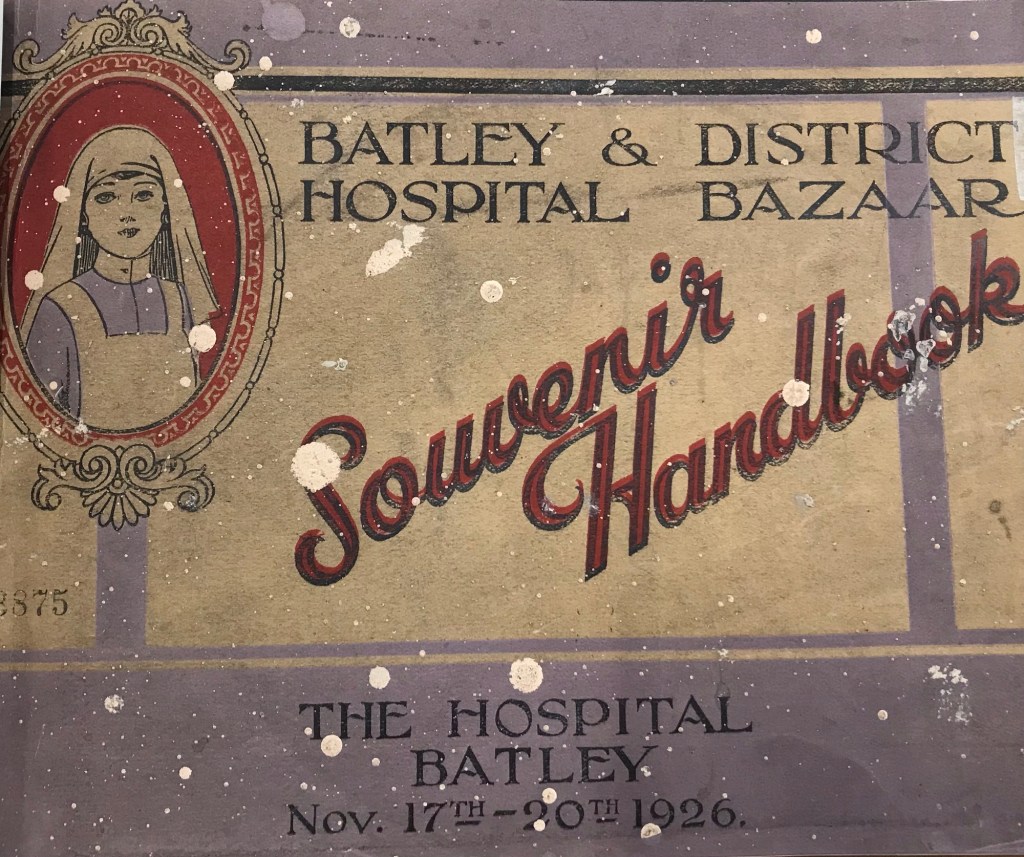
When the Stone was laid, the cost estimated was between £25,000 to £30,000, with £15,000 already raised.27 Cue more intensive fund-raising, including a four-day Bazaar in November 1926 which raised in excess of £10,000.28
The first fifty years of a hospital in Batley ended on a real high, with a memorable day which illustrates how well-regarded this Yorkshire town was.
Tuesday 24 April 1928 marked the formal opening of Batley and District Hospital’s new extension. The official ceremony was conducted as part of a royal visit to Batley by the Duke and Duchess of York. They later became King George VI and Queen Elizabeth. They were also the parents of the young Princess Elizabeth, who would later be Queen Elizabeth II. In fact, at one point in the Royal procession to the hospital, a shrill voice in the crowd was heard inquiring “Wheer’s t’babby”, referring to Princess Elizabeth who the rumour mill mistakenly hinted would also attend.29
The Royal visitors were enthusiastically greeted by crowds of 10,000 on Carlinghow Hill, of which 2,000 were in the Hospital grounds.30
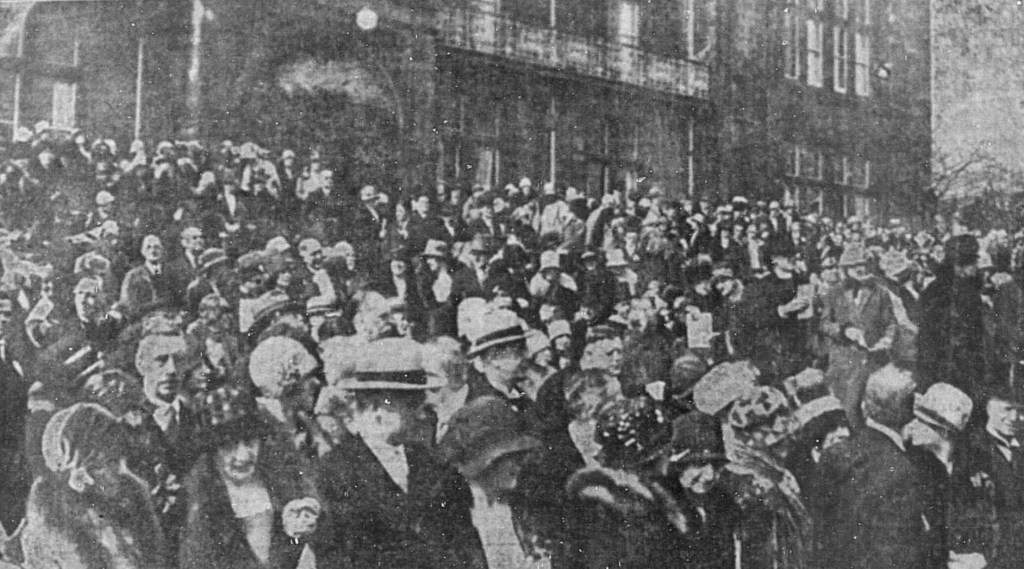
The Duchess, described as a living picture of fragrant beauty, wore a graceful satin-trimmed frock of mist-grey georgette, with collar and cuffs of grey fox, and a grey toque felt hat trimmed with grey feathers. On her left collar was a posy of bright anemones, and her neck was adorned with a triple string of pearls. She was heard to say “What a large crowd.”31 She also observed “ This is one of the nicest hospitals I have been in. It is so homelike and everyone looks so happy.”32
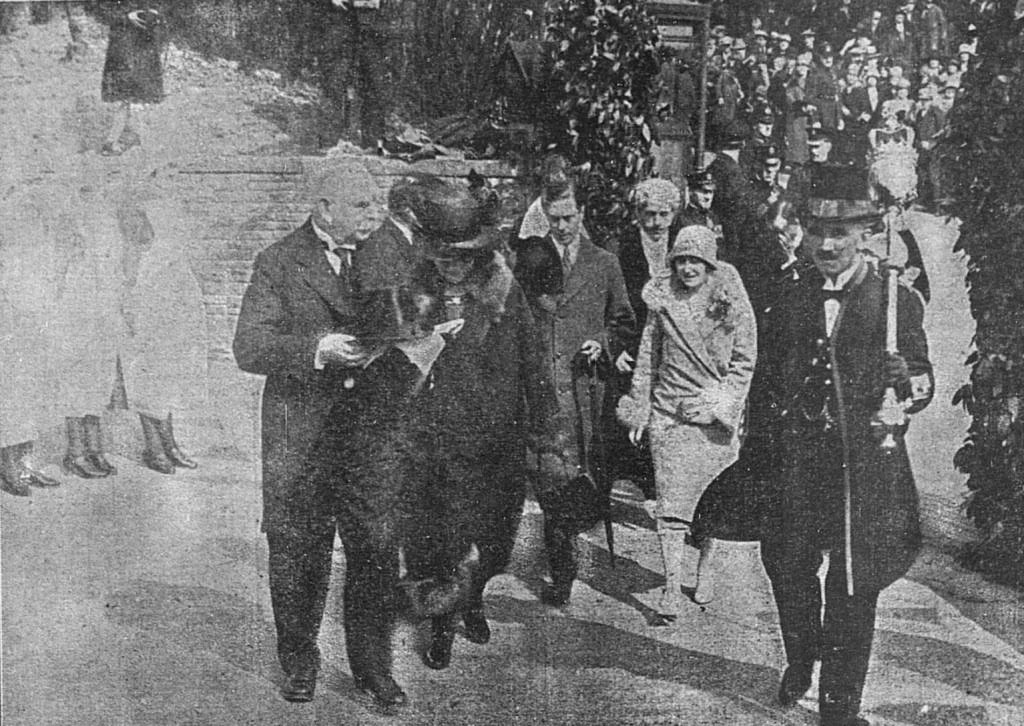
The Duke, in his speech, delivered in what was described as a strong, clear voice (an interesting observation at the time given his stammer and resulting dislike of public speaking), praised Batley.
The Duchess and I are very pleased to come here to-day to visit this ancient town. We are most grateful for the welcome we have received on all sides,
As a centre of the woollen trade Batley has held absolute still holds a very important position in the country…
I would like to take this opportunity of warmly congratulating you on the spirit of progress and liberality which exists among you, and which has shown itself in the generous contributions to this hospital, especially on the part of the workpeople, while such bodies as the Ladies Hospital Association have every reason to be proud of the part they have played in this great undertaking.33
Once the extension was formerly opened, a tour of the hospital included the Children’s Ward. This was one area of the building in which the Duchess took a particular interest, describing it as “simply charming”. Visiting some of the young patients in cots, on seeing a child with long curly hair, big blue eyes, rosy red cheeks and a dimple, she exclaimed “What a lovely little girl.” The Duke concurred, commenting on the girl’s brightness. Except the “girl” was Freddie Ineson, who began to cry when the Duchess bent over the cot rails to ask him how he was.34
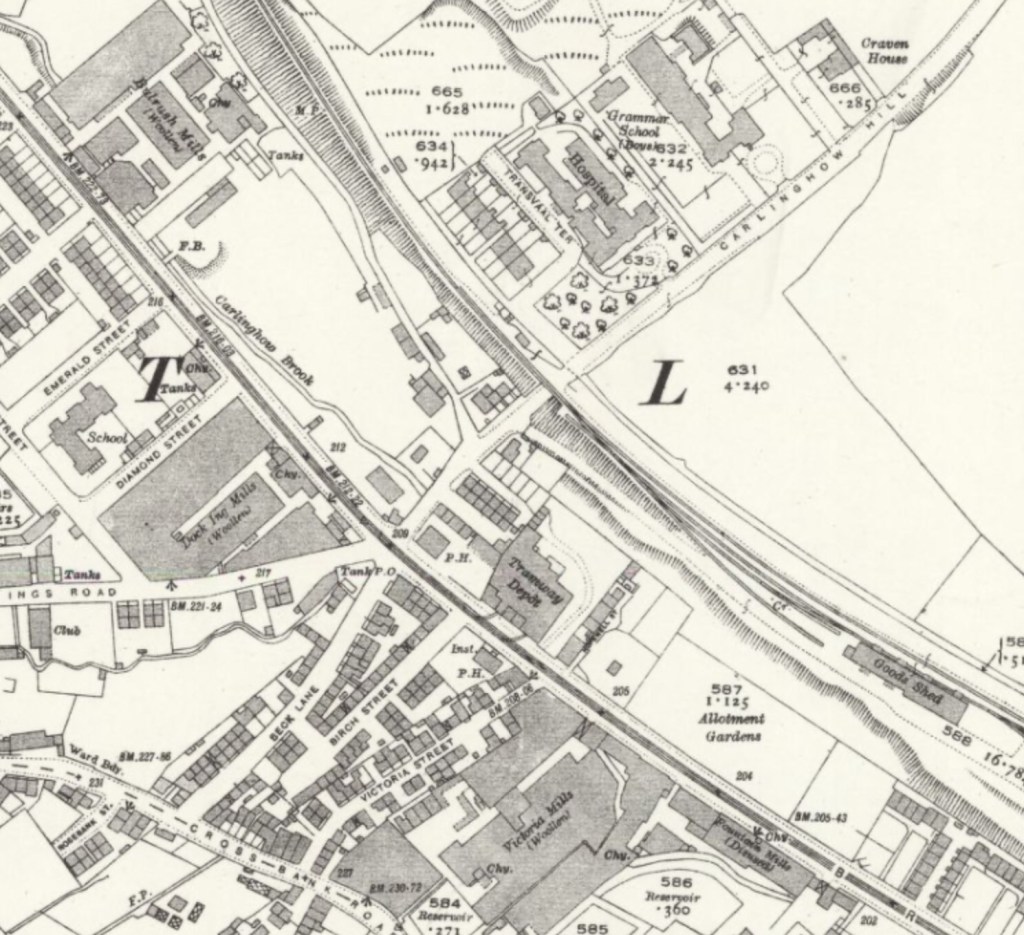
Re-use by CC-BY (NLS)
Batley Hospital became part of the NHS in 1948. It operated as a hospital until its closure in 1988, treating many Batley folk during that time.
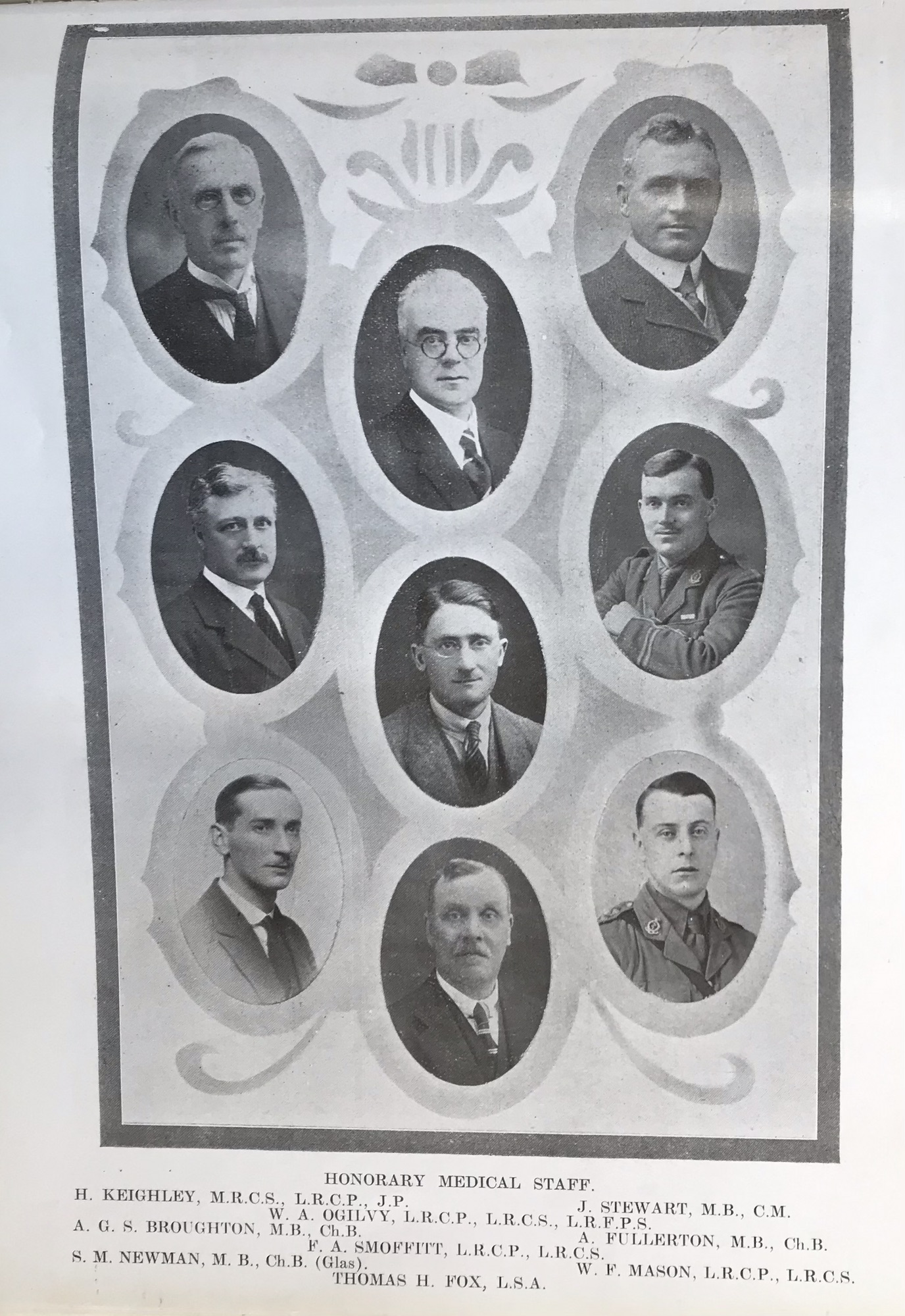
I will end this Batley hospital piece with some photos of some of the hospital staff in circa 1925, along with some images of the hospital from that period.

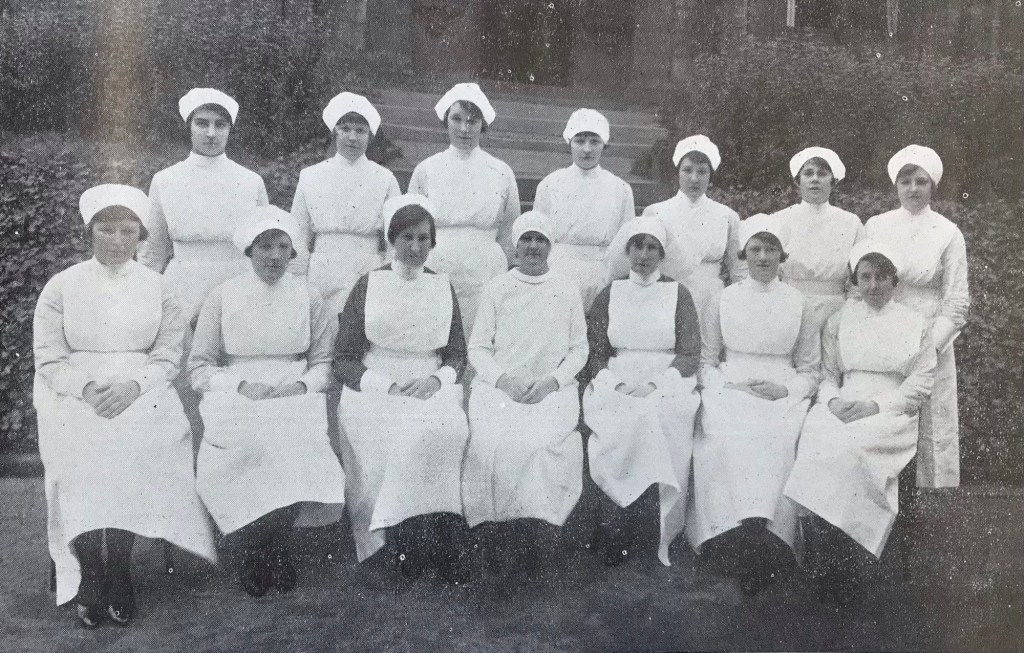
Back Row: Nurse Trickett, Nurse Maycock, Nurse Kearans, Nurse McPortland, Nurse Gibson, Nurse Bragg, Nurse Layfield
Front Row: Nurse Alderson, Nurse Crowther, Sister Rothwell, Miss Gardner (Matron), Sister Parker, Nurse Edwards, Nurse Wooller
Postscript:
I want to say a big thank you for the donations already received to keep this website going. They really do help.
The website has always been free to use, and I want to continue this policy in the future. However, it does cost me money to operate – from undertaking the research to website hosting costs. In the current difficult economic climate I do have to regularly consider if I can afford to continue running it as a free resource.
If you have enjoyed reading the various pieces, and would like to make a donation towards keeping the website up and running in its current open access format, it would be very much appreciated.
Please click 👉🏻here👈🏻 to be taken to the PayPal donation link.
By making a donation you will be helping to keep the website online and freely available for all.
Thank you.
Footnotes:
1. Batley and District Hospital Souvenir Handbook 1926.
2. Batley Reporter and Guardian – 9 February 1878.
3. Batley and District Hospital Souvenir Handbook 1926.
4. Batley News, 31 March 1883.
5. Batley Reporter and Guardian, 13 July 1878. She was succeeded around 10 months later by Miss Wright, from the Infirmary at Newcastle as reported by the Batley News, 21 May 1887.
6. Batley Reporter and Guardian, 9 November 1878.
7. Ibid.
8. Batley Reporter and Guardian, 18 January 1879.
9. Batley News, 31 March 1883.
10. Batley and District Hospital Souvenir Handbook 1926.
11. Batley Reporter and Guardian, 20 April 1878.
12. Batley and District Hospital Souvenir Handbook 1926.
13. Ibid.
14. Batley Reporter and Guardian, 23 April 1881.
15. Batley News, 31 March 1883.
16. Batley and District Hospital Souvenir Handbook 1926.
17. Ibid.
18. Batley News, 21 February 1896
19. Batley and District Hospital Souvenir Handbook 1926.
20. Ibid.
21. Ibid.
22. Ibid.
23. Ibid.
24. Ibid.
25. Ibid.
26. Batley News, 5 December 1925.
27. Ibid.
28. Yorkshire Post, 3 February 1927.
29. Leeds Mercury, 25 April 1928.
30. Batley News, 28 April 1928.
31. Ibid.
32. Ibid.
33. Ibid.
34. Ibid.
Other Sources:
• Censuses, Various.
• Haigh, Malcolm H. The History of Batley 1800-1974, 1978.
• Newspapers, Various including Batley Reporter and Guardian, 24 August 1878; Batley Reporter and Guardian, 7 February 1880; Batley Reporter and Guardian, 5 June 1880; and Batley News – 5 December 1905
• Parish Registers, Various.


 Past To Present Genealogy